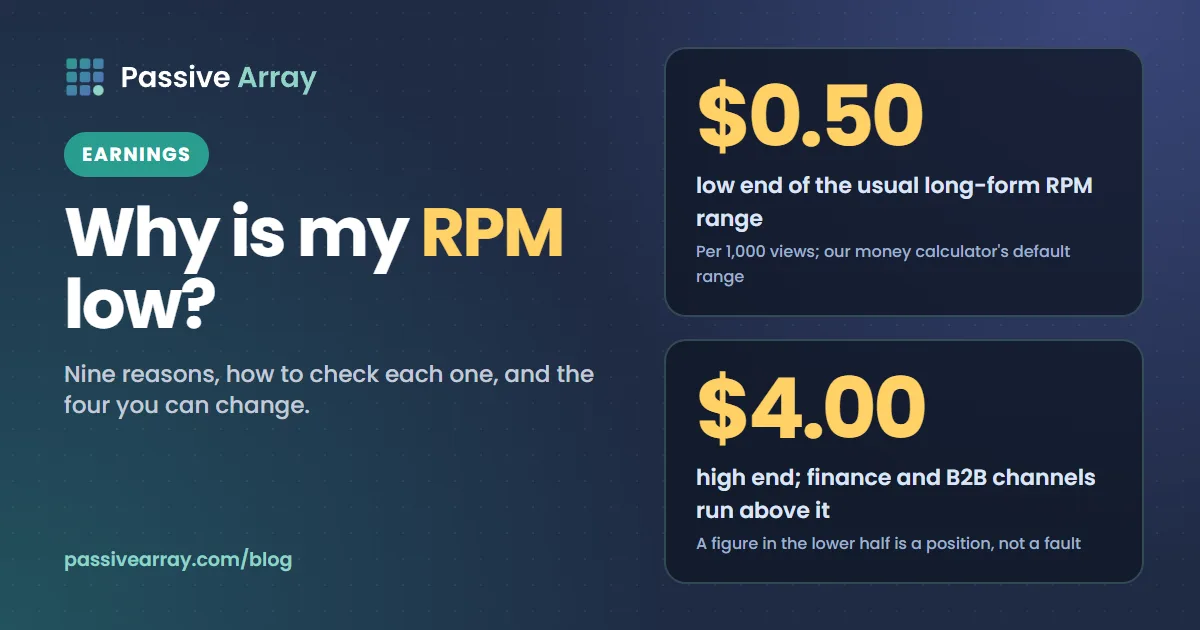
A low YouTube RPM almost always comes down to four things: where your viewers are, what your videos are about, how much of your viewing is Shorts, and how many of your views carried no ad at all. For most long-form channels RPM lands between $0.50 and $4.00, so a figure in the lower half of that is not a fault, it is a position. This guide walks through the nine reasons, how to check each in your own analytics, and which ones you can move.
If you want to see what a given RPM means in money, the YouTube money calculator runs the formula on any channel.
What RPM measures
YouTube defines RPM as the revenue you earned per 1,000 views, after YouTube's share, from ads, channel memberships, Premium revenue, Super Chat and Super Stickers combined. It divides by every view, including the ones that showed no ad.
CPM is different. It is what advertisers paid per 1,000 ad impressions, before YouTube's cut, counting only the views that showed an ad. That is why your CPM is always higher than your RPM, and why "YouTube pays $X" headlines that quote CPM overstate what reaches you. Our guide to how much YouTube pays per view covers the two numbers in detail.
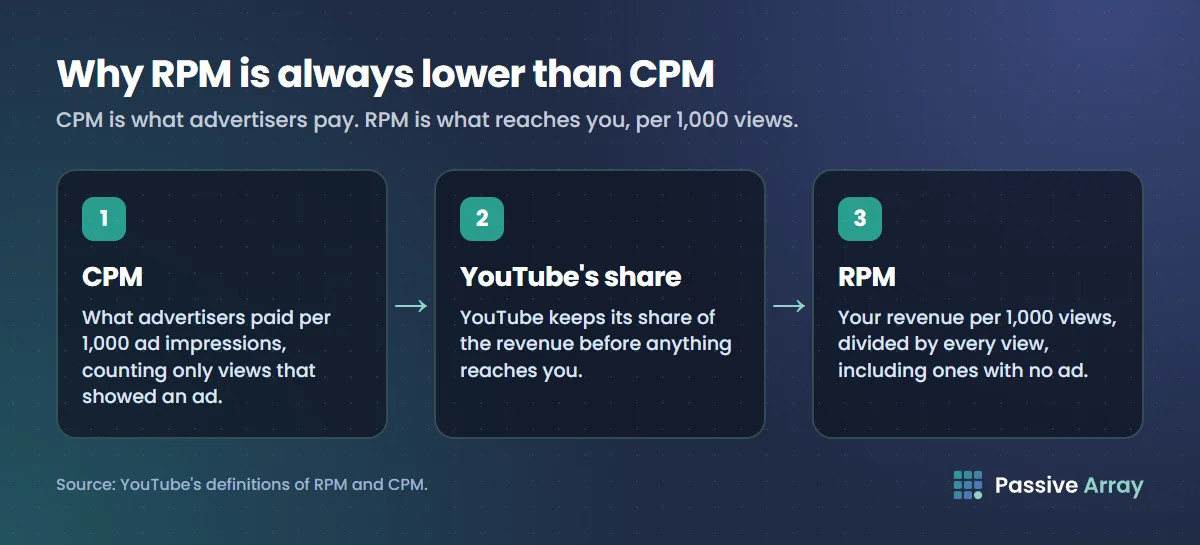
The practical result: RPM goes down whenever views grow faster than revenue. A viral video that reached a cheap audience, or a run of Shorts, lowers RPM even if your total earnings went up.
How to check your RPM in YouTube Studio
Open YouTube Studio, choose Analytics, then the Revenue tab. RPM is one of the headline cards next to estimated revenue and playback-based CPM. Change the date range to compare months, and use Advanced mode to break revenue down by video, by country and by traffic source. Those three breakdowns answer most of the questions below.
RPM only appears once a channel is monetized and has earned something, so a channel approved last week may see nothing yet.
The nine reasons RPM is low
1. Your viewers are in low-paying advertising markets
Advertising budgets are concentrated in a handful of countries. The same video with the same watch time earns several times more from viewers in the United States, the United Kingdom, Canada, Australia and northern Europe than from South Asia, Southeast Asia or Africa. This is the single biggest reason two channels with identical content report completely different RPMs, and both are telling the truth.
Check: Analytics, Advanced mode, Geography. If most of your views come from countries where advertisers pay little, that is your RPM.
2. Your niche attracts cheap ads
Advertisers bid more to reach someone watching a video about software, insurance, investing or business than someone watching gaming clips, music or entertainment. Finance and B2B channels regularly run well above the top of the typical range. Kids' content, music and prank or reaction formats sit near the bottom.
Check: Compare your RPM against videos in your own catalogue that covered a more commercial topic. If those run higher, the niche is doing the work.
3. A large share of your views are Shorts
Shorts are paid from a shared pool after music costs, at a 45% share, divided by every engaged view in the country. The per-view figure is a small fraction of long-form. A channel whose views are mostly Shorts will have a channel-level RPM near the bottom of any range even if its long-form videos earn well. How Shorts monetization works explains the pool.
Check: Analytics, Content, filter by Shorts versus Videos and compare RPM for each.
4. Your videos are under eight minutes
Videos of eight minutes or more can carry mid-roll ads, which means more ad impressions per view. A six-minute video gets a pre-roll and perhaps a post-roll; a twelve-minute video can carry several more. This is the easiest structural lever on RPM, but only when the content genuinely supports the length. Padding a video to cross eight minutes lowers retention, and lower retention costs more than the extra ad gains.
Check: Compare RPM on your videos over and under eight minutes.
5. Videos are getting limited ads
The yellow icon in Studio means a video was judged not fully advertiser-friendly: strong language early on, sensitive topics, violence, or content a reviewer flagged. Those videos still run some ads but at a much lower rate. A few of these among your top performers drags the channel average down.
Check: Content tab, Monetization column. Green is full ads, yellow is limited. You can request a human review on a yellow icon.
6. The time of year
Advertisers spend most in the last three months of the year and least in January. RPM commonly falls after New Year and climbs through the autumn. A January drop is seasonal, not a sign something broke.
Check: Set the date range to the last 12 months and look at the RPM line month by month.
7. Many views carried no ad
RPM divides by all views, including those where no ad was served: ad blockers, viewers in regions with little ad inventory, viewers who left before the ad, and playbacks where YouTube chose not to show one. The more of those you have, the lower RPM is, even if the ads that did run paid well.
Check: Compare RPM with playback-based CPM. A large gap means a large share of unmonetized views.
8. Your audience is young or the content is made for kids
Videos marked made for kids cannot show personalised ads, which pay far more than contextual ones, and several ad formats are switched off entirely. Channels with a very young audience see the same effect even on videos not marked that way, because less personalised advertising is served.
Check: Analytics, Audience, age breakdown; and the made-for-kids setting on your videos.
9. The channel is newly monetized
RPM needs volume to settle. In the first weeks after approval, a handful of videos and a few countries dominate the number, and it swings widely. Give it a month or two of data before reading anything into it.
What you can actually change
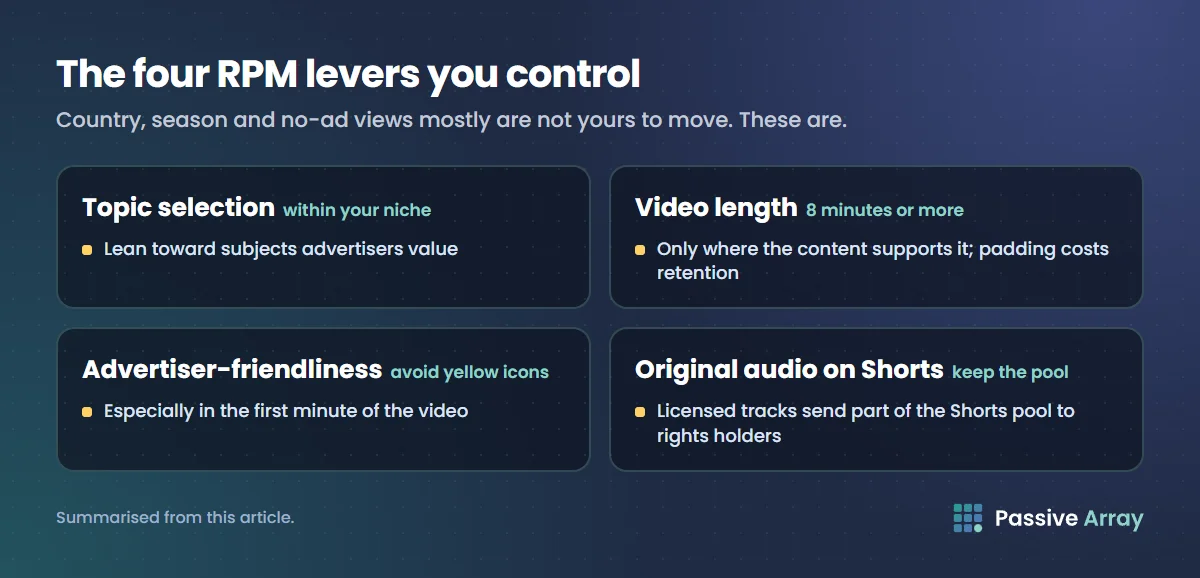
Of the nine, you have real control over four:
- Topic selection within your niche, toward subjects advertisers value
- Video length, where the content supports eight minutes or more
- Advertiser-friendliness, especially in the first minute
- Original audio on Shorts, which keeps more of the pool
Audience geography moves slowly and only by making content that audience wants. Season you cannot change. Unmonetized views you can only reduce at the margin.
What a "good" RPM is
There is no single good number. A $1.50 RPM is excellent for a music channel with a South Asian audience and poor for a finance channel with an American one. Judge your RPM against your own history, your niche and your geography, not against a figure someone quoted on a forum. The YouTube money calculator lets you set your own RPM range so the estimate reflects your channel rather than an average of everyone's.
Frequently asked questions
Is RPM the same as CPM?
No. CPM is what advertisers pay per 1,000 ad impressions before YouTube's share, counting only views that showed an ad. RPM is what you receive per 1,000 total views after the share, from all revenue sources. RPM is always the lower of the two.
Why did my RPM drop in January?
Advertising budgets reset after the year-end peak, so rates fall across YouTube in January and recover through the year. If your views and content did not change, the drop is seasonal.
Why is my RPM not showing?
RPM appears in the Revenue tab only once the channel is in the Partner Program and has recorded revenue. New channels, and channels whose monetization is paused, see no figure.
Does RPM increase over time?
Often, but not by itself. It rises when the audience shifts toward higher-paying countries, when videos get longer or more commercial, or when memberships and Super Chat grow. It does not rise simply because the channel is older.
Which niches have the highest RPM?
Finance, investing, insurance, software, business and some education topics, because advertisers in those fields pay the most to reach viewers. Entertainment, music, gaming and kids' content sit at the low end.