A small brand can run its first influencer campaigns with free tools: a free search to find creators, free calculators to vet and price them, the platforms' own branded content tools for disclosure, and tracked links and discount codes to measure results. What free tools cannot give you is a complete database of every creator, verified audience demographics, contact details, or campaign management in one place. That is what paid influencer platforms charge for.
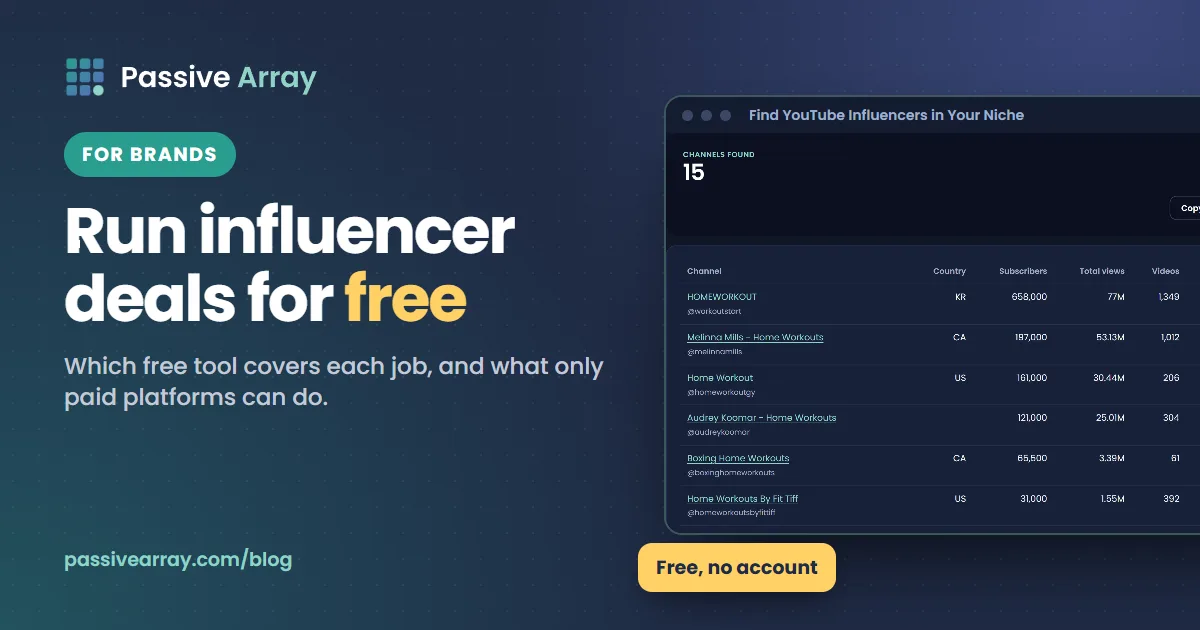
This guide maps each job in an influencer campaign to a free tool, starting with discovery. Find YouTube Influencers in Your Niche turns a topic into a list of up to 25 YouTube channels with live subscribers, views and video counts, with no sign-up. Each section below says exactly what the tool does, and where it stops.
The free influencer marketing stack, job by job
An influencer campaign has the same jobs whatever its size. Our guide to how influencer marketing works walks through all nine steps. Here is which free tool covers each one:
| Job | Free option | What it does not do |
|---|---|---|
| Find creators by topic | YouTube niche finder, platform search | Covers YouTube only; no complete directory |
| Find creators in one country | YouTube location search | Uses the country the creator declared, not audience location |
| Find more creators like a good one | YouTube lookalike finder | Depends on the seed channel's own keywords |
| Check recent performance | Channel quality checker, channel comparison | No audience demographics |
| Check for fake followers | Instagram and TikTok fake follower estimators | An estimate from public numbers, not a follower audit |
| Price a deal | Sponsorship and pricing calculators | Estimates, not market quotes |
| Disclose the ad | YouTube, Instagram and TikTok branded content tools | Not enough alone, per the FTC |
| Track results | Unique discount codes, tagged links, a spreadsheet | No automatic attribution across creators |
| Report | Creator's insights screenshots, EMV calculator | Manual collection |
The rest of this guide goes through each job in order.
How to find YouTube influencers for free
YouTube is the easiest platform to search for free, because YouTube publishes channel statistics through its official Data API. Passive Array has three discovery tools built on it. They answer different questions, so pick by where you are starting.
Start from a topic: the niche finder
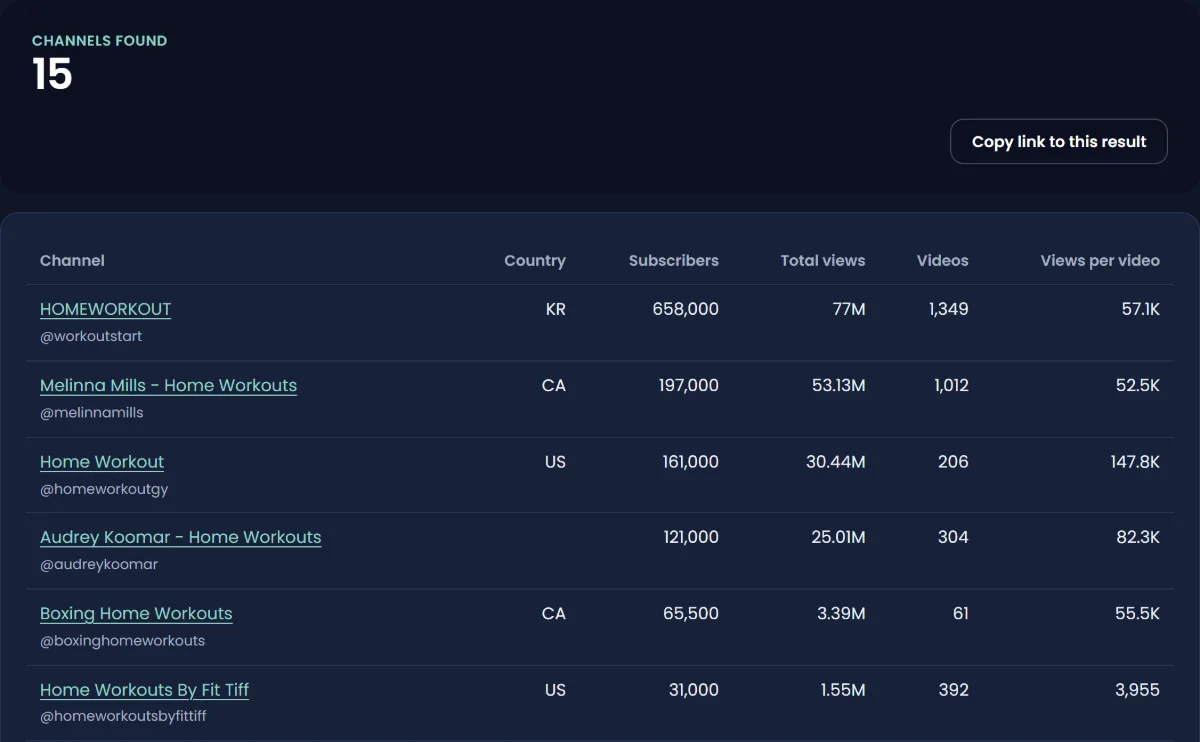
Type a topic and the niche finder runs it through YouTube's own channel search, takes the 50 most relevant channels, pulls live statistics for each, drops channels outside your subscriber range (10,000 to 1,000,000 by default) and, if you pick a country, drops channels that have not declared that country. It shows up to 25, biggest first, with subscribers, total views, videos and views per video.
The keyword does most of the work. YouTube matches it against channel names and descriptions, so search the way creators describe themselves:
| Instead of | Try |
|---|---|
| skincare brand | skincare routine, skincare for acne |
| fitness | home workout, calisthenics, running coach |
| software | excel tutorial, notion setup |
| pet food | dog training, raw feeding, new puppy |
Run three or four phrasings and note the channels that keep appearing. Those are the ones YouTube itself treats as central to the topic.
Start from a country: the location search
If your campaign is for one market, search YouTube influencers by location starts from the country. It runs a YouTube channel search told to favour that country, keeps only channels whose declared country matches, applies a wide default range of 1,000 to 10,000,000 subscribers, and shows up to 25. If you leave the keyword empty it searches for "vlog", so add your own keyword for anything specific.
Smaller markets often return short lists, because many creators never set a country. Search in the local language, use a city or local word as the keyword, and lower the subscriber minimum.
Start from one good creator: the lookalike finder
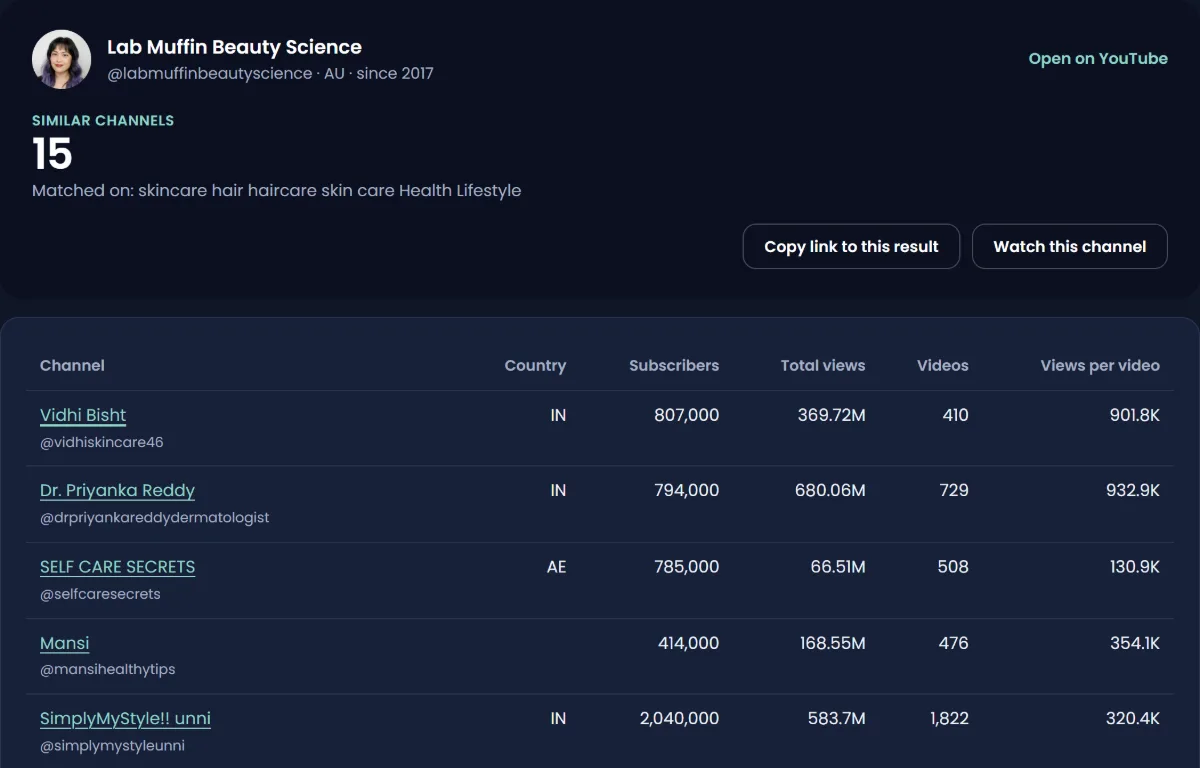
Once one creator has worked for you, the YouTube lookalike finder finds more like them. Paste the channel, and it builds a search from that channel's own keywords and YouTube's topic categories, then lists up to 15 channels sorted by how close their subscriber count is to the seed's. The "Matched on" line shows exactly what it searched for, which explains odd results.
What these YouTube search tools cannot do
These are honest limits, taken from how the tools work:
- They are not a complete directory. Each search starts from YouTube's 50 most relevant matches, then filters. A tight range can leave only a few results even in a big niche.
- Views per video is a lifetime average. One old viral video can make a quiet channel look busy. Recent average views come from the quality checker or the comparison tool.
- The country is self-declared. It says where the creator says they are based, not where their viewers are. Audience geography is private to the channel owner.
- No contact details. The YouTube API does not provide them. Look on the channel's About page or in video descriptions.
- Hidden subscriber counts read as zero, so those channels drop out when your minimum is above zero.
- YouTube only. There is no free public API that lets an outside site search Instagram or TikTok creators the same way.
How to find Instagram and TikTok influencers for free
For Instagram and TikTok, free discovery is mostly manual, with the platforms' own marketplaces where available.
- Search inside the app. Search your topic, open the top accounts and the Reels or videos that appear, and note the creators whose content suits your product.
- Look at who your customers already follow. Check the accounts that tag or mention your brand or your competitors.
- Follow the comment sections. Creators who comment thoughtfully on bigger creators in your niche are often good, affordable partners.
- Use the platform marketplaces. Instagram's creator marketplace is accessed through Meta Business Suite in the countries where it is available, and Meta's 2024 announcement describes search by creator and audience attributes plus machine-learning recommendations in testing. TikTok One includes creator search with advanced filters, and TikTok describes a Creator AI Search that returns up to 200 creators from a pasted brief. The pages we read do not state a fee for discovery, but availability depends on your country and account.
YouTube has the same kind of in-house option. YouTube Creator Partnerships, formerly BrandConnect, makes eligible Partner Program creators in 24 countries discoverable to brands, and YouTube announced Gemini-assisted creator search in March 2026. Access for advertisers runs through Google's ad products.
How to vet influencers for free
A list of names is not a shortlist. Vetting is where free tools are strongest, because most warning signs show in public numbers.
Check recent performance, not totals
For YouTube, the channel quality checker scores engagement, reach and consistency from the last 10 uploads, which the search list cannot show. The channel comparison tool puts two or three channels side by side. Look hardest at average views and views per subscriber; our YouTube engagement rate benchmarks show what is typical.
Check for bought followers
For Instagram, the fake follower estimator takes five public numbers, followers, following, posts and average likes and comments, and scores them against what a real audience of that size usually produces. A TikTok version does the same. Both give an estimate and list each red flag behind it. Our guide on how to spot fake followers explains the seven signals in plain terms.
The tool is honest about a hard limit: Instagram has no free public API that lets an outside site read an account's follower list, so no free web tool can inspect every follower. Paid platforms that claim follower-level audits use their own data collection, and you should ask how.
Ask for the private numbers
Audience country, age and gender, and reach on recent posts, are visible only to the creator. Ask for screenshots from YouTube Studio, Instagram Insights or TikTok Analytics, with the date range visible. This is free, and it fills the biggest gap in public data. The full checklist is in how to vet an influencer before you pay.
How to price a deal for free
Free calculators give you a range before the creator sends a rate card, so you know if a quote is reasonable.
- YouTube: the sponsorship price calculator prices an integration as average views on the last 10 uploads divided by 1,000, times a sponsorship CPM, with defaults of $20 to $50. How much to charge for a sponsored YouTube video explains the method from the creator side, which is the side you are negotiating with.
- Instagram and TikTok: the pricing calculators start from followers and adjust for engagement against the typical rate for the account's size.
Treat these as estimates. Niche, audience country, usage rights and exclusivity all move the real price.
Free tools for disclosure
Every major platform gives you a free disclosure tool, and you should require it in the brief:
- YouTube: the paid promotion declaration in YouTube Studio. YouTube's policy says creators "must" use it for branded content.
- Instagram: the Paid partnership label, with your brand tagged as partner. Your brand needs a professional account.
- TikTok: the commercial content disclosure setting, which shows a Paid partnership label.
These tools are free, but they are not the whole job. The FTC says a platform offering a disclosure feature "is no guarantee" that it is effective, and recommends creators add their own clear disclosure too. In the UK, the ASA says a platform label "may not be enough on its own".
Free tools to track and measure results
Measurement does not need software at the start. It needs a plan before the content goes live.
- Give each creator a unique discount code. Your store reports redemptions per code. This is the most common measurement method among brands in Influencer Marketing Hub's 2026 benchmark survey, where promo and discount codes were the top tool selected.
- Give each creator a unique tagged link. Add campaign parameters to the URL so your website analytics shows visits and sales per creator.
- Collect insights screenshots at a fixed date, for example 30 days after posting: views, reach, clicks, saves and shares.
- Put it all in one spreadsheet: creator, fee, views, clicks, code uses, sales, and cost per result.
- Value the attention consistently. The earned media value calculator turns impressions and engagement into one figure so campaigns can be compared on the same scale. It is not revenue.
For public numbers over time, the YouTube channel growth tracker records a channel's views and subscribers day by day, which is useful for spotting a creator whose audience is shrinking. How to judge the results is covered in does influencer marketing work.
What free tools cannot do compared with paid platforms
Being honest about this saves you money in the long run. Paid influencer platforms exist because the jobs below take a lot of time by hand.
| Paid platforms usually offer | With free tools you get |
|---|---|
| A large searchable database across Instagram, TikTok and YouTube | A YouTube search that starts from 50 relevant matches; manual search elsewhere |
| Estimated audience demographics for any creator | Only what the creator chooses to share in screenshots |
| Contact emails | Whatever the creator lists on their profile |
| Historical follower and view charts | Data from the day you start tracking |
| Campaign management: briefs, approvals, deadlines | Email and a spreadsheet |
| Contracts and payments in one place | Your own contract template and payment method |
| Automatic reporting across creators | Screenshots and manual totals |
An outside platform cannot see a creator's private analytics unless the creator connects their account, so its audience figures may be estimates. Ask any vendor how they are collected.
When free is enough
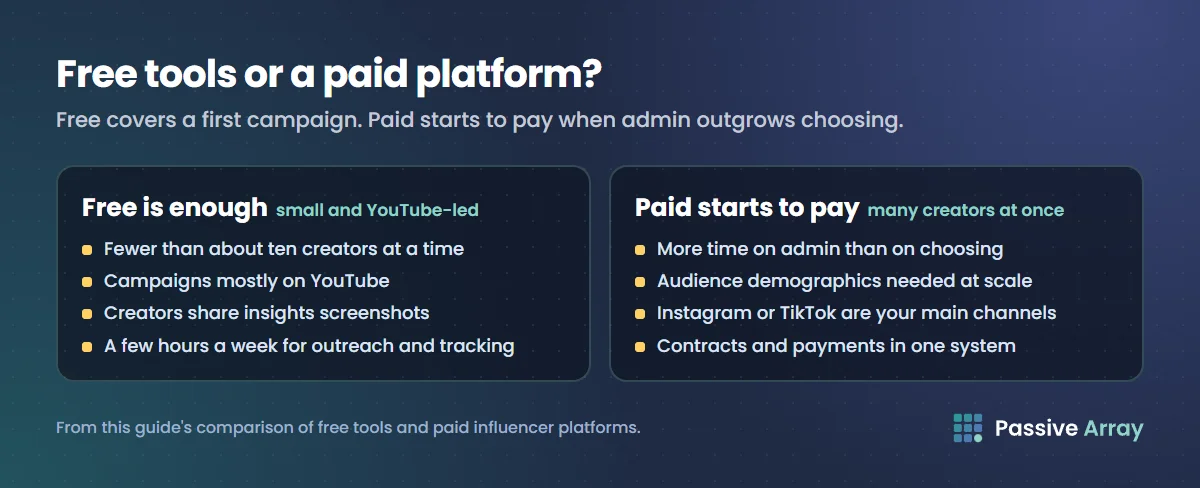
- You work with fewer than about ten creators at a time.
- Your campaigns are mostly on YouTube, where public data is strongest.
- You can ask each creator for insights screenshots.
- Someone on the team can spend a few hours a week on outreach and tracking.
When a paid platform starts to pay for itself
- You run many creators at once and spend more time on admin than on choosing creators.
- You need audience demographics before contacting anyone, at scale.
- Instagram or TikTok are your main channels and manual search is too slow.
- You need contracts, payments and usage rights handled in one system.
Even then, keep the free checks. A paid database still lists creators with bought followers, and a ten-minute manual check catches what a score misses.
A free workflow for your first campaign
- Write one goal and one number to judge it by.
- Run three or four searches in the niche finder, plus the location search if you sell in one country.
- Open the channels that fit and check they posted in the last few weeks.
- Run the best eight through the quality checker; keep five.
- For Instagram or TikTok creators, run the fake follower estimator.
- Ask your five for audience screenshots and a rate.
- Check each rate against the pricing calculators.
- Brief and contract the best two or three, with disclosure and tracking written in.
- After 30 days, collect results in the spreadsheet and use the lookalike finder to find the next creators like your best performer.
Sources
- YouTube Help: Get started with YouTube Creator Partnerships
- YouTube Official Blog: YouTube Creator Partnerships: a new era for brand and creator collaborations, March 2026
- YouTube Help: YouTube branded content policy
- Meta for Business: Creator marketplace expands to new markets and tests smarter recommendations, 2024
- Instagram: Partner with brands and earn
- TikTok for Business: TikTok One, an all-in-one creative platform, May 2026
- TikTok Ads Help: About the commercial content disclosure setting for creators
- FTC: FTC's Endorsement Guides: What People Are Asking
- ASA: Recognising ads: Social media and influencer marketing
- Influencer Marketing Hub: Influencer Marketing Benchmark Report 2026
Frequently asked questions
How do I find YouTube influencers for free?
Type your topic into a free YouTube influencer search such as the Passive Array niche finder, set a subscriber range, and you get up to 25 matching channels with live stats. Try several phrasings, the way creators describe their own content. Then check recent views on each before you contact anyone.
Is there a free YouTube influencer search tool?
Yes. The niche finder, the location search and the lookalike finder are free with no sign-up, and all use YouTube's official Data API for live numbers. YouTube Creator Partnerships also lets brands discover eligible creators, with access through Google's ad products.
How do I find influencers on YouTube in my country?
Use a location search that keeps only channels which declared your country, and add a keyword in the language local creators use. Remember the country is where the creator says they are based. Ask for the audience country breakdown from YouTube Studio before you pay.
Can I get an influencer's email address for free?
Not through the YouTube API, which does not provide contact details. Many creators list a business email on their channel's About page, in video descriptions, or in their Instagram or TikTok bio. Paid platforms often include contact details, which is one of the main things they charge for.
Are free influencer tools accurate?
The public numbers they use, such as subscribers, views, likes and comments, come straight from the platforms, so those are accurate on the day. Anything derived from them, like a fake follower score or a price range, is an estimate. Audience demographics are not public at all, so no free tool can show them.
Do I need a paid influencer platform?
Not to start. Most small brands can find, vet, price and track a handful of creators with free tools and a spreadsheet. A paid platform starts to make sense when you manage many creators at once or need audience data at scale before outreach.
What is the best free tool to find TikTok or Instagram influencers?
The platforms' own search and their creator marketplaces, where available in your country: Instagram's creator marketplace through Meta Business Suite and TikTok One. Outside sites cannot search those platforms' creators freely, because there is no free public API for it. Use the fake follower estimators to vet the accounts you find.