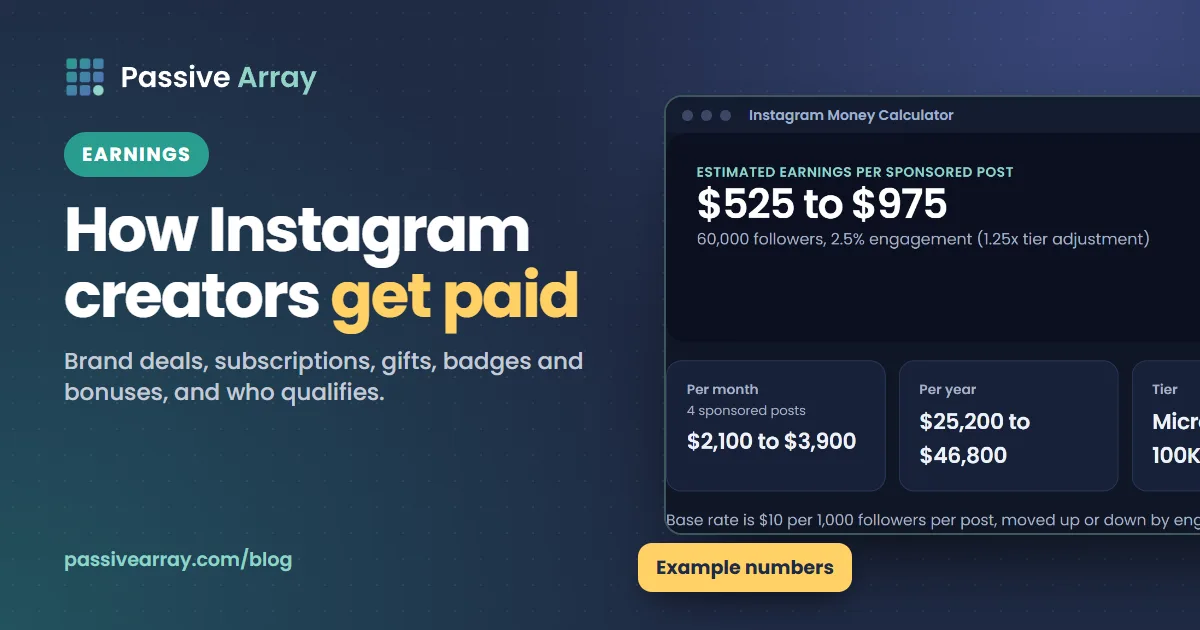
Instagram creators make most of their money from brands, not from Instagram. Sponsored posts, reels and stories, often with extra fees for partnership ads and usage rights, are the main income for most accounts. Instagram's own payouts, subscriptions, gifts on reels, badges in Live and invite-only bonuses, add to that, but each has its own eligibility rules and several are limited to certain countries.
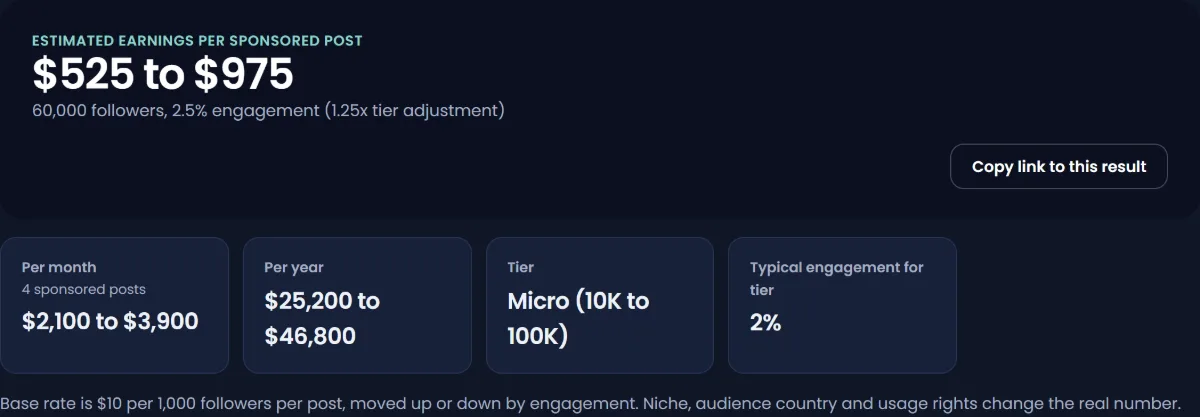
There is no fixed "pay rate per follower" on Instagram. If you want a number for your own account, the Instagram money calculator estimates sponsored post income from your followers and engagement rate, and shows how it got there. The rest of this guide explains each income stream, who can use it, and how to work out what it is worth to you.
The short answer: the ways Instagram creators earn
| Income stream | Who pays | Paid by Instagram? | Who can use it |
|---|---|---|---|
| Sponsored posts, reels and stories | Brands | No | Anyone a brand will hire |
| Partnership ads and usage rights | Brands | No | Creators who grant a brand permission |
| Creator marketplace deals | Brands, found through Instagram | No | Eligible creators in supported countries |
| Subscriptions | Your followers, monthly | Yes, through Instagram | Eligible creators in supported countries |
| Gifts on reels | Your viewers, with Stars | Yes | 18+, professional account, follower minimum, supported countries |
| Badges in Live | Your viewers | Yes | Eligible creators |
| Bonuses | Yes | Invitation only, selected countries | |
| Affiliate links and your own products | Customers | No | Anyone |
Instagram lists most of these on its own creators site under "earn money": subscriptions, gifts, badges, bonuses, brand partnerships through the creator marketplace, and partnership ads. Whether each one appears in your app depends on your country, your account type and whether you meet Meta's monetization policies.
Does Instagram pay you for views or followers?
Not in the way YouTube shares ad revenue. Instagram has no open program that pays every creator a rate per thousand views. The closest thing is bonuses, which Instagram describes as rewarding "the performance of your reels, carousels and single image posts". Meta's own announcements describe these bonuses as invite-only tests, run at different times in the United States, South Korea and Japan, and for limited periods.
So if you are asking "does Instagram pay money for videos", the honest answer in 2026 is: only if you are invited to a bonus, or if viewers send you gifts on your reels. A large audience on its own earns nothing until you turn it into brand deals or fan payments.
That is why the money calculator estimates sponsored post income rather than views income. For most creators, brand deals are the number that matters.
1. Brand deals: where most of the money is
A brand pays you to feature its product in a post, reel, story or carousel. You agree the deliverables, the fee, the deadline and what the brand may do with the content afterwards.
How a typical deal is priced
The common starting point is a rate per thousand followers, adjusted for engagement. The calculators on this site start at $10 per 1,000 followers for a feed post, then move that up or down depending on how your engagement rate compares with the typical rate for your account size. An account above its tier's typical rate gets up to 1.6 times the base, one below gets as little as 0.6 times.
Our full method, including how reels, stories and carousels compare with a feed post, is in how much to charge for a sponsored Instagram post. The Instagram pricing calculator runs it and quotes a feed post, a story and a reel separately.
A worked example
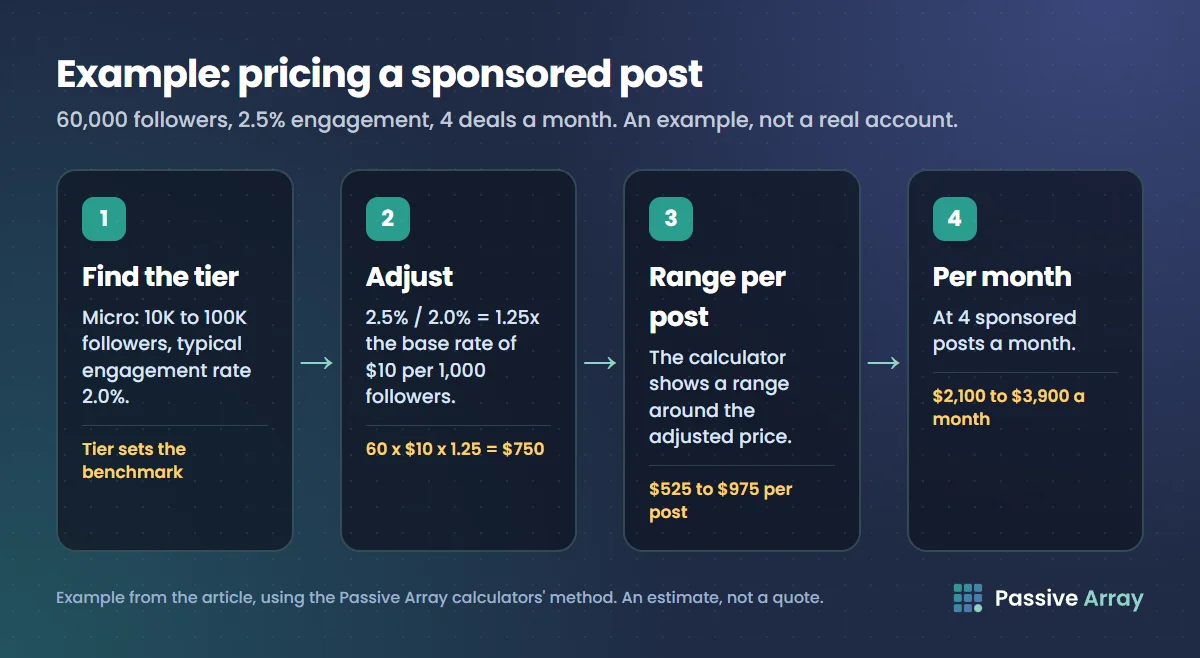
Say a creator has 60,000 followers, a 2.5% engagement rate and closes 4 sponsored posts a month. This is an example, not a real account.
- Tier: micro (10K to 100K followers), typical engagement rate 2.0%.
- Engagement adjustment: 2.5 / 2.0 = 1.25x.
- Adjusted price: 60 x $10 x 1.25 = $750 per post.
- Range: $525 to $975 per sponsored post.
- Per month at 4 posts: $2,100 to $3,900. Per year: $25,200 to $46,800.
The weak point in that sum is the number of deals. Four paid posts every month is a busy schedule for an account that size. If you are planning a budget, use the number of deals you have actually closed in the last few months.
Why engagement matters more than followers
A brand is buying attention. A 100,000-follower account where few people react delivers less attention than a 30,000-follower account with an active community, and experienced brands check. Work out your rate with the Instagram engagement rate calculator, then compare it with the typical rate for your size in our Instagram engagement rate by follower count benchmarks.
If your rate is low, raising it is the fastest way to raise your price. Our guide on how to increase your Instagram engagement rate covers what moves it.
2. Partnership ads, usage rights and whitelisting
Many deals now include a second part: the brand wants to run your content as a paid ad. On Instagram that usually means partnership ads, which run from the brand's ad account but show your handle.
Instagram's creator site says "you need to give permission before businesses will see the option to promote your branded content posts." That permission is valuable to the brand, because an ad from a creator's handle borrows the creator's credibility. Treat it as a separate line item:
- Usage rights. A brand using your content in its own ads or channels. Common practice is an extra 20% to 50% of the fee for a fixed period and fixed channels. Unlimited, permanent rights should cost far more.
- Partnership ads or whitelisting. Ads running from your handle. Price it at least as high as usage rights, and set an end date.
- Exclusivity. Agreeing not to work with competitors for a period costs you future deals. Charge for it.
If you leave these out of the quote, you are giving them away. When a brand asks to cut the budget, an itemised quote lets you remove a deliverable instead of lowering your rate.
3. Instagram's creator marketplace
The creator marketplace is where brands search for creators inside Meta's tools and send project invitations. Instagram describes it as a way to "make money by collaborating with brands". It does not change how much a deal pays. It changes how brands find you.
Access depends on country. Meta launched it in the United States and has expanded it in stages. Its 2024 expansion added ten more countries, including Argentina, France, Germany and Turkey. You also need a professional account and must meet Meta's Partner Monetization Policies, which include having "an authentic, established presence" and living in a country where the feature is available. Meta does not publish a single follower minimum for the marketplace.
To improve your chances inside it, fill in your interests so you get relevant projects, and keep your public numbers honest. Instagram's own advice is to share data such as follower count and average likes, views, comments and shares to support your rate.
4. Subscriptions
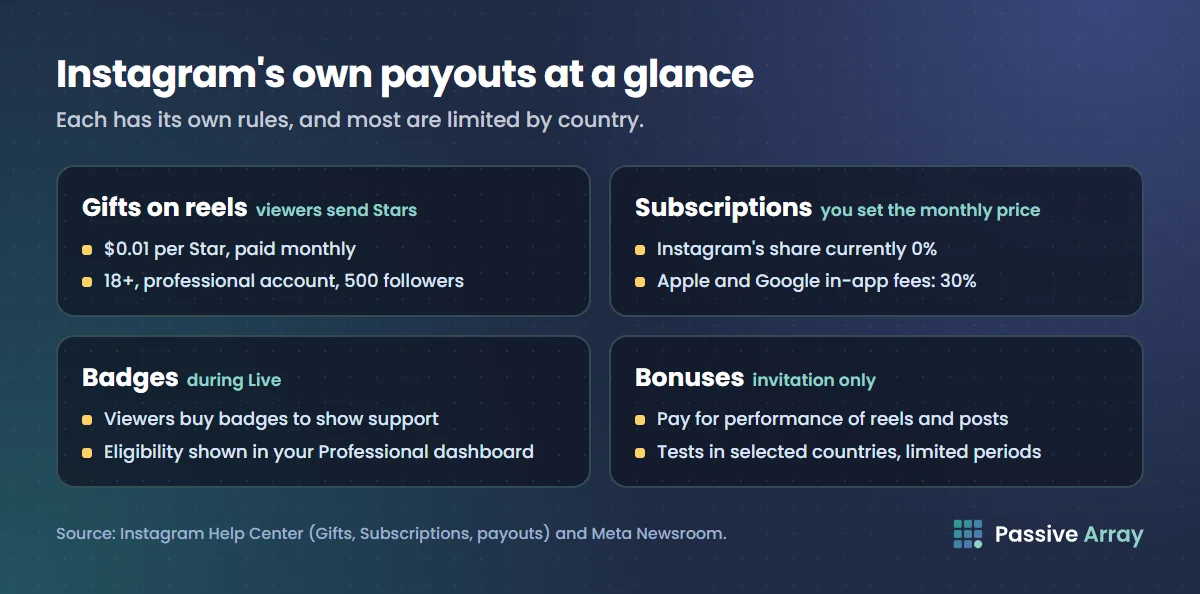
Subscriptions let followers pay you monthly for extra content. You set the price. Instagram's announcement says "You can set a monthly price of your choice."
Subscribers can get:
- Subscriber-only posts, stories, reels and lives.
- Subscriber highlights that keep your exclusive stories.
- Subscriber-only broadcast channels and social channels.
- A subscriber badge next to their name in comments and messages.
Subscriptions are limited to eligible creators in specific countries. Instagram's 2023 expansion listed dozens of countries, including the US, UK, Canada, Japan and India, and creators must meet the Partner Monetization Policies. On fees, Meta's help page says Instagram's own revenue share on subscriptions is currently 0%, but when fans subscribe through the iOS or Android app, Apple and Google take their in-app purchase fees, which the help page puts at 30%.
Subscriptions suit creators whose followers want more of them specifically: coaches, educators, artists, fitness creators and anyone who can promise a steady extra. A small, loyal audience can earn more here than a large casual one.
5. Gifts on reels
Viewers buy Stars and send them as gifts on your reels. Instagram's help page on gifts says creators receive $0.01 USD for every Star received, paid monthly.
The requirements in Instagram's Help Center are:
- A professional (creator or business) account.
- Age 18 or older.
- At least 500 followers.
- A payout account set up.
- Living in a country where gifts are available.
When Meta first launched gifts in 2023, its announcement said creators needed at least 5,000 followers. The Help Center now lists 500, so check the monetization section of your Professional dashboard to see whether gifts are switched on for you. Collaborative posts are not eligible for gifts.
6. Badges in Live
During a live video, viewers can buy badges to show support. A badge appears as a heart next to the viewer's name in the comments. Badges work best for creators who already go live regularly with a chatty audience, such as Q&A sessions, tutorials and behind-the-scenes streams. They are listed among Instagram's monetization tools with their own eligibility rules, which Instagram shows in your Professional dashboard.
7. Bonuses
As covered above, bonuses pay for the performance of reels, carousels and photos, but only for invited creators in the countries where a bonus is running. You cannot apply. If you are invited, the offer appears in your Professional dashboard, and Instagram's payout help says you must set up a payout account before the bonus period ends or you can lose the earnings.
8. Income that does not go through Instagram
Some of the steadiest creator income never touches Instagram's payment systems:
- Affiliate links. You earn a commission on sales through your link or code. Brands like this model because they pay only for results. Ask for a flat fee on top if the deal also needs content from you.
- Your own products. Presets, courses, templates, coaching, merchandise or a service. You keep the margin and the customer relationship.
- Other platforms. In March 2026 Meta announced Creator Fast Track for Facebook: creators with at least 100,000 followers on Instagram, TikTok or YouTube can get $1,000 a month, and those with over a million $3,000 a month, as three months of guaranteed pay for sharing eligible reels on Facebook. Meta points to the program page for full eligibility. Our comparison of YouTube alternatives and how each one pays covers the other platforms.
Who can earn on Instagram: requirements at a glance
| Feature | Requirements we could confirm from Meta | Limited by country? |
|---|---|---|
| Gifts | Professional account, 18+, 500 followers, payout account | Yes |
| Subscriptions | Eligible creators who meet the Partner Monetization Policies | Yes |
| Badges | Own eligibility rules, shown in the Professional dashboard | Check the dashboard |
| Bonuses | Invitation only | Yes, tests have run in selected countries |
| Creator marketplace | Professional account, Partner Monetization Policies | Yes |
| Brand deals | None from Instagram, but paid partnership label required | No |
Every Instagram monetization tool sits on top of the Partner Monetization Policies: an authentic, established presence, content that follows the Community Guidelines and Content Monetization Policies, and residence in an eligible country. Meta also says it can change or end these features at any time. The definitive answer for your account is the monetization section of your Professional dashboard.
How to estimate what your Instagram account could earn
Use this order, because it starts with the income stream most creators rely on.
- Measure your engagement rate. Average likes and comments on your last 12 posts, divided by followers. The engagement rate calculator mentioned above does the sum.
- Price one sponsored post. Put followers and engagement into the Instagram money calculator. It returns a per-post range, then monthly and yearly figures for the number of deals you enter.
- Price each format. Run the pricing calculator to see a feed post, story and reel quoted separately.
- Add Instagram's own payouts. Check your Professional dashboard for subscriptions, gifts and bonuses, and use your actual payout history, not a guess.
- Add income outside Instagram. Affiliate commissions and product sales, from your own records.
Show brands the value of what you already posted
Earned media value, or EMV, puts a dollar figure on the attention a post earned: roughly what the same impressions, likes, comments, shares and saves would have cost as ads. It is not revenue, but it is a useful way to show a brand what a previous campaign delivered. The earned media value calculator values each action at fixed weights, for example $6 per 1,000 impressions and $1.50 per share, and shows the result line by line.
Put that number, your engagement rate and your audience's top countries in your creator media kit. Brands read those first.
Rules you must follow when you earn from brands
Instagram's creator site says any payment or gift from a business partner, including free trips or gifted products, needs the paid partnership label. The US Federal Trade Commission goes further. Its guide for influencers says to disclose "any financial, employment, personal, or family relationship with a brand", to put the disclosure where it is "hard to miss", and warns: "Don't assume that a platform's disclosure tool is good enough." In videos, say it as well as showing it.
Use both: the paid partnership label, and a clear "ad" or "sponsored" in the caption's first line and in the reel itself. Words like "spon" or "collab" are not clear enough, according to the FTC.
Mistakes that cost Instagram creators money
- Buying followers or engagement. It lowers your engagement rate, which lowers your price, and brands check. Our guide to spotting fake followers shows the same signals brands use, and the fake follower estimator runs them on any account.
- Pricing on followers alone. Engagement and audience country change what an account is worth more than follower count does.
- Forgetting usage rights. The fee covers a post on your profile, not months of paid ads.
- Waiting for Instagram to pay you. Bonuses are invite-only and can end. Build brand and fan income you control.
- Not tracking deals. Keep a simple record of every deal: fee, deliverables, rights and results. It becomes your rate card and your proof.
If you want to see where your account stands before you pitch, the guide to auditing an Instagram account walks through the checks.
Sources
- Instagram for Creators: Earn money on Instagram
- Instagram for Creators: Partner with brands and earn (creator marketplace)
- Instagram for Creators: Bringing subscriptions to more creators on Instagram, July 2023, updated September 2023
- Instagram Help Center: How to earn money on Instagram Gifts
- Instagram Help Center: About Instagram Subscriptions for creators
- Instagram Help Center: About payouts on Instagram
- Instagram Help Center: Instagram Partner Monetization Policies
- Meta Newsroom: Giving creators more ways to earn money on Facebook and Instagram, November 2023, updated April 2024
- Meta Newsroom: Making it easier for brands and creators to collaborate on Instagram
- Meta for Business: Creator marketplace expands to new markets
- Meta Newsroom: Creator Fast Track, March 2026
- FTC: Disclosures 101 for social media influencers
Frequently asked questions
Does Instagram pay money for videos?
Not as a standard rate per view. Instagram pays for reels only through invite-only bonuses and through gifts that viewers send with Stars. Most creators earn from their reels by selling sponsored reels to brands.
What is the Instagram followers to income ratio?
There is no official ratio, because Instagram does not pay per follower. A common pricing starting point for brand deals is $10 per 1,000 followers per feed post, which our calculators then adjust from 0.6x to 1.6x depending on engagement. Two accounts with the same followers can earn very different amounts.
How do I calculate my Instagram earnings?
Start with brand deals: work out your engagement rate, then put followers and engagement into the Instagram money calculator to get a per-post range, and multiply by the number of deals you actually close. Add your real payouts from subscriptions, gifts or bonuses from your Professional dashboard, and any affiliate or product income.
How many followers do you need to make money on Instagram?
Brand deals have no minimum, and small accounts with strong engagement do get paid work. Instagram's Help Center lists 500 followers, age 18+ and a professional account for gifts. Other tools such as subscriptions and the creator marketplace have their own criteria and depend on your country.
What is earned media value on Instagram?
Earned media value estimates what the attention a post earned would have cost as paid ads, by valuing impressions, likes, comments, shares and saves at fixed rates. It is not money you receive. Creators use it to show brands what past campaigns delivered, and brands use it to compare campaigns.
Why can't I see subscriptions or gifts in my account?
Most Instagram monetization tools are limited by country, age, account type and Meta's Partner Monetization Policies. If a tool is missing, check the monetization section of your Professional dashboard, which shows what you are eligible for and what is missing. Meta can also change or pause these features.
Do I have to label sponsored posts on Instagram?
Yes. Instagram requires the paid partnership label for any payment or gift from a business, and the FTC says a platform's label alone may not be enough. Add a clear "ad" or "sponsored" at the start of the caption and say it in the video.