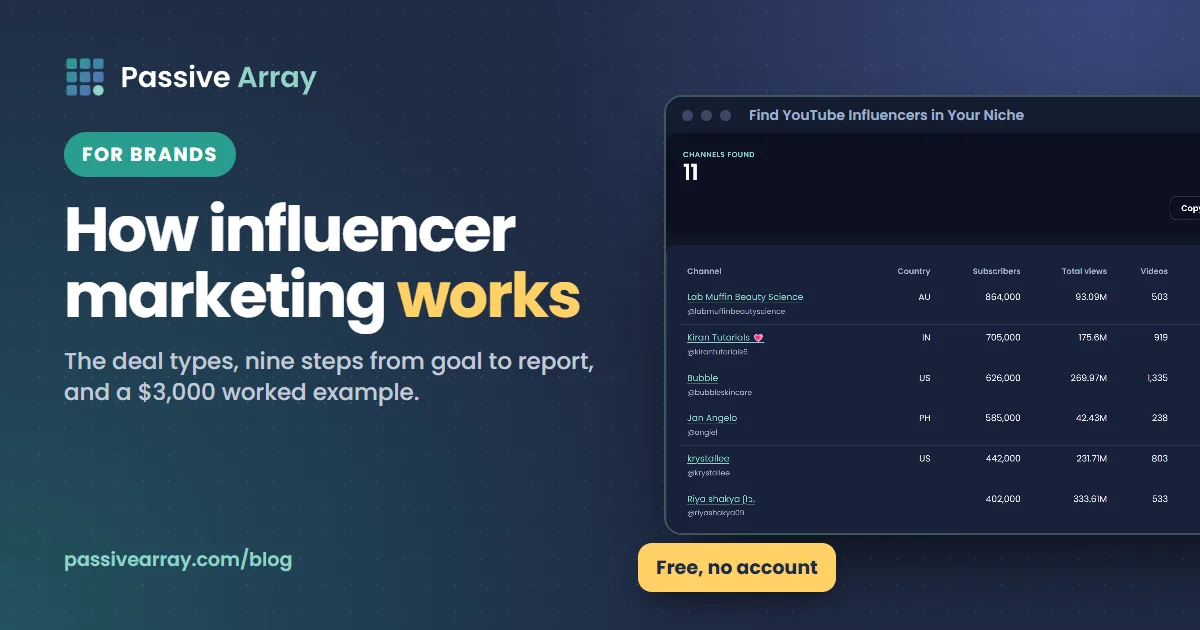
Influencer marketing works like this: a brand pays a creator, in money, free product or commission, to show or recommend something to the creator's audience, and the creator labels that content as an ad. The brand is buying two things at once: attention from a specific audience, and a recommendation from someone that audience already trusts. Everything else, from finding creators to measuring results, is about buying those two things at a fair price.
For a small brand the process has nine steps: set one goal, set a budget, find creators, vet them, price the deal, brief and contract, approve the content and the disclosure, publish and amplify, then measure. Finding creators no longer needs a paid database to start. A free tool like Find YouTube Influencers in Your Niche gives you a first list of channels with live subscriber and view counts in a minute. The rest of this guide walks through each step, with a worked budget example and the disclosure rules from the regulators.
What is influencer marketing?
Influencer marketing is a form of advertising where the message comes from a creator, not the brand. The creator makes the content in their own style, posts it to their own audience, and tells that audience they were paid or given something.
Four parties are usually involved:
- The brand, which pays and sets the goal.
- The creator, who makes and posts the content and owns the audience relationship.
- The platform, YouTube, Instagram, TikTok, Twitch or X, which sets its own rules for branded content and offers its own disclosure tools.
- Sometimes an agency or talent manager, on either side, who negotiates and handles paperwork.
The reason brands pay for this rather than running their own ads is simple: a creator's audience chose to follow that person. A recommendation inside content people chose to watch is received differently from an ad they tried to skip. Whether that difference is worth the price is the question does influencer marketing work answers with real measurement steps.
The main types of influencer deals
Not every deal is a paid post. These are the formats most small brands use, and how each is usually paid:
| Deal type | What the creator does | How they are usually paid |
|---|---|---|
| Sponsored integration | A 30 to 90 second segment inside a normal video | Flat fee per video |
| Dedicated video or post | The whole piece is about the product | Higher flat fee |
| Short-form mention | A Reel, TikTok or Short featuring the product | Flat fee, often lower |
| Gifting | Receives free product, may or may not post | Product only, no guarantee |
| Affiliate | Shares a tracked link or code | Commission on each sale |
| UGC (user-generated content) | Makes content the brand posts on its own channels or ads | Flat fee for the content and rights |
| Partnership ads or whitelisting | The brand runs paid ads from the creator's account | Fee for the access, plus the brand's ad spend |
| Ambassador | Several posts over months | Monthly or per-campaign retainer |
Most small brands start with one of three: a sponsored integration with a mid-sized YouTube creator, a few Instagram or TikTok posts from smaller accounts, or affiliate deals where they pay only on sales. Gifting is cheapest but gives you no control over whether anything gets posted.
One rule applies across all of them: a free product is still a payment for disclosure purposes. The FTC's guide for influencers says to disclose "if you got anything of value to mention a product", and Instagram's creator site says "anything received from business partners counts, whether it be money or otherwise".
How influencer marketing works, step by step
- Set one goal and one number to judge it by.
- Set a budget, including a test budget.
- Find creators whose audience matches your customer.
- Vet each creator's real reach and audience.
- Work out a fair price before you ask for a rate card.
- Write a brief and a contract.
- Approve the content and the disclosure before it goes live.
- Publish, then decide whether to amplify with ads.
- Measure against the goal and decide what to repeat.
1. Set one goal
Pick one main goal per campaign, because the goal decides which creators fit and how you measure success.
| Goal | What to measure | Good fit |
|---|---|---|
| Awareness | Views, reach, new followers on your account | Larger creators, Shorts and Reels |
| Consideration | Link clicks, site visits, saves | Integrations in longer videos |
| Sales | Code redemptions, tracked sales | Creators whose audience already buys in your category |
| Content | Usable videos and photos for your own ads | UGC creators, regardless of audience size |
A campaign that tries to do all four usually proves none of them. Write the goal and the number in the brief so the creator knows what success looks like too.
2. Set a budget
Decide a total, then split it. A sensible structure for a first campaign is a small test across three to five creators, then a larger spend with the one or two who performed. Keep some budget back for usage rights or paid amplification if a piece of content works well.
Budget for more than the creator fee. Product samples, shipping, a discount you give the audience, and any ad spend behind the content all count toward cost when you measure results later.
3. Find creators
Start from your customer, not from follower counts. Ask: what does my customer watch when they are not shopping? A brand selling ergonomic chairs might look at home office setup channels, programming tutorials and productivity creators, not furniture reviewers alone.
On YouTube, search the way creators describe themselves. The niche finder runs your keyword through YouTube's channel search, filters by subscriber range and declared country, and lists up to 25 channels with live stats. If your market is one country, search YouTube influencers by location starts from the country instead. Once one creator works well, the lookalike finder finds channels on the same topics at a similar size. Our guide to free influencer marketing tools compares these with what paid platforms add.
The platforms also run their own marketplaces. YouTube Creator Partnerships (formerly BrandConnect) lets brands discover eligible Partner Program creators, Instagram has a creator marketplace inside Meta Business Suite, and TikTok has TikTok One. Availability depends on your country.
4. Vet each creator
A search list tells you who exists, not who is worth paying. Before you contact anyone, check:
- Average views on recent posts, not subscribers or followers. A 300,000-subscriber channel that averages 15,000 views is a 15,000-view channel.
- Engagement against their size. Typical engagement rates fall as accounts grow, so compare with the benchmark for their tier.
- Signs of bought followers or likes, such as very low comments relative to likes. Our guide on how to spot fake followers lists the seven patterns.
- Audience fit, which only the creator can show you, from YouTube Studio, Instagram Insights or TikTok Analytics.
The full ten-minute routine is in how to vet an influencer before you pay. Ask for audience country and age screenshots early. Creators who work with brands regularly have them ready, often in a creator media kit.
5. Work out a fair price
Brands that price first negotiate better. You do not need the creator's rate card to know roughly what a deal is worth.
- YouTube: price on average views. The YouTube Sponsorship Price Calculator uses average views on the last 10 uploads times a sponsorship CPM, with defaults of $20 to $50 per 1,000 views. A dedicated video is priced at 1.75 times an integration and a Shorts mention at 0.25 times.
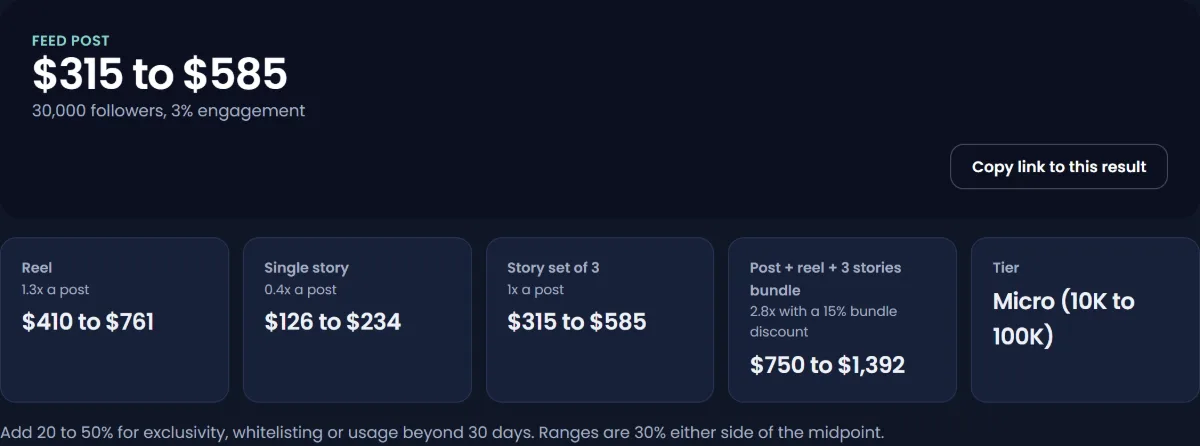
- Instagram: the Instagram Influencer Pricing Calculator starts from $10 per 1,000 followers for a feed post and adjusts for engagement against the typical rate for the account's size, then prices reels, stories and bundles from that.
- TikTok: how much to charge for a sponsored TikTok covers the same method for TikTok.
These are estimates, not market prices. Niche, audience country and how much work the content needs all move the real number. They give you a range so you know whether a quote is close or far off.
6. Brief and contract
The brief tells the creator what you need without writing their script. A good brief fits on one page:
- The product and the one message that matters most.
- What the creator must show or say, and what they must not claim.
- The call to action: a link, a code or a search term.
- Format, length, and the date it goes live.
- The disclosure you expect, and the platform tool to switch on.
The contract adds the business terms: the fee and when it is paid, the deliverables, how many revisions, who owns the content, how long you can reuse it (usage rights), whether you can run ads from their account (whitelisting), any exclusivity with competitors, and what happens if the post is late or removed. Usage rights and exclusivity are usually priced on top of the content fee, so agree them before you agree the price.
One part of the brief has legal weight. The FTC's guidance says a company "is ultimately responsible for what others do on your behalf", and that even a brand only sending free products is "still on the hook" for a creator's deceptive claims. Do not let creators claim results your product cannot back up.
7. Approve the content and the disclosure
Ask to see the content before it posts. The FTC recommends this for a practical reason: "It's much easier to review posts before they're posted than to search for them afterwards." For Stories and other content that disappears, it recommends requiring approval of paid posts in advance, because monitoring them later is not realistic.
Check three things on the draft: the claims are accurate, the call to action works, and the disclosure is clear. Disclosure has its own section below because it is the step brands most often get wrong.
8. Publish and amplify
When the content goes live, check the disclosure label is on and the link or code works. Share it on your own channels if your contract allows.
If a piece performs well, you can put ad money behind it. YouTube calls this a creator partnerships boost, Meta calls it partnership ads, and TikTok calls it Spark Ads. On Instagram and TikTok the creator grants permission inside the app first, so agree it in the contract. Ad spend is always a separate cost from the creator fee.
9. Measure and decide
Collect the numbers at a fixed point, for example 30 days after posting. Ask the creator for an insights screenshot showing views, reach, clicks and audience. Compare with the goal you set in step 1. Repeat with the creators who delivered, drop the ones who did not, and use what you learned in the next brief.
Measurement is where most small brands stop too early. Work out cost per view (fee divided by views, times 1,000), cost per click and cost per sale for each creator, and compare them with what the same result costs you through ads. If a creator's content is good enough to reuse, count that too: content you would otherwise have paid a production team for has value even when the post itself sold little.
A worked example: a $3,000 first campaign
Say a small brand selling a $45 skincare product has $3,000 for a first test. These numbers are an example, not a quote.
They shortlist one YouTube creator and two Instagram creators:
| Creator | Public numbers | Estimated price range |
|---|---|---|
| YouTube channel, skincare routines | Averages 25,000 views on recent uploads | Integration: 25 x $20 to 25 x $50 = $500 to $1,250 |
| Instagram account A | 30,000 followers, 3% engagement | Feed post about $315 to $585; reel about $410 to $760 |
| Instagram account B | 60,000 followers, 1.6% engagement | Feed post about $336 to $624 |
For account A, 3% engagement is 1.5 times the 2.0% typical rate the pricing calculator uses for accounts between 10,000 and 100,000 followers, so the feed post midpoint is 30 x $10 x 1.5 = $450, with a range of 30% either side. For account B, 1.6% is 0.8 times typical, so the midpoint is 60 x $10 x 0.8 = $480.
A plan within budget: the YouTube integration at about $1,000, a reel from account A at about $600, a feed post from account B at about $480, and roughly $500 for product, shipping and a 15% audience discount code. That leaves a few hundred dollars to boost whichever piece performs best.
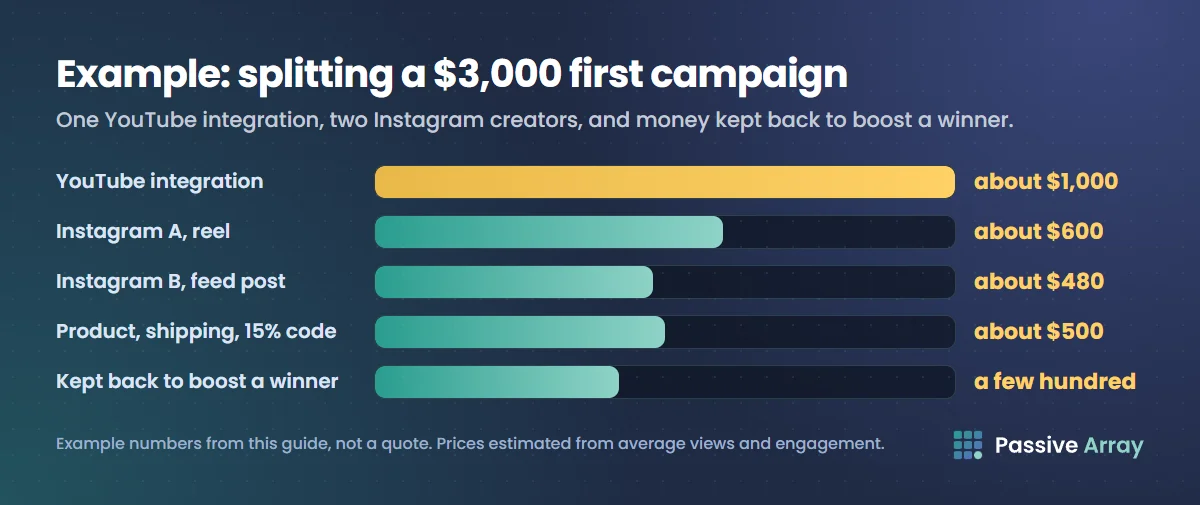
Notice what drove the choice. Account B has twice the followers of account A but costs about the same, because its engagement is below typical for its size. Price follows reach and engagement, not follower count.
Disclosure: what the rules require
Disclosure is not optional, and it is not only the creator's problem. YouTube's branded content policy says creators and their partners are "responsible for understanding and complying with all applicable legal requirements". The UK's Advertising Standards Authority says "both brands and influencers are responsible for ensuring that ads are obviously identifiable".
What the FTC says (United States)
From the FTC's "Disclosures 101 for Social Media Influencers" and its Endorsement Guides FAQ:
- Disclose any relationship: financial, employment, personal or family, and any free or discounted product.
- Put it where people will see it. Not only in a bio, not only behind a "more" link, and not buried in a pile of hashtags at the end.
- Use plain words. "Ad", "advertisement" and "sponsored" work, as does a plain sentence such as thanking the brand for the free product. Vague tags like "spon", "sp" or "collab" do not.
- Video needs disclosure in the video, not only in the description. The FTC says simultaneous on-screen and spoken disclosures are more likely to be clear. Live streams need repeated disclosure because people join late.
- Platform labels are not enough on their own. The FTC says the fact that a platform offers a disclosure feature "is no guarantee" it is effective, and advises creators to add their own.
- US rules can apply abroad. The FTC says US law applies if it is reasonably foreseeable that a post will affect US consumers.
What the ASA and CMA say (United Kingdom)
The ASA's guidance, written with the Competition and Markets Authority, prefers a label that calls the content advertising, with "Ad" usually the most appropriate, placed upfront. It says "sponsored" is open to varied interpretation, and that labels such as "gifted", "supported by" or "in association with" are unlikely to be clear enough. Affiliate content counts as advertising. A platform label such as Instagram's Paid partnership may not be enough on its own.
The platform tools
| Platform | Tool | Where |
|---|---|---|
| YouTube | Paid promotion declaration ("My video contains branded content") | YouTube Studio > Content > select the video, or during upload under Show more > Paid Promotion |
| Paid partnership label, with the brand tagged as partner | Advanced settings when posting; the brand needs a professional account | |
| TikTok | Commercial content disclosure setting, labelled Paid partnership | Content disclosure and ads, on the post screen |
YouTube says creators "must" use its paid promotion declaration, and that its systems may add the label automatically if they detect undisclosed branded content. TikTok says commercial content that is not disclosed may become ineligible for the For You feed. So the brief should require both: the platform tool switched on, and a clear "ad" in the content itself.
Where influencer marketing usually goes wrong
- Choosing by follower count. Followers are history. Recent average views and engagement are what you will actually get.
- No tracking. Without a unique code or tracked link per creator, you cannot tell which creator drove sales.
- Over-scripting. A creator reading your ad copy sounds like an ad. Give the message and the facts, then let them say it their way.
- One post, one verdict. A single post from one creator is a small sample. Test several, then judge.
- Forgetting usage rights. If you want to reuse the content in ads, agree it and pay for it upfront.
- Weak disclosure. It puts both sides at risk and, on TikTok, can limit distribution.
Sources
- FTC: Disclosures 101 for Social Media Influencers
- FTC: FTC's Endorsement Guides: What People Are Asking
- ASA: Recognising ads: Social media and influencer marketing
- YouTube Help: Add paid product placements, sponsorships and endorsements
- YouTube Help: YouTube branded content policy
- YouTube Help: Get started with YouTube Creator Partnerships
- Instagram: Partner with brands and earn
- TikTok Ads Help: About the commercial content disclosure setting for creators
Frequently asked questions
What is influencer marketing?
Influencer marketing is advertising delivered by a creator to their own audience. The brand pays in money, free product or commission, the creator makes content in their own style, and the content is labelled as an ad. Brands use it because a recommendation from someone the audience chose to follow lands differently from a standard ad.
How do influencers get paid by brands?
Usually a flat fee per piece of content, agreed before it is made. Other models are free product (gifting), commission on sales through an affiliate link or code, and monthly retainers for ambassadors. Fees for usage rights, whitelisting and exclusivity are normally added on top.
How do brands find influencers?
Most start by searching the platform for their topic and noting who keeps appearing. Free tools like the YouTube niche finder and location search speed this up with live stats, and YouTube, Instagram and TikTok each run their own creator marketplaces in supported countries. Paid platforms add larger databases and audience data.
How much does influencer marketing cost?
It depends on reach, engagement, niche and format. A common starting point is pricing YouTube deals on average views times a sponsorship CPM, and Instagram deals per 1,000 followers adjusted for engagement. Our calculators give a range for any creator so you can check whether a quote is fair.
Do influencers have to say a post is an ad?
Yes. The FTC requires disclosure of any material connection, including free products, and the UK ASA and CMA expect an upfront "Ad" label. YouTube, Instagram and TikTok also require creators to use their branded content tools. Brands share responsibility for making sure it happens.
Is the brand responsible for what the influencer says?
Largely, yes. The FTC says a company is ultimately responsible for what others do on its behalf, including false claims made by creators it sent free products to. Give creators accurate facts, tell them which claims they cannot make, and review content before it goes live.
How long does an influencer campaign take?
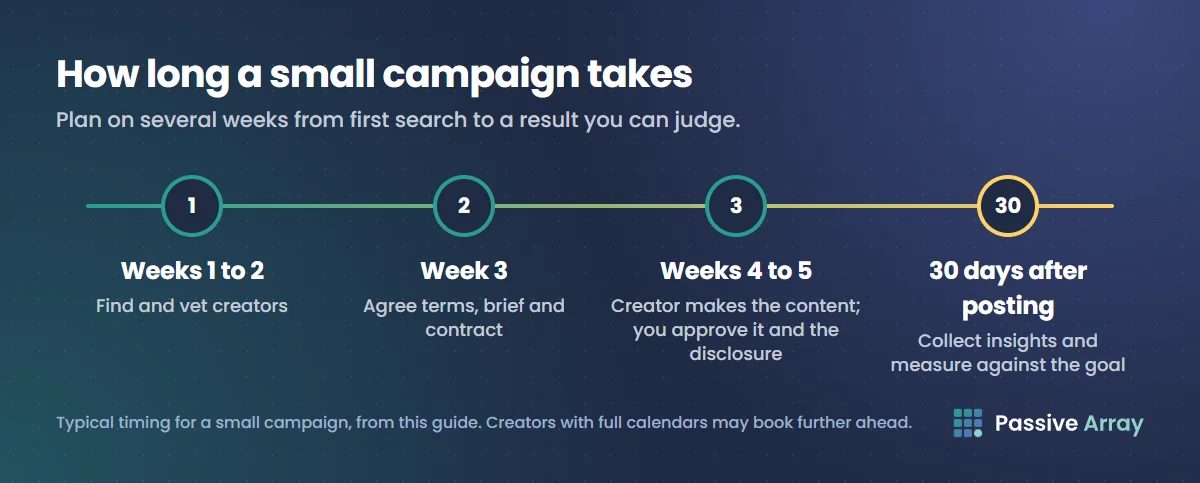
For a small campaign, plan on several weeks: one or two to find and vet creators, one to agree terms, one or two for the creator to make the content and for you to approve it, then about 30 days after posting to measure. Creators with full calendars may book further ahead.