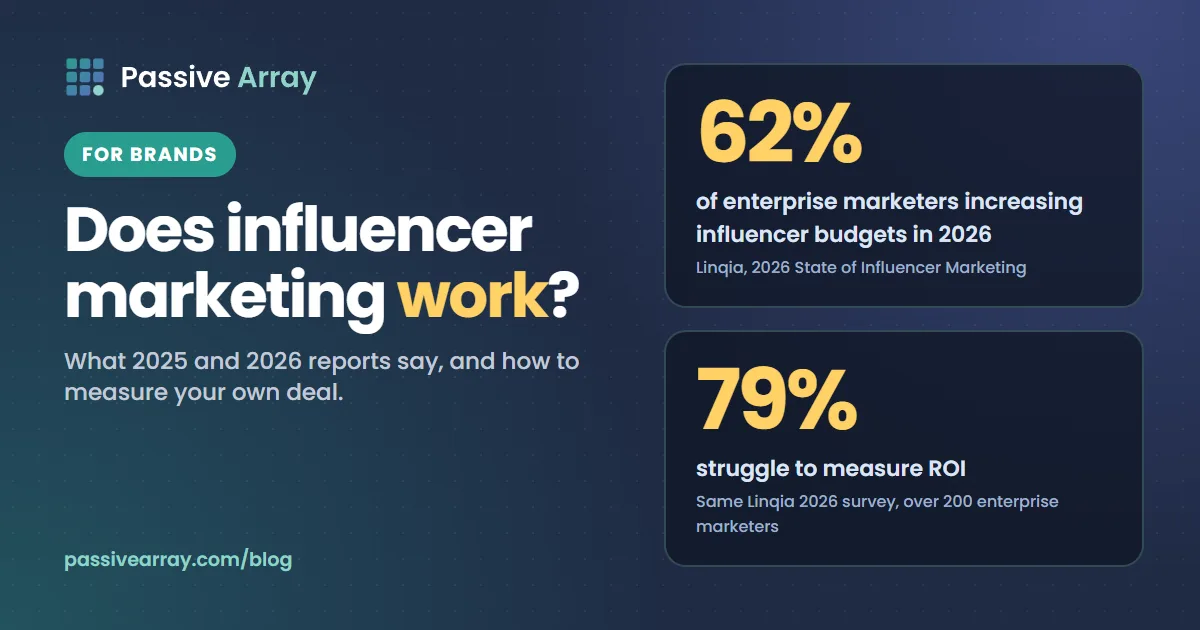
Influencer marketing works for some brands and some deals, and the only reliable way to know if it works for yours is to measure each deal against a goal you set before it ran. Industry surveys show brands keep raising their budgets, but the same surveys show most marketers find return on investment hard to prove. So treat "does it work" as a measurement question, not a belief.
This guide does two things. First, it lays out what named 2025 and 2026 reports actually say, clearly separated from our own reading of them. Second, it gives you a method to measure your own deal, using simple formulas and the free Earned Media Value Calculator to compare campaigns on one scale. If you are new to how deals are set up, start with how influencer marketing works.
What the reports say
These figures come from reports we opened in 2026. Each is that publisher's own survey or estimate, with its own sample and methods. They are not neutral measurements of every brand, and several publishers sell influencer marketing services.
| Publisher and year | Sample | What it reports |
|---|---|---|
| IAB, Creator Economy Ad Spend & Strategy Report, November 2025 | US spend estimate and a survey of ad buyers | US creator ad spend projected at $37 billion in 2025, a 26% increase year over year, growing about 4 times faster than the media industry overall. 48% of ad buyers call creators a "must buy". 40% rank overall ROI as their top KPI for creator campaigns. |
| Linqia, 2026 State of Influencer Marketing | Over 200 enterprise marketers | 62% are increasing influencer budgets in 2026. 79% struggle to measure ROI. 48% name attribution as their biggest measurement gap. 81% say creator content outperforms brand-created assets. |
| Influencer Marketing Hub, Influencer Marketing Benchmark Report 2026 | 600+ marketing professionals | 87.49% expect their influencer budget to increase. Brand awareness is the most selected KPI. Promo and discount codes are the most used measurement tool, at 45.9%, ahead of affiliate links at 26.0%. |
The platforms publish their own figures too. These are marketing claims from companies that sell the ads, so read them as such:
- TikTok says TikTok One creator content boosted with Spark Ads had a 159% higher engagement rate than non-creator content at the same CPM, from an internal analysis of North America between February 2024 and January 2025.
- YouTube says advertisers promoting creator-led Shorts saw an average 30% increase in conversion lift, and cites a Google-commissioned Circana meta-analysis finding YouTube drove 86% higher incremental long-term return on ad spend than paid social.
Our reading of these numbers
This part is our interpretation, not the reports' claims.
- Spending is not proof of return. Budgets rise when marketers believe something works, and also when competitors spend or when other channels get more expensive. A rising budget tells you about confidence, not results.
- The measurement problem is real and widely admitted. When 79% of enterprise marketers in Linqia's survey say ROI is hard to measure, a small brand should expect the same difficulty and plan tracking before the deal.
- Most programs are judged on awareness. Influencer Marketing Hub's respondents picked brand awareness most often, and IAB's buyers listed it first among campaign goals. Awareness is real, but it is the hardest goal to tie to money. If you need sales, say so in the brief and measure sales.
- Platform figures compare formats, not your business. A 30% conversion lift is an average across advertisers on YouTube's own measurement. It does not predict what one creator will do for one product.
So the honest answer to "is influencer marketing worth it" is: it can be, when the creator fits the customer, the price follows real reach, and you measure the result. The rest of this guide is how to do that.
What "works" means: pick the goal first
A deal can succeed on one goal and fail on another. Decide which one you are judging before you look at numbers.
| Goal | Main metric | Formula |
|---|---|---|
| Awareness | Effective CPM (cost per 1,000 views) | Fee / views x 1,000 |
| Traffic | Cost per click | Fee / link clicks |
| Sales | Cost per sale, ROAS, ROI | Fee / sales; revenue / cost; (gross profit - cost) / cost |
| Content | Cost per usable asset | Fee / pieces you can reuse |
| Attention value | Earned media value | Weighted sum of impressions and engagement |
Use the full cost, not just the creator fee: product samples, shipping, the discount you give the audience, agency fees and any ad spend behind the content.
How to measure an influencer deal, step by step
- Write the goal and the target number in the brief. For example: "at least 25 sales at a cost per sale under $50".
- Set up tracking before the content goes live. A unique discount code and a unique tagged link per creator. Test both.
- Record your baseline. Your typical daily sales, site visits and branded searches for the two weeks before the post, so you can see a change.
- Agree the reporting date and the screenshots in the contract. Views, reach, link clicks, saves and shares, plus audience countries, from YouTube Studio, Instagram Insights or TikTok Analytics.
- Collect results at a fixed point, such as 7 and 30 days after posting, and keep the same windows for every creator.
- Calculate the cost metrics in the table above.
- Compare with your other channels. If paid social costs you $55 per sale and a creator delivered sales at $40, the creator won on that goal.
- Add what the formulas miss, such as repeat purchases, reusable content and later views, as separate lines, so you can see how much of the result depends on them.
- Decide: repeat, renegotiate or drop. Repeat creators who hit the target, renegotiate those who came close, and drop the rest.
Worked example: a YouTube integration
Say a small brand pays $1,200 for a 60-second integration in a YouTube video. These numbers are an example, not a benchmark.
After 30 days, the video has 48,000 views, the tracked link has 600 clicks, and the creator's code and link together show 30 sales at an average order of $60. The brand's gross margin is 60%.
| Metric | Calculation | Result |
|---|---|---|
| Effective CPM | $1,200 / 48,000 x 1,000 | $25 |
| Cost per click | $1,200 / 600 | $2.00 |
| Cost per sale | $1,200 / 30 | $40 |
| Revenue | 30 x $60 | $1,800 |
| ROAS | $1,800 / $1,200 | 1.5 |
| Gross profit | $1,800 x 60% | $1,080 |
| ROI on first orders | ($1,080 - $1,200) / $1,200 | -10% |
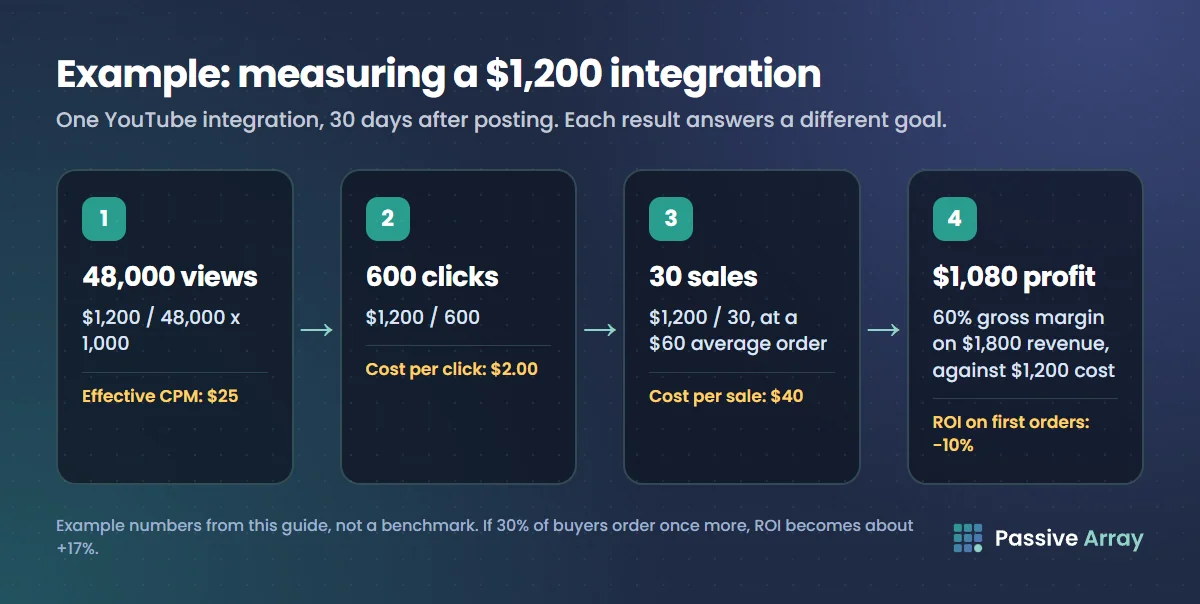
On first orders alone, this deal lost a little money. That is common, and it is not the end of the analysis:
- Repeat buyers. If 30% of these customers buy once more in the next six months, that is 9 more orders, $540 in revenue and $324 in gross profit. Total gross profit becomes $1,404, and ROI becomes about +17%.
- Later views. YouTube says 40% of a video's views happen more than a month after it goes live. Measure again at 90 days.
- Untracked sales. Some viewers search your brand name instead of using the link. A rise in branded search or direct visits over your baseline is a sign, though not proof.
- Compared with ads. If your paid social cost per sale is $55, a $40 cost per sale is better even before repeat orders.
Each of these is an assumption you should label in your own report. The first-order ROI is the only number that is fully measured.
Earned media value: useful, with limits
Earned media value, or EMV, estimates what the attention a post earned would have cost to buy as ads. It is useful for comparing posts and creators on one scale, especially when the goal is awareness and there are no sales to count.
The EMV calculator uses fixed weights: $6 per 1,000 impressions (with a range of $4 to $10), $0.10 per like, $0.50 per comment, $1.50 per share, $0.40 per save and $0.60 per link click.
Say an Instagram reel cost $600 and earned 60,000 views, 2,400 likes, 90 comments, 40 shares, 150 saves and 300 link clicks:
| Line | Calculation | Value |
|---|---|---|
| Impressions | 60 x $6 | $360 |
| Likes | 2,400 x $0.10 | $240 |
| Comments | 90 x $0.50 | $45 |
| Shares | 40 x $1.50 | $60 |
| Saves | 150 x $0.40 | $60 |
| Link clicks | 300 x $0.60 | $180 |
| EMV | $945 |
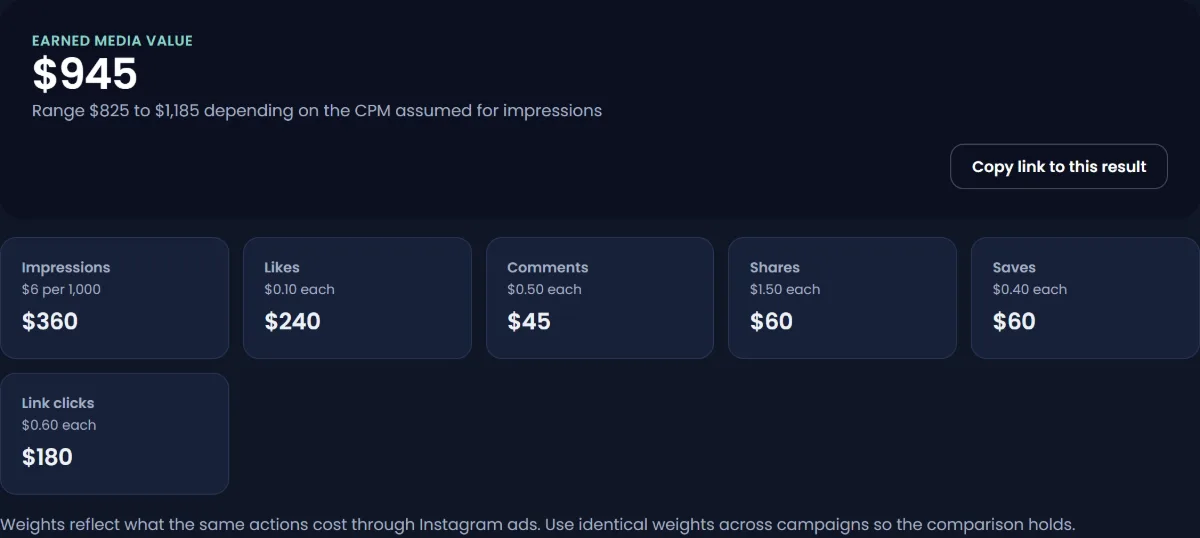
With impressions valued at $4 per 1,000, EMV is $825; at $10, it is $1,185. Against a $600 fee, the attention was worth more than it cost to buy as ads, on these weights.
Three rules keep EMV honest:
- It is not revenue. Never add it to sales or call it ROI. A post with a high EMV can sell nothing.
- Keep the weights fixed. EMV only means something next to another EMV built the same way.
- Fake engagement inflates it. Bought likes count at the same rate as real ones. Check creators before you report their numbers.
Why influencer deals fail to work
When a deal does not deliver, it is usually one of these, and most can be caught before you pay.
The audience was never real
Bought followers and likes do not buy products. The Instagram fake follower estimator scores five public numbers against what a real audience of that size produces, and lists the red flags. Influencer Marketing Hub's 2026 survey found fake or bot followers made up 56.5% of the fraud or quality issues its respondents reported. The patterns are explained in how to spot fake followers.
Engagement was weak for the creator's size
Engagement rates fall as accounts grow, so a raw percentage tells you little. Compare with the typical rate for the account's tier, as in Instagram engagement rate by follower count. On YouTube, the YouTube engagement rate calculator shows likes and comments per view across recent uploads.
The audience did not match the customer
High engagement from the wrong country or age group sells nothing. Ask for audience screenshots before you agree a fee. How to vet an influencer before you pay covers the ten-minute check.
The price followed followers, not reach
A creator with many followers and few recent views costs more than the attention is worth. Price YouTube deals on average views and Instagram deals with an engagement adjustment, as in how much to charge for a sponsored Instagram post, which shows the method from the creator side.
No tracking, or one post judged alone
Without a code and a link per creator, you cannot tell who sold what. And one post from one creator is a small sample. Test three to five creators before you decide the channel does not work for your brand.
The content read like an ad
Over-scripted content loses the reason you hired a creator. Give the facts and the message, then let the creator say it their way. Linqia's 2026 survey reports that 81% of marketers say creator content outperforms brand-created assets, which suggests the creator's voice is part of what you are paying for.
Is influencer marketing cost effective compared with ads?
Sometimes. Compare on the same goal and the same cost basis:
- For sales, compare cost per sale from creators with cost per sale from your paid ads, over the same window.
- For awareness, compare effective CPM from creators with the CPM you pay for ads, remembering that a creator's recommendation is not the same thing as an ad impression.
- For content, compare the creator fee with what you would pay to produce similar videos yourself, if you have the rights to reuse them.
Influencer deals often look expensive per view and good per sale or per asset, or the other way round. That is why the goal comes first. Where things are heading, including platform measurement tools and creator-content ads, is covered in influencer marketing trends in 2026.
Sources
- IAB: Creator economy ad spend to reach $37 billion in 2025, 20 November 2025
- Linqia: 2026 State of Influencer Marketing Report
- Influencer Marketing Hub: Influencer Marketing Benchmark Report 2026, May 2026
- YouTube Official Blog: YouTube Creator Partnerships: a new era for brand and creator collaborations, 23 March 2026
- TikTok for Business: TikTok One, an all-in-one creative platform, 13 May 2026
Frequently asked questions
Is influencer marketing worth it for small brands?
It can be, when the creator's audience matches your customer, the price follows real recent reach, and you track results with a code and link per creator. Start with a small test across three to five creators, measure cost per sale or cost per view, and compare with your other channels before scaling.
Is influencer marketing cost effective?
It depends on the goal. Compare creators with your ads on the same metric: cost per sale for sales, effective CPM for awareness, or cost per usable asset for content. Include product, shipping, discounts and ad spend in the cost, not just the fee.
What are the ROI statistics for influencer marketing?
Industry reports focus more on budgets and measurement than on a single ROI figure. In Linqia's 2026 survey, 79% of enterprise marketers said they struggle to measure ROI, and in IAB's 2025 report 40% of buyers ranked overall ROI as their top KPI for creator campaigns. Be wary of any single "return per dollar" figure without a named source and method.
How do you measure the effectiveness of influencer marketing?
Set one goal and a target number, give each creator a unique code and tagged link, record a baseline, and collect insights screenshots at fixed dates. Then calculate cost per view, cost per click and cost per sale, and compare with your other channels. EMV helps compare attention across campaigns.
Is EMV the same as ROI?
No. ROI compares profit with what you spent. EMV estimates what the attention would have cost to buy as ads. A campaign can have a high EMV and still lose money, so report them separately.
How long before you know if an influencer campaign worked?
Check at 7 days for the first wave and 30 days for most results, using the same windows for every creator. On YouTube, measure again at 90 days, because videos keep getting views long after they go live. Repeat-purchase value takes months to show.
Why did my influencer campaign not work?
The usual reasons are a fake or mismatched audience, pricing on followers instead of recent reach, no tracking, judging one post alone, or over-scripted content. Most of these can be caught before payment by vetting the creator and planning measurement in the brief.