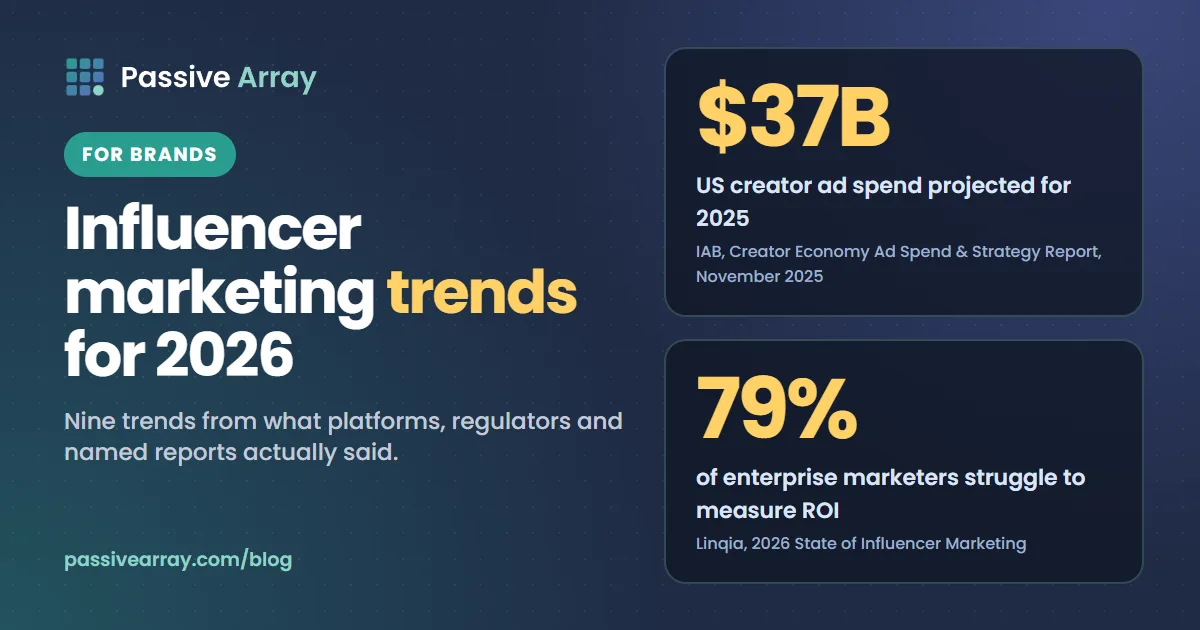
The biggest influencer marketing trends in 2026 are platforms building their own AI-assisted creator search, creator content being turned into paid ads, more work going to smaller creators, pressure to prove return on investment, and stricter rules on disclosure and fake engagement. Each trend below is based on something a platform or regulator announced, or a named report measured, in 2025 or 2026. We do not make forecasts with numbers, because nobody can measure the future.
For a small brand, most of these trends point the same way: find creators by audience fit, check their real reach, and measure every deal. You can start the first step for free with Find YouTube Influencers in Your Niche, which lists up to 25 channels for a topic with live stats. If you are new to the field, read how influencer marketing works first.
Influencer marketing statistics for 2026, at a glance
These are the figures behind the trends. Each is the publisher's own survey or estimate. Survey samples differ, and some publishers sell influencer marketing services, so read them as each publisher's view, not as neutral facts.
| Source | Figure |
|---|---|
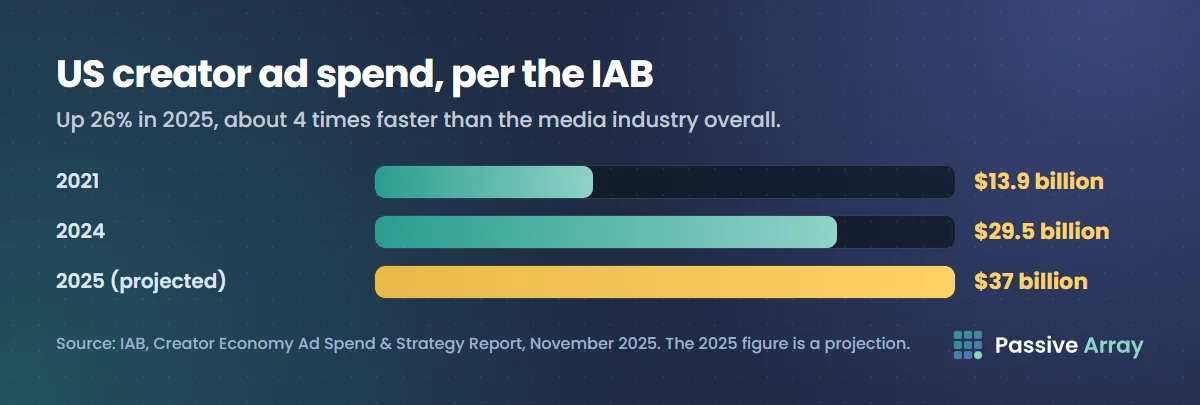
| IAB, November 2025 | US creator ad spend projected at $37 billion in 2025, up 26% year over year, growing about 4 times faster than the media industry overall |
| IAB, November 2025 | 48% of ad buyers consider creators a "must buy"; 40% rank overall ROI as their top KPI for creator campaigns |
| Linqia, 2026 (200+ enterprise marketers) | 62% increasing influencer budgets in 2026; 79% struggle to measure ROI |
| Linqia, 2026 | 100% repurpose influencer content beyond the creator's own channels; 81% say creator content outperforms brand-created assets |
| Influencer Marketing Hub, 2026 (600+ respondents) | 87.49% expect their influencer budget to increase |
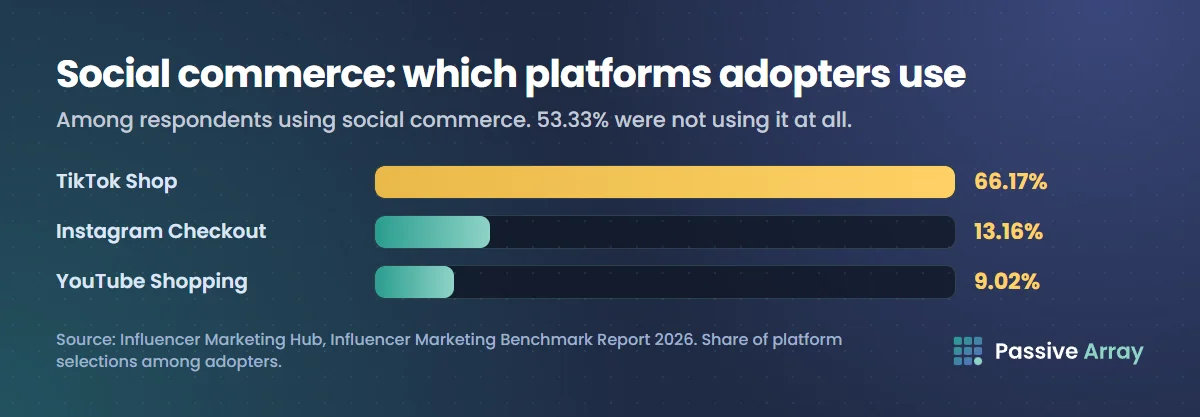
| Influencer Marketing Hub, 2026 | 53.33% not currently using social commerce; among adopters, TikTok Shop accounts for 66.17% of platform selections |
| Influencer Marketing Hub, 2026 | Fake or bot followers make up 56.5% of reported fraud or quality issues |
1. Spending keeps moving toward creators
The IAB's Creator Economy Ad Spend & Strategy Report, released in November 2025, projected US creator ad spend at $37 billion for 2025, up from $29.5 billion in 2024 and $13.9 billion in 2021. It said creator spend was growing about four times faster than the media industry overall. In 2026 surveys, Linqia found 62% of enterprise marketers increasing budgets, and Influencer Marketing Hub found 87.49% of its respondents expecting an increase.
What it means for you: more brands competing for the same creators. Good creators in a narrow niche get booked earlier, and rates follow demand. Price from data, not from what a creator's last sponsor paid. The YouTube Sponsorship Price Calculator prices an integration from a channel's recent average views, so you know where a fair range sits before you negotiate.
2. Platforms are becoming the matchmaker, with AI search
All three big video platforms announced creator-search tools for brands in 2025 and 2026:
- YouTube, March 2026: BrandConnect was renamed YouTube Creator Partnerships, with tools in YouTube Studio for creators and in Google Ads and Display & Video 360 for advertisers. YouTube said Gemini helps advertisers find creators from more than 3 million in its Partner Program, and that coming features would suggest creators based on audience similarity, organic brand mentions and subscriber growth.
- TikTok, May 2026: TikTok described TikTok One as its all-in-one creator marketing platform, including a Creator AI Search that takes a pasted campaign brief and returns a shortlist of up to 200 creators.
- Instagram, May 2025: Meta said it was testing Trends in Instagram's creator marketplace, which shows trending Reels topics with recommended creators, and a limited test of a Creator Marketplace API for agencies and third-party tools.
What it means for you: discovery is getting easier and cheaper, and the platforms' own tools can see data that outside tools cannot. But a platform's search favours creators who opted in and shared their insights; YouTube says creators who shared channel insights were surfaced 60% more in search. Keep your own search too, so you also find creators who never joined a marketplace. Our guide to free influencer marketing tools covers both.
3. Creator content is becoming ad creative
Brands increasingly pay for a creator's content and then run it as an ad. The platforms all announced tools for this:
- YouTube renamed partnership ads to "creator partnerships boost", which turns creator content into ads on Shorts and in-stream, and said advertisers promoting creator-led Shorts saw an average 30% increase in conversion lift.
- Meta said in May 2025 that advertisers can show only one partner in the ad header of partnership ads, and that it was testing Facebook Live partnership ads.
- TikTok described a Content Suite in global beta that finds creator posts eligible for Spark Ads, with 365 days of ad usage available through creator invitations.
Linqia's 2026 survey reported that 100% of its enterprise respondents repurpose influencer content beyond the creator's own channels.
What it means for you: usage rights are now part of almost every deal. Write them into the contract: which channels, for how long, and whether you can run ads from the creator's account. Expect to pay extra for them. Our guide on how much to charge for a sponsored YouTube video explains why creators price usage rights separately.
4. Smaller creators get more of the work
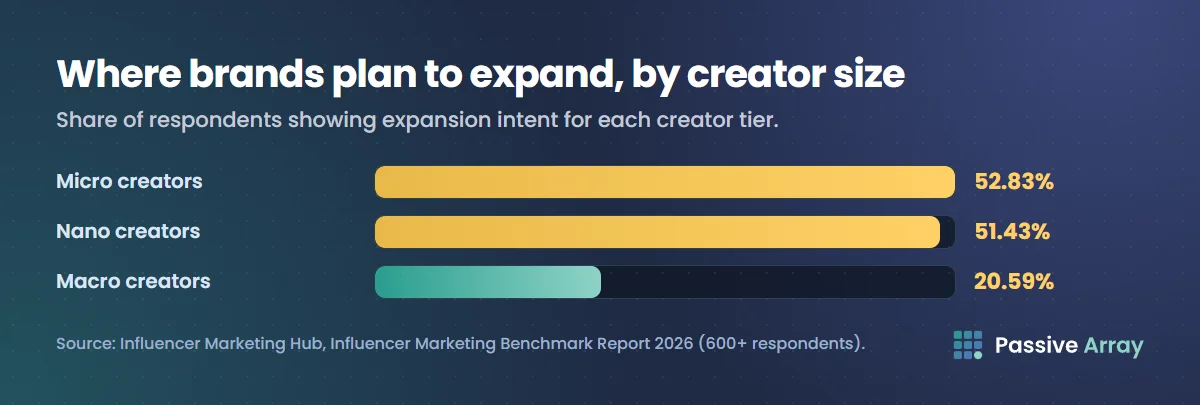
Influencer Marketing Hub's 2026 report found 51.43% of respondents showing expansion intent for nano creators and 52.83% for micro creators, against 20.59% for macro creators.
YouTube's Open Call, part of Creator Partnerships, points the same way. Brands post sponsored opportunities and invited creators submit videos. To take part, creators must be in the YouTube Partner Program, in the US, UK or India, with between 500 and 500,000 subscribers, and have posted a Short in the last 30 days. Participation is by invitation only.
What it means for you: a small brand can work with several smaller creators instead of one large one, and test which audiences buy. Smaller creators often answer their own email and price lower in total. The trade-off is more admin per view, which is why tracking each creator separately matters.
5. Measurement is the pressure point
The reports agree that proving results is the hard part. In Linqia's 2026 survey, 79% of enterprise marketers said they struggle to measure ROI, and 48% named attribution as the biggest gap. In IAB's 2025 report, 40% of buyers ranked overall ROI as their top KPI, and advanced attribution and consistent reporting were among the top areas buyers wanted improved. In Influencer Marketing Hub's 2026 report, promo and discount codes were the most used measurement tool, at 45.9%.
The platforms are responding with their own measurement. YouTube said in March 2026 that Brand Lift, Search Lift and Conversion Lift studies can now measure organic and paid creator content together.
What it means for you: platform lift studies need ad spend and are built for larger budgets. For a small brand, a unique code and a tagged link per creator still do most of the work. For awareness campaigns, the Earned Media Value Calculator turns impressions and engagement into one figure, so you can compare campaigns on the same scale. It is not revenue. Does influencer marketing work walks through a full measurement example.
6. Social commerce is growing, unevenly
Influencer Marketing Hub's 2026 report found that 53.33% of respondents were not using social commerce, while 46.67% planned to test it in 2026. Among those using it, TikTok Shop accounted for 66.17% of platform selections, followed by Instagram Checkout at 13.16% and YouTube Shopping at 9.02%.
What it means for you: if you sell physical products and your customers are on TikTok, shoppable creator content is worth testing. If not, a link and a code still work. Do not rebuild your store around a channel your customers do not use.
7. AI is in the workflow, not in front of the camera
Marketers report using AI for the back-office work, and caution about AI-made creators:
- Linqia's 2026 survey: 74% use AI to generate ideas, write briefs and streamline workflows, while 89% still avoid virtual influencers.
- IAB's 2025 report: nearly three in four creator ad buyers use or plan to use AI within a year, and 95% of advertisers have concerns about AI in creator marketing, led by loss of human connection.
- Influencer Marketing Hub's 2026 report: creator discovery is the top AI use, at 36.67%.
- YouTube's Open Call help page says videos with AI-generated visuals or made by AI creators may be automatically rejected.
What it means for you: use AI tools to draft briefs and sort long lists, but judge creators yourself. The value of a creator is a real person whose audience trusts them.
8. Disclosure is enforced by platforms as well as regulators
The disclosure rules themselves are not new, but enforcement is tighter and more automatic:
- YouTube's branded content policy says creators "must" declare paid promotion in Studio, and that if YouTube's systems detect undisclosed branded content, they may apply the label automatically.
- TikTok says creators who do not disclose commercial content get a notification and 24 hours to respond before the video becomes ineligible for the For You feed.
- The UK's ASA says its 2026 research found platform labels such as Instagram's Paid partnership may not be enough on their own, and that both brands and influencers are responsible for making ads obviously identifiable.
- The FTC's guidance in the US says a company is ultimately responsible for what others do on its behalf, and that a platform disclosure tool is no guarantee of an effective disclosure.
What it means for you: put disclosure in every brief: the platform tool switched on, plus a clear "Ad" in the content itself, upfront. Approve content before it goes live.
9. Fake engagement is now a legal risk, not only a waste
In August 2024 the FTC announced a final rule banning fake reviews and testimonials. It also bars selling or buying fake indicators of social media influence, such as followers or views generated by bots or hijacked accounts, when the buyer knew or should have known they were fake and used them to misrepresent influence for a commercial purpose. The FTC can seek civil penalties against knowing violators.
Meanwhile, fake audiences remain the main quality problem brands report: in Influencer Marketing Hub's 2026 report, fake or bot followers made up 56.5% of reported fraud or quality issues.
What it means for you: vet every creator before you pay. Check engagement against their size, comments against likes, and following against followers. How to spot fake followers explains the seven signals, and how to vet an influencer before you pay gives the full ten-minute routine. Never buy followers or engagement for your own brand accounts either.
What these trends mean for a small brand in 2026
Put together, the trends suggest a simple plan. This is our recommendation, not a finding from the reports.
- Search by audience, on more than one tool. Use the platforms' marketplaces where you have access, and free searches for creators outside them.
- Favour several smaller creators for a first test, chosen for audience fit and recent reach.
- Price from data. Use average views on YouTube and engagement-adjusted rates on Instagram and TikTok, and treat calculator results as estimates.
- Negotiate usage rights upfront, because you will probably want to run the best content as ads.
- Track each creator separately with a code and a link, and decide what to repeat based on cost per result.
- Make disclosure a contract term, with content approval before posting.
- Vet for fake engagement every time, even when a marketplace recommends the creator.
What we are not saying
You will find many "influencer marketing predictions for 2026" with exact market sizes and growth rates. We have left those out unless a named publisher measured or projected them in a report we could open. Where a figure is a projection, such as the IAB's 2025 spend estimate, we say so. Influencer rates for 2026 vary too much by niche, country and format for one honest table, which is why we point to calculators that show a range for a specific creator.
Sources
- IAB: Creator economy ad spend to reach $37 billion in 2025, 20 November 2025
- Linqia: 2026 State of Influencer Marketing Report
- Influencer Marketing Hub: Influencer Marketing Benchmark Report 2026, May 2026
- YouTube Official Blog: YouTube Creator Partnerships: a new era for brand and creator collaborations, 23 March 2026
- YouTube Help: Partner with brands through Open Call
- YouTube Help: YouTube branded content policy
- TikTok for Business: TikTok One, an all-in-one creative platform, 13 May 2026
- TikTok Ads Help: About the commercial content disclosure setting for creators
- Meta for Business: Meta at IAB NewFronts 2025, 8 May 2025
- ASA: Recognising ads: Social media and influencer marketing
- FTC: FTC's Endorsement Guides: What People Are Asking
- FTC: Final rule banning fake reviews and testimonials, 14 August 2024
Frequently asked questions
What are the key influencer marketing statistics for 2026?
From named reports: the IAB projected US creator ad spend at $37 billion for 2025, up 26%. Linqia's 2026 survey found 62% of enterprise marketers increasing budgets and 79% struggling to measure ROI. Influencer Marketing Hub's 2026 report found 87.49% of respondents expecting budget increases. Each is that publisher's own survey or estimate.
Is influencer marketing still growing in 2026?
The reports we opened say budgets are still rising. The IAB's November 2025 report put US creator ad spend growth at 26% for 2025, about four times faster than the media industry overall, and 2026 surveys from Linqia and Influencer Marketing Hub found most respondents planning increases.
What are influencer marketing rates in 2026?
There is no single honest rate table, because rates depend on recent reach, engagement, niche, audience country and format. A common method prices YouTube deals on average views times a sponsorship CPM and Instagram deals per 1,000 followers adjusted for engagement. Our calculators give a range for a specific creator.
What do the statistics say about influencer marketing ROI?
The reports focus on how hard ROI is to measure rather than on one ROI figure. Linqia's 2026 survey found 79% of enterprise marketers struggle to measure it and 48% see attribution as the biggest gap. Be careful with any "return per dollar" figure that does not name a publisher and method.
Do people trust influencers?
The figures available come mostly from the platforms themselves. YouTube says 78% of viewers say YouTube has the most trusted creators for product recommendations, from its own research. Treat platform-published trust figures as marketing claims and judge trust per creator by reading their comments.
What are the influencer marketing rules in the UK?
The ASA and CMA expect paid and affiliate content to be obviously identifiable as advertising, usually with an "Ad" label placed upfront. "Sponsored", "gifted" and abbreviations are discouraged, and platform labels may not be enough on their own. Both the brand and the influencer are responsible.
How should a small brand plan its influencer budget in 2026?
Start with a small test across three to five creators, chosen for audience fit and priced from recent reach. Keep part of the budget for usage rights or paid amplification of the content that performs. Measure cost per result for each creator, then move the budget to whoever delivered.