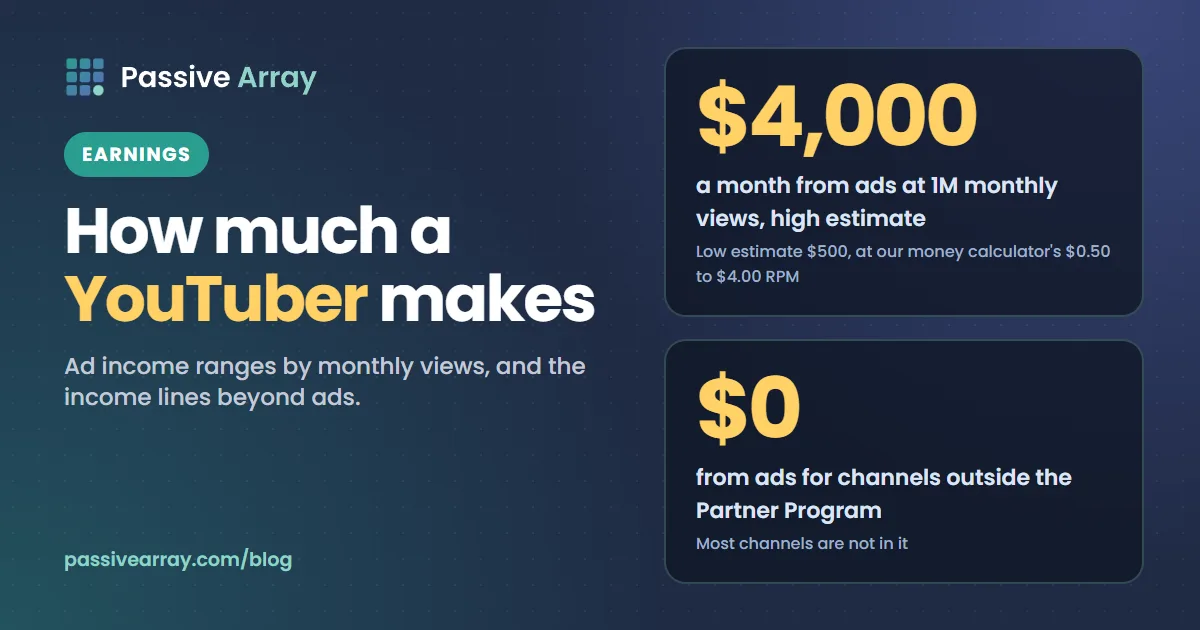
A YouTuber's ad income comes down to one formula: monthly views, divided by 1,000, multiplied by RPM. For long-form channels RPM usually falls between $0.50 and $4.00, so a channel with 100,000 monthly views earns roughly $50 to $400 a month from ads, and a channel with 1 million monthly views roughly $500 to $4,000. Sponsorships, memberships and products often add more than ads do.
There is no "average YouTuber salary". YouTube does not publish one, and most channels earn nothing because they are not in the Partner Program. What there is, is the formula, and you can apply it to any channel.
Ad income by monthly views
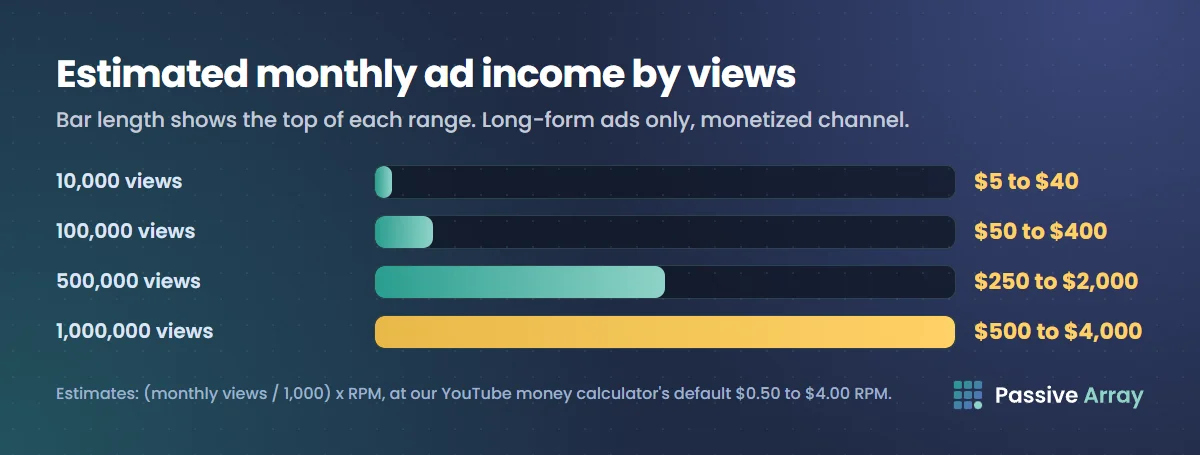
Using the default RPM range in our YouTube money calculator:
| Monthly views | Per month | Per year |
|---|---|---|
| 10,000 | $5 to $40 | $60 to $480 |
| 100,000 | $50 to $400 | $600 to $4,800 |
| 500,000 | $250 to $2,000 | $3,000 to $24,000 |
| 1,000,000 | $500 to $4,000 | $6,000 to $48,000 |
| 10,000,000 | $5,000 to $40,000 | $60,000 to $480,000 |
These are ad revenue only, for long-form videos, on a monetized channel. Channels in high-paying niches such as finance can earn several times the top of each range. Channels whose views are mostly Shorts earn far below the bottom.
Why subscribers do not decide pay
YouTube pays for views, not subscribers. A channel with 1 million subscribers that gets 50,000 views a month earns less than a channel with 50,000 subscribers that gets 2 million. The number to look at is recent monthly views. Our guide to views per subscriber shows how far apart the two can drift.
What moves a YouTuber up or down the range
- Audience country. Viewers in the US, UK, Canada and Australia are worth several times more to advertisers than viewers in most other markets.
- Niche. Finance, software and insurance pay far more per view than gaming, music or entertainment. See YouTube CPM by niche.
- Shorts share. Shorts are paid from a shared pool at a much lower rate per view.
- Video length. Videos of eight minutes or more can run mid-roll ads.
- Time of year. Ad rates peak in the last quarter and dip in January.
Income beyond ads
For many full-time YouTubers, ads are not the main income. The other lines:
- Sponsorships. A brand pays for a mention or integration, usually priced on the video's average views. For channels above roughly 50,000 views per video this often earns more per video than a month of ads. The sponsorship price calculator estimates a fair rate.
- Channel memberships, Super Chat and Super Thanks. Viewers pay the creator directly through YouTube.
- Affiliate links. A commission when viewers buy a product through the creator's link.
- Products and courses. Merchandise, digital products and courses sold to the audience.
- YouTube Premium revenue. A share of Premium subscription revenue based on how long Premium members watch the creator's videos.

Gross is not take-home
The figures above are what YouTube pays out. A creator then pays tax, editing, equipment, software and sometimes a manager or network share. A channel earning $4,000 a month from ads may keep much less once it pays an editor. How YouTube pays you covers payment timing and tax withholding.
Check a specific channel
- Confirm it is monetized with the monetization checker. If not, its ad income is zero.
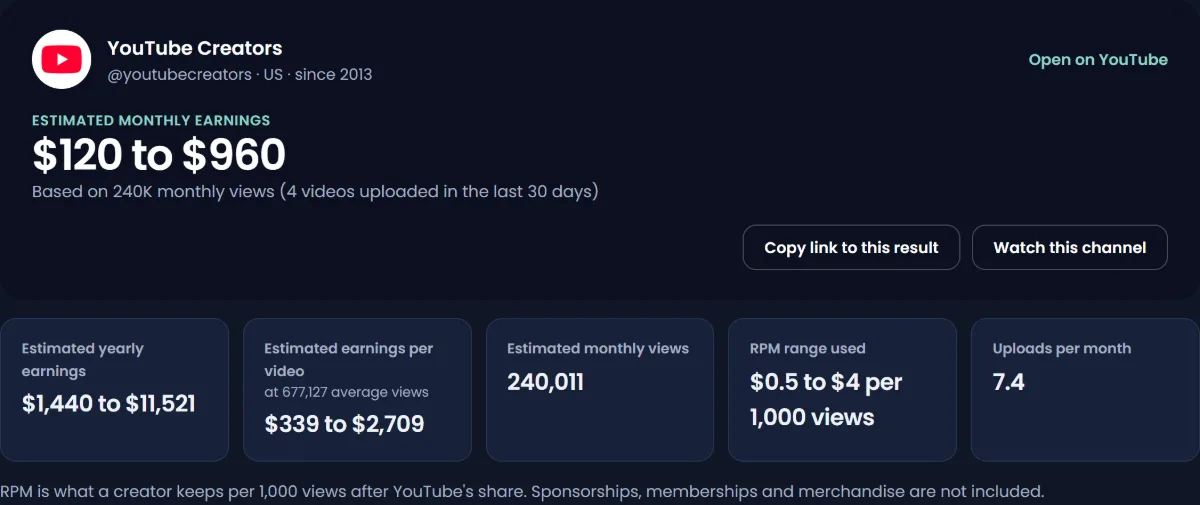
- Run it through the YouTube money calculator, which reads the last 30 days of views from the official YouTube API and applies an RPM range you can edit.
- Read the result as a bracket. Only the creator's own YouTube Studio shows the real figure.
For the same arithmetic on single videos, see how much YouTube pays for 1 million views.