A million views sounds like it should come with a fixed price. It does not. YouTube pays per thousand views at a rate called RPM, and that rate varies several times over between channels. So the honest answer is a range, and the useful part is knowing where in it a channel lands.
The short answer
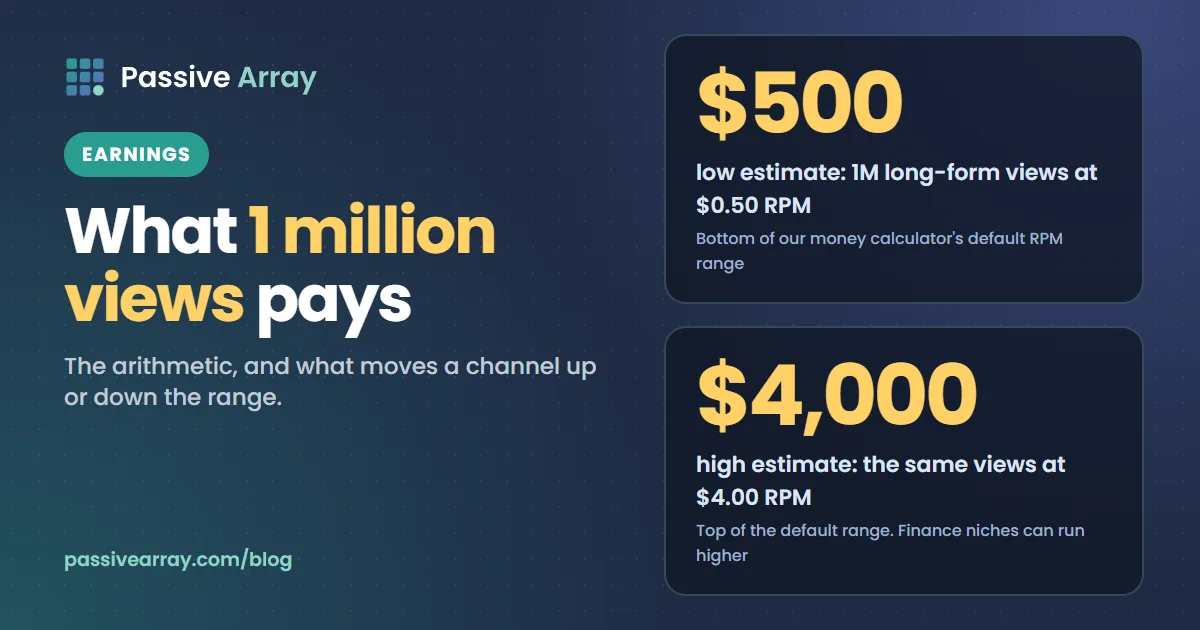
For long-form videos on a channel in the YouTube Partner Program, one million views usually earns somewhere between $500 and $4,000 in ad revenue. That is the range our YouTube money calculator uses by default.
For Shorts, the same million views earns a small fraction of that. And for a channel that is not monetized, a million views earns nothing from YouTube at all.
The arithmetic
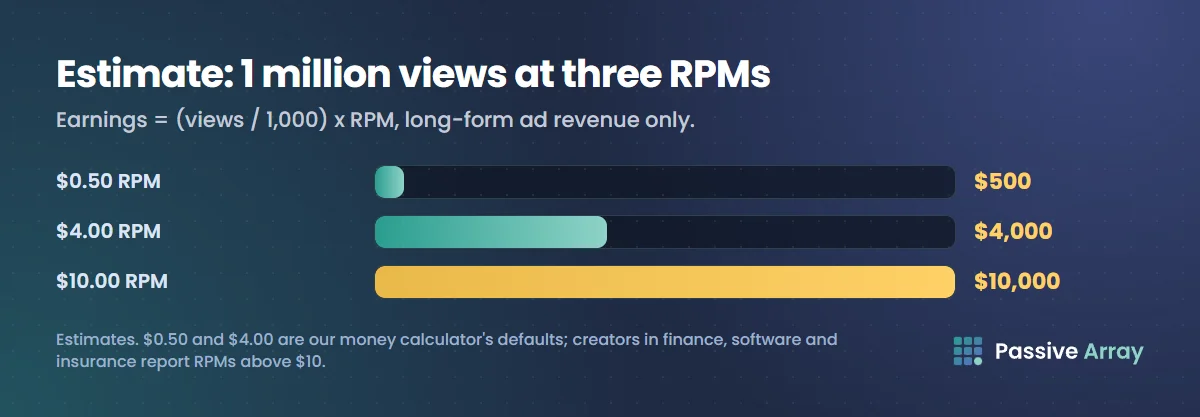
Earnings = (views / 1,000) x RPM
RPM is revenue per thousand views, after YouTube's share and after counting the views that showed no ad. It is the only rate that matters to the creator. The defaults on this site are $0.50 at the low end and $4.00 at the high end.
| Views | Low ($0.50 RPM) | High ($4.00 RPM) |
|---|---|---|
| 1,000,000 | $500 | $4,000 |
| 2,000,000 | $1,000 | $8,000 |
| 5,000,000 | $2,500 | $20,000 |
| 10,000,000 | $5,000 | $40,000 |
Some niches sit well above the high default. Personal finance, business software and insurance attract advertisers who pay far more per impression, and creators in those niches regularly report RPMs above $10. At $10, a million views is $10,000. If that is your niche, raise the high RPM in the calculator and the range moves with it. Why your RPM is low covers the other direction.
What decides where you land
Where the audience lives. Advertisers pay most to reach viewers in the US, UK, Canada and Australia. The same million views from a mostly Indian or Brazilian audience earns a fraction of what it would from a mostly American one. This is the biggest single factor.
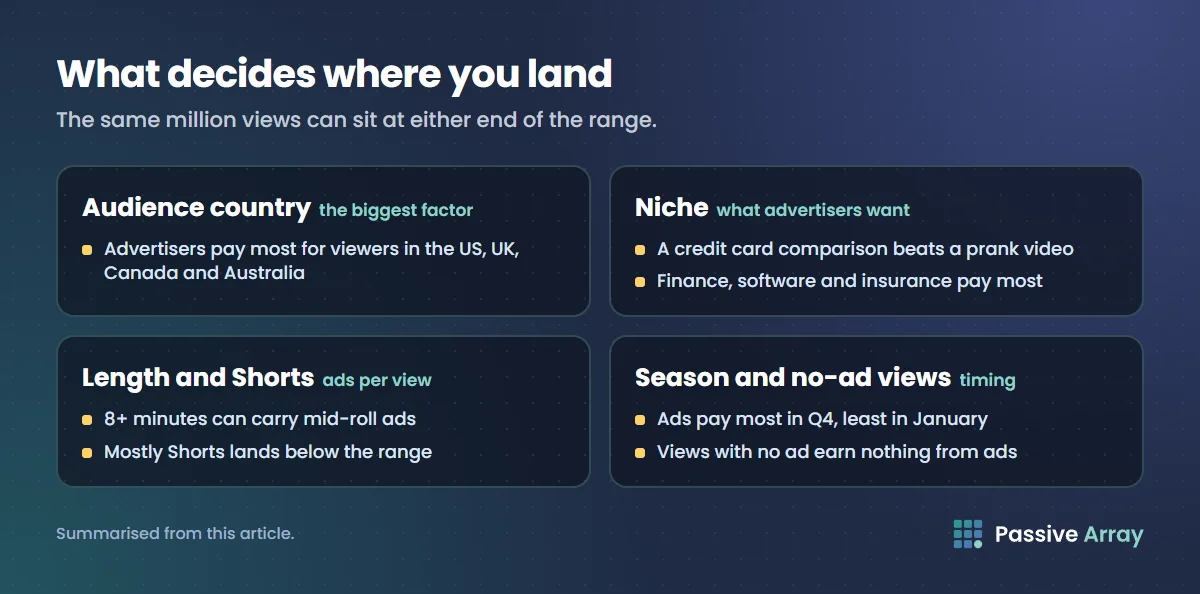
The niche. A million views on a credit card comparison and a million views on a prank video are not worth the same to an advertiser.
Video length. Videos of eight minutes or longer can carry mid-roll ads. A long video with two mid-rolls shows more ads per view than a five-minute one.
Shorts share. Shorts are paid from a shared pool, not per ad on your video, and the per-view figure is far lower. A channel whose million views are mostly Shorts lands below the bottom of this table. How YouTube pays for Shorts explains the pool.
Time of year. Advertisers spend most in the last quarter of the year and least in January, so the same views are worth more in November than in February.
Ad blockers and premium viewers. Views with no ad shown earn nothing from ads. YouTube Premium viewers earn a share of Premium revenue instead, based on watch time.
A million views on one video versus a channel
The table works the same way whether the million views came from one viral video or from fifty smaller ones. In practice, viral videos often earn toward the bottom of the range, because they reach a broader, more international audience than a channel's regulars. A steady catalogue watched by a core audience in high-paying countries usually earns more per view.
A million views is often worth more in sponsorship
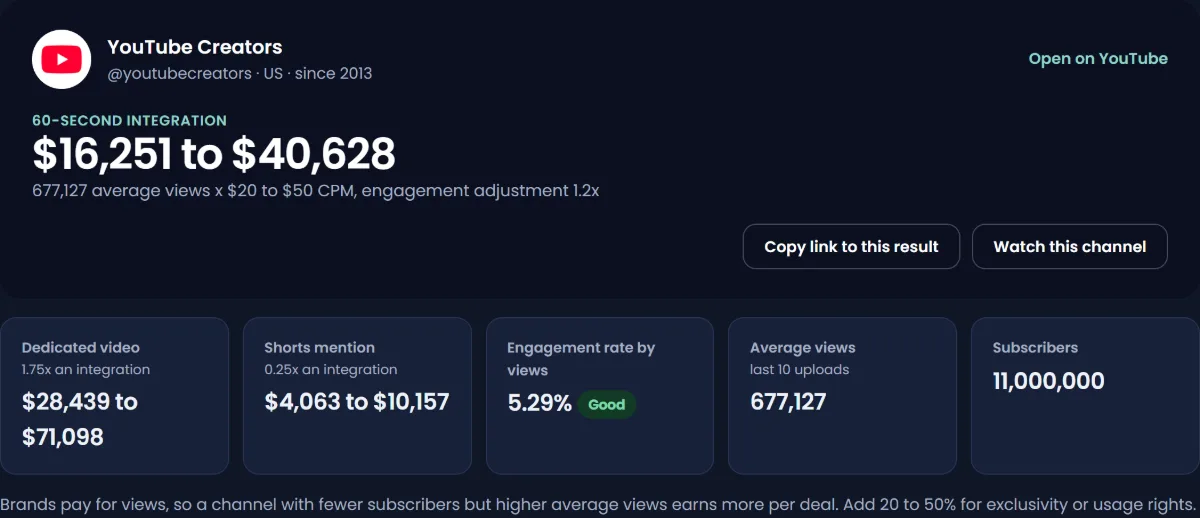
Ad revenue is usually not the biggest line for a channel at this scale. A brand paying for an integrated read prices it on the video's expected views at a much higher rate than ad RPM. A channel averaging 100,000 views per video can often charge more for one integration than it earns from ads on a million views. The sponsorship price calculator shows the range.
Before you estimate anyone's earnings
- Check the channel earns from ads at all with the monetization checker. A channel outside the Partner Program earns nothing from views.
- Look at the Shorts share of recent uploads. If it is high, read the bottom of the range.
- Treat the result as a bracket. Only the creator's own YouTube Studio shows the real figure, and every site estimating it, including this one, is working from public views.
To run the numbers on a real channel, paste it into the YouTube money calculator. It takes the last 30 days of views from the official API and applies the same RPM range, which you can edit.