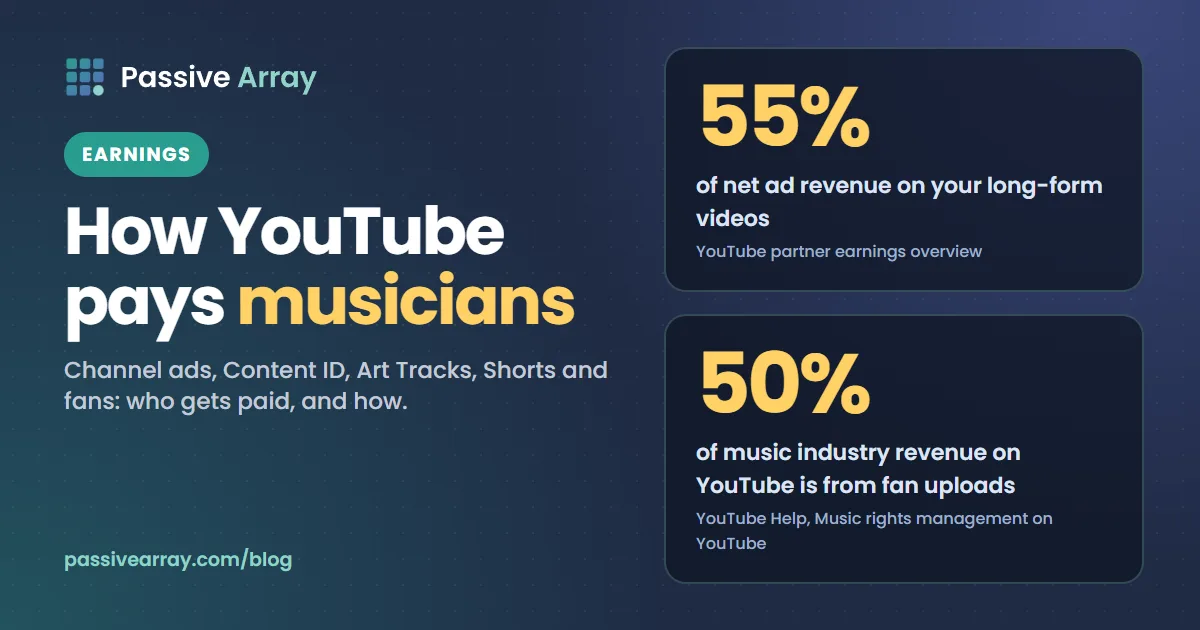
YouTube does not pay musicians a fixed rate per stream, and it does not publish one. A music artist earns from several separate streams: ad revenue on their own channel's videos, Content ID revenue when other people's uploads use their recordings, Art Tracks delivered by a distributor, a share of Shorts revenue set aside for music, and fan funding such as Super Thanks and merch. How much reaches you depends on which of those you have switched on, and on who sits between you and YouTube.
This guide maps each stream, who takes a cut, and how to put a realistic number on it. For your own channel's ad income, the YouTube money calculator gives an estimate from recent views, always as a range.
The ways musicians get paid on YouTube
YouTube's artist resources and Help Center describe the money in a few distinct routes. Most artists use more than one.
| Stream | Where it comes from | Who receives it first |
|---|---|---|
| Ads on your own channel | Ads shown on your public videos, through the Partner Program | You via AdSense, or your content owner |
| Content ID | Ads on other people's videos that use your recording | The rights owner: label, distributor or you |
| Art Tracks and Topic channel | Auto-generated versions of your released tracks | Your label or distributor |
| Shorts music share | Part of the Shorts revenue pool reserved for music licensing | Music rights holders |
| YouTube Premium | Premium members watching your content | Shared with partners and rights holders |
| Supers and memberships | Fans paying through Super Chat, Super Stickers, Super Thanks or memberships | You, through the Partner Program |
| Shopping and tickets | Merch tagged in videos, concerts promoted on your channel | You, through your store or ticketing partner |
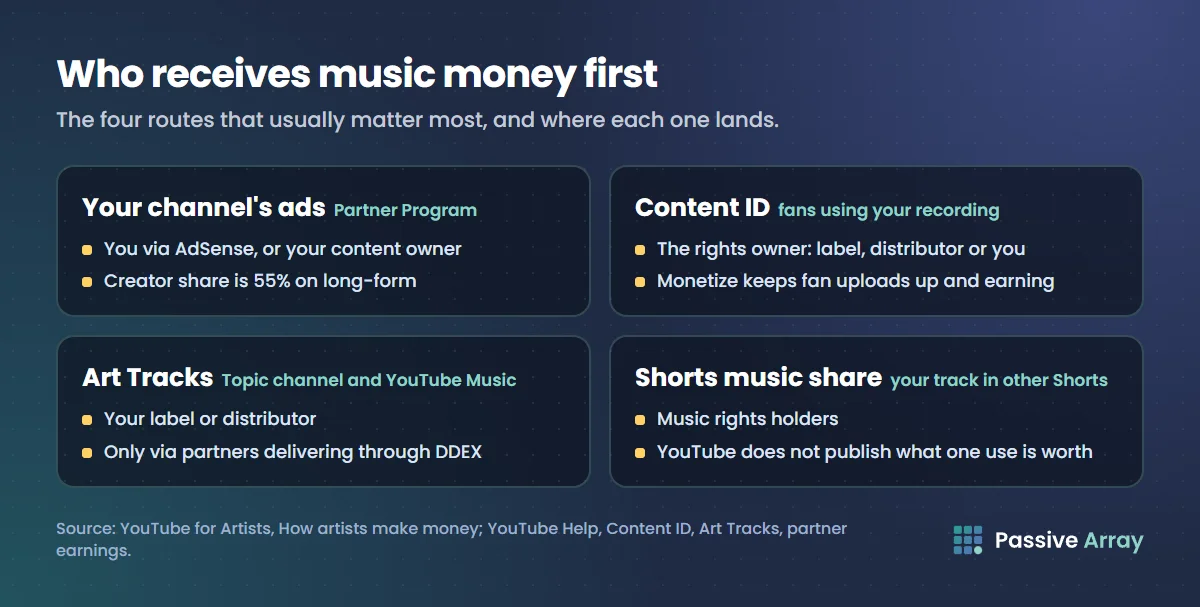
The first two usually matter most. They are also the two most often confused, so they get their own sections below.
Who actually gets paid: the recording and the song
Every piece of recorded music on YouTube has two sets of rights, and YouTube's music rights page treats them separately.
- The master recording is the specific recorded version of a song. YouTube says the record label that recorded it holds the rights to its use, and when the master is used in a video, the label "is paid royalties for their ownership of the recording, which they share with the artist." If you are independent and release through a distributor, you are effectively in the label's position.
- The composition is the underlying song: melody and lyrics. Public performance royalties for it are collected by performing rights organizations and collecting societies, which pay songwriters and publishers. Other composition rights are controlled by publishers.
So a single view of a music video can generate money for the recording owner and, separately, for the songwriter and publisher. If you wrote and recorded the song yourself, you may be owed on both sides, but only if you are registered with the organizations that collect each one.
Route 1: ads on your own channel
If you upload your own music videos, lyric videos, live sessions or behind-the-scenes content, your channel can earn ad revenue like any other. The rules are the standard Partner Program ones. YouTube's artist monetization page lists them:
- Shopping and Supers: 500 subscribers, 3 uploads in the past 90 days, and either 3,000 valid public watch hours in the past 12 months or 3 million valid public Shorts views in the past 90 days.
- Ads and YouTube Premium revenue: 1,000 subscribers and either 4,000 valid public watch hours in the past 12 months or 10 million valid public Shorts views in the past 90 days.
From 1 February 2027, YouTube's changes page raises the ad tier for new applicants to 8,000 qualified watch hours in the last 365 days or 20 million qualified Shorts views in the last 90 days. Channels already in the program keep their status. Our guide to YouTube monetization requirements covers the full list, including the rules that are not numbers.
On long-form videos, YouTube's partner earnings page gives the creator 55% of net ad revenue. Where that 55% goes depends on your setup. YouTube for Artists explains it simply: with a content owner, such as a label or distributor that manages your channel's rights, "Revenue from YouTube goes to the content owner to decide how to distribute earnings." Without one, "YouTube revenue will go directly to an artist or channel owner via Google AdSense."
How much do music videos earn per view?
YouTube does not publish RPM by genre or by category. What is known is how RPM works: it is your revenue per 1,000 views after YouTube's share, across every view, including the ones that showed no ad. Our calculator's default range is $0.50 to $4.00 per 1,000 views, an editorial assumption, and it places music near the low end. Advertisers generally pay more to reach viewers researching purchases, such as finance or software, than viewers listening to songs. YouTube CPM by niche explains why topics pay so differently.
Two more things push music RPM down:
- Short running times. YouTube only allows mid-roll ads on monetized videos of 8 minutes or longer. Most songs are shorter, so most music videos can only carry ads before or after the video. YouTube for Artists itself suggests mid-rolls for "non-music, shoulder content over 8 minutes", meaning interviews, documentaries and long live sets.
- Repeat listening on other surfaces. Some listening happens through YouTube Premium or YouTube Music, which is paid differently from ad views.
A worked example
Say an independent artist's channel gets 200,000 views a month across its music videos and is in the Partner Program with no content owner. This is an example, not real data.
- Low estimate: 200,000 / 1,000 x $0.50 = $100 a month.
- High estimate: 200,000 / 1,000 x $4.00 = $800 a month.
- Likely position: for music, nearer the low half than the high half, unless the audience is concentrated in high-paying ad markets.
If the same channel's rights were managed by a label or distributor, the money would arrive with them first, and you would receive what your contract says. If you want to see what that channel would be worth as an asset, the channel value calculator multiplies estimated yearly ad earnings by the number of years you choose.
Route 2: Content ID, when other people use your music
This is where many artists earn the most, and where many lose money they never knew existed. Content ID scans uploads against a database of files submitted by rights owners. When it finds a match, it makes a claim, and the rights owner chooses what happens. YouTube's Content ID page lists three actions:
- Block the video from being viewed.
- Monetize it, "by running ads against it and sometimes sharing revenue with the uploader."
- Track the video's viewership statistics.
The action can differ by country. For musicians the important one is Monetize: every fan cover, dance video, vlog or lyric upload that uses your recording can send its ad money to you or your rights holder. YouTube's music rights page says rights holders have licensing agreements that let this kind of fan content stay up while they earn from it, and states that fan-uploaded content accounts for 50 percent of music industry revenue on YouTube.
You cannot usually join Content ID directly as a small artist. YouTube limits it to rights owners who "own exclusive rights to a substantial body of original material that is frequently uploaded to YouTube." Independent artists get in through a distributor or label that has access. Copyright claim vs copyright strike explains what a claim does to the uploader's video, which helps if fans ask why your claim appeared on their upload.
Ask your distributor about your own channel
If your recordings are in Content ID, your own uploads of those recordings can match too. Before you release, ask your distributor how it handles claims on your official channel, so your own videos are not claimed by your own rights management. This is a setup question, not a policy rule, and each distributor handles it in its own way.
Route 3: Art Tracks, Topic channels and distributors
When your release is delivered to YouTube by a label or distributor, YouTube can create Art Tracks: automatically generated versions of each album track, made from the sound recording and the album art. These typically appear on your auto-generated Topic channel and on YouTube Music.
You do not upload Art Tracks yourself. YouTube says they are limited to label and distributor partners that deliver music through its DDEX feed. That makes your choice of distributor a money decision:
- Fees: YouTube's aggregator page says distributors "typically charge a flat fee or keep a percentage of royalties", and that "these royalty rates can vary based on the aggregator". Compare before signing.
- Preferred Distributors: YouTube's top tier of distributors must offer content delivery and management for YouTube, including Art Track delivery and Content ID rights management, and must give clients usage and revenue reporting for YouTube and YouTube Music.
- Reporting: your earnings from Art Tracks and Content ID come through the distributor's reports, not through YouTube Studio.
Route 4: the music share of Shorts revenue
When creators use your track in their Shorts, part of the Shorts revenue goes to music licensing. YouTube's Shorts monetization page explains the split for each Short's share of the pool:
| Music in the Short | Share to the Creator Pool | Share to music licensing |
|---|---|---|
| No music | All of it | None |
| One track | Half | Half |
| Two tracks | One third | Two thirds |
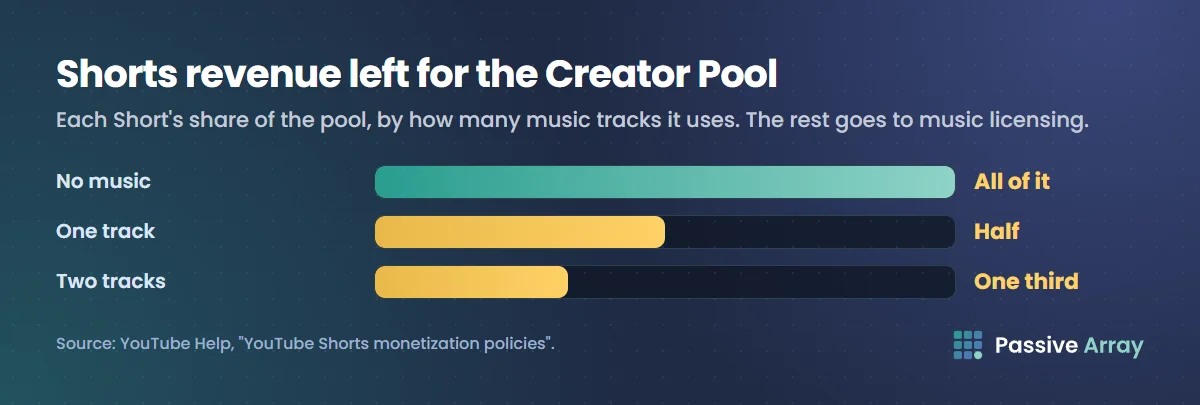
The music share is paid to rights holders under YouTube's music agreements. YouTube does not publish how much a single use is worth, so treat Shorts as exposure first and income second. A song that takes off as a Shorts sound can pull listeners to your full videos and Art Tracks, which is where the ad money is larger.
If you post your own Shorts, the same rules apply to you as a creator: you keep 45% of the revenue allocated to you, and using your own original audio keeps more of the pool on the Creator Pool side. Our guide to Shorts monetization covers the module and the 2027 changes.
Route 5: fans, merch and tickets
Non-ad income is often steadier for artists than ad rates. YouTube for Artists lists:
- Supers: Super Chat during premieres and live streams, Super Stickers and Super Thanks on videos.
- Shopping: connect your online store to your channel and tag merch in videos. YouTube notes that merch setup requires Partner Program enrollment, even for artists with a content owner.
- Concert tickets: link a Bandsintown account to promote shows. YouTube says this is only available for Official Artist Channels.
- Channel memberships: YouTube's memberships page says channels must not have a significant number of ineligible videos, and counts videos with music claims as ineligible. A music channel whose uploads are mostly claimed may not qualify.
Should you get an Official Artist Channel?
An Official Artist Channel merges your existing channel, your Topic channel and your Vevo channel, if you have one, into a single channel with combined subscribers. YouTube's requirements:
- One channel for one artist or band, focused on your music.
- At least one official music release on YouTube, delivered by a music distributor or label.
- Following all YouTube policies, including copyright.
- At least one of: working with a YouTube Partner Manager, being in the Partner Program, being in a label network that works with a Partner Manager, or having your music distributed by a listed music partner.
The channel itself does not raise your RPM. It matters because it gives you artist features such as ticketing, gathers your audience in one place, and gives you Artist Analytics for your music across YouTube.
Music channel rules that block monetization
If you run a channel that uploads music rather than makes it, the monetization policies are strict. YouTube's reused content section lists these as not monetizable:
- "Collections of songs from different artists (even if you have their permission)"
- "Songs modified to change the pitch or speed, but are otherwise identical to the original song"
- "Promotion of other people's content (even if you have permission)"
That rules out most compilation, slowed or sped-up, and "nightcore"-style channels, even when the uploader has permission. If your channel is built on other artists' recordings, the money from those views goes to the rights owners through Content ID, not to you.
How to set up your music for the most YouTube income
- Release through a distributor that delivers to YouTube. Check whether it offers Art Tracks and Content ID, what it charges, and how it reports YouTube income.
- Register your songs as a writer. Join the performing rights organization in your country so composition royalties can reach you.
- Build your own channel's catalogue. Official videos, live sessions, acoustic versions and longer behind-the-scenes content give the channel its own ad income. Longer non-music content can carry mid-roll ads.
- Apply for the Official Artist Channel once you have an official release.
- Join the Partner Program when you qualify. Even with a content owner, YouTube says you may need it to set up merch and Supers. Check where you stand in YouTube Studio > Earn.
- Make your songs easy to use in Shorts. Each use spreads the track and can generate music licensing revenue for the rights holder.
- Track what grows. Daily public views and subscribers show which releases are pulling people to the channel. The growth tracker charts that for any channel.
For the content and promotion side, our guide to growing a music YouTube channel goes further.
How to estimate what a music channel earns
For any channel, yours or another artist's, start by checking that it is in the Partner Program. The monetization checker reads public signals and returns a confidence score. Then run the money calculator and set the RPM range towards the low end for a music audience. The result estimates ad income on the channel's own uploads only. It cannot see Content ID income from fan uploads, Art Tracks, Premium, Shorts music licensing or distributor fees, which is why no public tool can tell you what an artist really earns from YouTube.
Once you are monetized, what YouTube pays after monetization explains the first-payment timeline and the $100 payout threshold.
Sources
- YouTube for Artists: How artists make money on YouTube
- YouTube Help: Music rights management on YouTube
- YouTube Help: How Content ID works
- YouTube Help: Music aggregators
- YouTube Help: What is an Art Track?
- YouTube Help: Official Artist Channels
- YouTube Help: YouTube Shorts monetization policies
- YouTube Help: YouTube partner earnings overview
- YouTube Help: Changes to the YouTube Partner Program
- YouTube Help: Channel memberships eligibility
- YouTube Help: Manage mid-roll ad breaks in long videos
- YouTube Help: YouTube channel monetization policies
Frequently asked questions
How much does YouTube pay music artists per stream?
YouTube does not publish a per-stream rate for music. Artists earn from ad revenue on their own channel, Content ID on other people's uploads, Art Tracks, Premium and the music share of Shorts, and each pays differently. For your own channel's ad views, our calculator's default range of $0.50 to $4 per 1,000 views applies, with music usually near the low end.
What are the YouTube music monetization requirements?
The same Partner Program rules as any channel: 1,000 subscribers plus 4,000 public watch hours in 12 months or 10 million public Shorts views in 90 days for ad revenue. The lower tier for Supers and Shopping needs 500 subscribers, 3 uploads in 90 days, and 3,000 watch hours or 3 million Shorts views. New applicants from 1 February 2027 need 8,000 hours or 20 million Shorts views for the ad tier.
Can you monetize Shorts that use music?
Yes, if your channel is in the Partner Program and has accepted the Shorts Monetization Module. A Short with one licensed track sends half of its revenue to music licensing and half to the Creator Pool, and you keep 45% of what is allocated to you. Original audio keeps the whole share in the Creator Pool.
Do artists get paid when fans use their songs on YouTube?
Often, yes, if the recording is in Content ID. The rights owner can choose to monetize matching videos, which runs ads on them and sends the revenue to the rights owner. Independent artists usually get Content ID through a distributor or label.
What is the RPM for music on YouTube?
YouTube does not publish RPM by genre. Music tends to sit near the low end of the range because advertisers pay less to reach listeners than buyers, and most songs are shorter than the 8 minutes needed for mid-roll ads. Your own RPM is in YouTube Studio under Analytics > Revenue.
Can a music compilation channel be monetized?
Generally not. YouTube's reused content policy lists collections of songs from different artists, even with permission, and songs changed only in pitch or speed as not monetizable. Views on those uploads earn money for the rights owners through Content ID instead.
Do I need a distributor to earn from music on YouTube?
Not for your own channel's ad revenue, which you can earn through the Partner Program and AdSense. You do need a label or distributor for Art Tracks, Content ID and an Official Artist Channel. Distributors charge a flat fee or a percentage of royalties, so compare them before choosing.
By Nasir Uddin, founder of Passive Array. Rules and figures checked Nov 1, 2026.