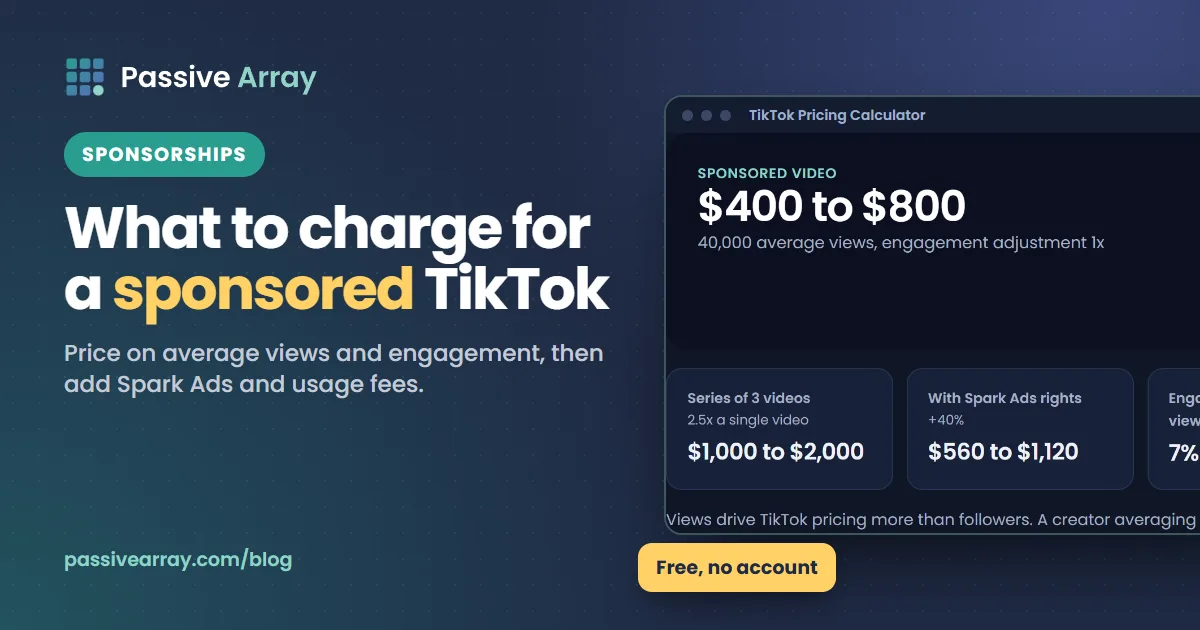
Charge for a sponsored TikTok on your average views per video, not your followers. A defensible starting range is $10 to $20 per 1,000 average views, adjusted up or down for your engagement rate, with extra fees for Spark Ads rights, usage rights and exclusivity. A creator averaging 40,000 views a video with average engagement lands at roughly $400 to $800 for one sponsored video.
The TikTok pricing calculator runs that method from three numbers: followers, average views and engagement rate by views. It returns a price for one video, a series of three and a version with Spark Ads rights. This guide explains each step, so you can defend the number on a call, and shows what published market ranges say for comparison.
Why views, not followers, set the price on TikTok
On TikTok the For You feed decides who sees each video. A large follower count says little about how many people your next video will reach. A creator with 500,000 followers whose videos now get 20,000 views is a 20,000-view creator to a brand. A creator with 40,000 followers averaging 150,000 views is worth more.
Brands know this. They pay for attention, so price the way they buy. It is the same logic we use for pricing a sponsored YouTube video on average views. Instagram is the exception that still prices mainly on followers, as our guide to what to charge for a sponsored Instagram post explains, because reach there follows the follower base more closely.
Use typical views, not your best ones
Average the views of your last 12 videos and leave out a single viral hit. If one video got 2 million views and the rest got 30,000, your price is a 30,000-view price. A brand pays for what the next video is likely to do, and an inflated average leads to an awkward conversation after the campaign. If your views are very uneven, use the median instead of the average.
The formula
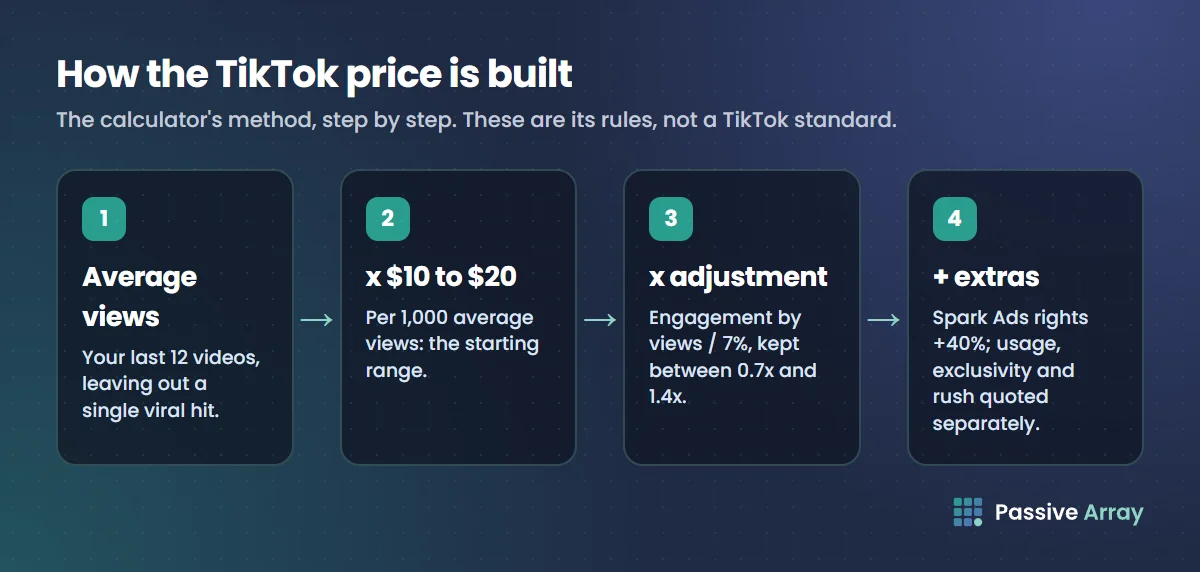
Price per sponsored video = average views / 1,000 x $10 to $20 x engagement adjustment
The engagement adjustment is your engagement rate by views divided by 7%, kept between 0.7x and 1.4x:
- At 7% engagement by views, the price stays as it is (1.0x).
- At 4.9% or below, the price is cut by 30% (0.7x).
- At 9.8% or above, the price rises by 40% (1.4x). Higher engagement adds nothing more.
These are the calculator's rules, not a TikTok rule or an industry standard. They exist so that two creators with the same views but very different audiences do not get the same price.
A worked example
Say a creator averages 40,000 views a video. This is an example, not a real account.
| Engagement by views | Adjustment | One video | Series of 3 | With Spark Ads rights |
|---|---|---|---|---|
| 3.5% (Below average) | 0.7x | $280 to $560 | $700 to $1,400 | $392 to $784 |
| 7% (Average) | 1.0x | $400 to $800 | $1,000 to $2,000 | $560 to $1,120 |
| 12% (Good) | 1.4x | $560 to $1,120 | $1,400 to $2,800 | $784 to $1,568 |
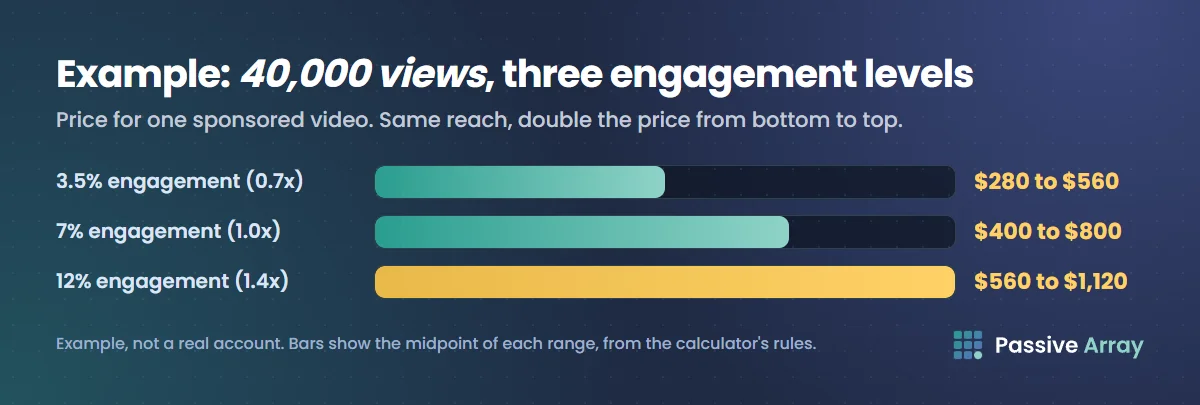
Same reach, double the price from the bottom row to the top. Engagement is the main thing a creator can change in a few weeks, which is why it is worth working on before you raise your rates.
How to calculate your TikTok engagement rate
TikTok shows views, likes, comments and shares on each video, but not one engagement rate for the account. Work it out yourself:
Engagement rate by views = (likes + comments + shares) / views x 100
- Open your last 12 videos.
- Write down views, likes, comments and shares for each.
- Add each column up.
- Divide total likes + comments + shares by total views and multiply by 100.
The TikTok engagement rate calculator does the sum and shows the rate by views and by followers. Use the rate by views in the pricing calculator.
What is a good TikTok engagement rate?
The pricing calculator grades engagement by views like this:
| Engagement by views | Grade |
|---|---|
| Under 3% | Low |
| 3% to 5% | Below average |
| 5% to 9% | Average |
| 9% to 12% | Good |
| Over 12% | Excellent |
Many brand briefs still ask for engagement by followers. That rate falls as accounts grow, because a big follower base catches up with the reach. Our TikTok engagement rate benchmarks list the typical rate by followers for each size, from about 12% for accounts under 10,000 followers to about 4% above a million. Know both numbers before the call.
TikTok rates look much higher than Instagram's. That is normal, because TikTok shows videos to people who do not follow you. Do not compare a TikTok rate with an Instagram benchmark.
What published market rates say
Market rate tables can help you sanity-check your number, but treat them with care. Most do not publish how they were collected.
Influencer Marketing Hub's influencer rates page, last updated in October 2026, gives these TikTok ranges per video as its "2026 benchmarks":
| Tier (followers) | Influencer Marketing Hub range per video |
|---|---|
| Nano (1K to 10K) | $50 to $200 |
| Micro (10K to 100K) | $200 to $800 |
| Macro (100K to 1M) | $800 to $5,000 |
| Mega (1M+) | $5,000 to $50,000+ |
The page calls these "planning benchmarks, not fixed rate cards" and does not describe its method, sample size or data sources. The tiers are by followers, which on TikTok is a weak guide to reach. Use the table as a cross-check: if the views method gives you $600 and you are a micro creator, you are inside that range. If it gives you $3,000 as a micro creator because one video series is doing very well, you can defend that with your average views, but expect questions.
What the base price does not include
Quote these as separate line items. If you bundle them into one number, you lose them the moment a brand asks for a discount.
- Spark Ads rights. Spark Ads let a brand pay to promote your own post as an ad from your account. The calculator adds 40% to the single video price for these rights. Set an end date.
- Usage rights. The brand reuses your video in its own ads, website or other channels. Common practice is an extra 20% to 50% for a fixed period and fixed channels, the same as on Instagram and YouTube. Unlimited, permanent rights should cost multiples of the fee.
- Exclusivity. Not working with competitors for three or six months costs you future deals. Price it per month.
- Series discount. Three videos priced at 2.5 times one video is about 17% off per video. Bundles save you briefing and approval time, and they give the brand repetition, so a modest discount is fair.
- Production. Travel, props, extra people, a location or a brand-written script all add time. The base price assumes a normal creator-made video.
- Revisions and rush. Include one or two rounds of changes. Bill more. A two-day turnaround is a premium.
A sample quote
Say a creator averages 60,000 views with 8% engagement by views. The adjustment is 8 / 7 = about 1.14x, so one video comes to roughly $690 to $1,370. A quote could read:
- One sponsored video, one round of revisions: $700 to $1,350.
- Spark Ads rights for 60 days: add 40%.
- Usage on the brand's own channels for 3 months: add 30%.
- Category exclusivity for 3 months: priced separately on request.
A range tells the brand you understand the variables. A single number looks like a rule of thumb and invites a counter-offer.
What to do when a brand offers less
Low offers are normal, especially from brands new to creator marketing. Before you say yes or no, work through these in order:
- Ask what the budget covers. Many low offers assume Spark Ads rights or usage are included. Separate them, and the base fee often turns out closer to your range.
- Remove deliverables, not your rate. If the budget is fixed, offer one video instead of three, or drop the Spark Ads rights. Your rate per video stays the same, so the next brand sees the same price.
- Offer a shorter rights period. Thirty days of Spark Ads instead of 90 costs the brand less and keeps your price intact.
- Show the proof. Send your average views, engagement rate by views and audience countries. If your engagement is above average for your size, quote the figure. It is the strongest argument you have.
- Know your floor. Decide before the call the lowest fee you would accept for the work involved. Gifted products alone are fine for brands you would buy from anyway, but they are still branded content and still need disclosure.
If a brand offers a commission-only deal through an affiliate link or code, treat it as a test of sales, not a sponsorship. Ask for a flat fee plus commission when the brief needs a dedicated video from you.
How sponsored TikToks compare with Creator Rewards
For many mid-sized accounts, one sponsored video pays more than a month of Creator Rewards. The TikTok money calculator shows both side by side for your numbers. Also note that TikTok's support pages say sponsored content generally does not count as original content for the Creator Rewards Program, so a sponsored video earns its fee, not rewards. Our guide to the TikTok Creator Rewards Program explains what does qualify.
Disclose it: TikTok's branded content setting and the FTC
TikTok's Branded Content Policy says: "When posting branded content, you must enable the commercial content disclosure toggle." Branded content includes paid posts, gifted products and affiliate or promo-code commissions.
To turn it on when you post, per TikTok's Ads Help Center:
- Create your post and open Content disclosure and ads. If you are not part of TikTok One, open More options first.
- Turn on Disclose commercial content.
- Choose Branded content (for a third party) rather than Your brand (for your own business).
- Use Brand partnership to tag the partner. The authorisation period is 60 days by default.
- Save, tap Continue, and post.
The post then shows a Paid partnership label. For a post that is already live, open the post, then More options, then Ad settings, and follow the same steps. TikTok's Creator Academy warns that content without proper disclosure may not be eligible for the For You feed.
The FTC also says: "Don't assume that a platform's disclosure tool is good enough." In a video, the disclosure "should be in the video and not just in the description", and it is better said and shown. Add "ad" or "sponsored" on screen and say it near the start. Words like "spon" or "collab" are not clear enough.
TikTok's Branded Content Policy also lists products you cannot promote in branded content, including tobacco and nicotine, weapons, weight loss products and certain financial services. Check the brand's category before you agree a fee.
Before you send a quote: checklist
- Average views from your last 12 videos, without the outlier.
- Engagement rate by views and by followers.
- Your audience's top countries, age and gender, from TikTok Analytics.
- Two or three past results, with dates, if you have done deals before.
- The calculator's range for one video, a series and Spark Ads.
- A note of what is not included: usage, exclusivity, extra revisions.
Put the numbers in a one-page creator media kit. Brands that work with many creators check whether audiences are real, so expect them to look at your follower and view patterns the way our guide on vetting a creator before paying describes.
Mistakes that cost TikTok creators money
- Pricing on followers. On TikTok, average views are what a brand is buying.
- Using a viral average. Price on typical views. A disappointing campaign hurts the next deal more than a lower fee would.
- Giving away Spark Ads rights. They are worth money to the brand. Charge for them and set an end date.
- Skipping disclosure. It risks your reach on TikTok and puts you and the brand at risk with regulators.
- Inflating numbers. Bought followers or views lower your engagement rate and are easy for brands to spot. Our guide to spotting fake followers shows the signals, and the TikTok fake follower estimator runs them on any account.
- Undercharging the first deal. Your first rate becomes your reference rate. Start from the method, not from fear.
If your views are too low to price well yet, work on growth first. Our guide on how to grow on TikTok covers how the For You feed tests videos.
Sources
- TikTok: Branded Content Policy
- TikTok Ads Help Center: How to turn on the commercial content disclosure setting in TikTok
- TikTok Creator Academy: Create branded content
- TikTok Support: Creator Rewards Program
- FTC: Disclosures 101 for social media influencers
- Influencer Marketing Hub: Influencer rates, last updated October 2026
Frequently asked questions
How much do TikTok sponsors pay?
Using the views method, one sponsored video is worth about $10 to $20 per 1,000 average views, adjusted from 0.7x to 1.4x for engagement. A creator averaging 40,000 views at 7% engagement by views prices at $400 to $800. Influencer Marketing Hub's 2026 benchmarks put micro creators (10K to 100K followers) at $200 to $800 per video.
How is TikTok engagement rate calculated?
Add up likes, comments and shares on your last 12 videos, divide by their total views and multiply by 100. That is engagement by views. Divide by followers instead to get engagement by followers, which many brand briefs ask for.
What is a good engagement rate on TikTok?
By views, the pricing calculator treats 5% to 9% as average, 9% to 12% as good and over 12% as excellent. By followers, typical rates fall with size, from about 12% under 10,000 followers to about 4% above a million in our benchmarks.
Does TikTok show engagement rate?
TikTok shows views, likes, comments and shares on each video, and your own analytics show more detail, but it does not show one engagement rate for the account. Work it out from your last 12 videos or use a free engagement rate calculator.
How much should I charge with 10K followers on TikTok?
It depends on your views. If a 10K account averages 15,000 views at average engagement, the method gives about $150 to $300 a video. If its videos average 80,000 views, the same account can quote $800 to $1,600.
Should I charge extra for Spark Ads?
Yes. Spark Ads let the brand run your post as a paid ad from your account, which is worth more to them than a normal post. The pricing calculator adds 40% to the single video price, and you should always set an end date for the authorisation.
Do I have to use TikTok's branded content toggle?
Yes. TikTok's Branded Content Policy says you must turn on the commercial content disclosure setting for branded content, which adds a Paid partnership label. The FTC also expects a clear spoken or on-screen disclosure in the video itself.