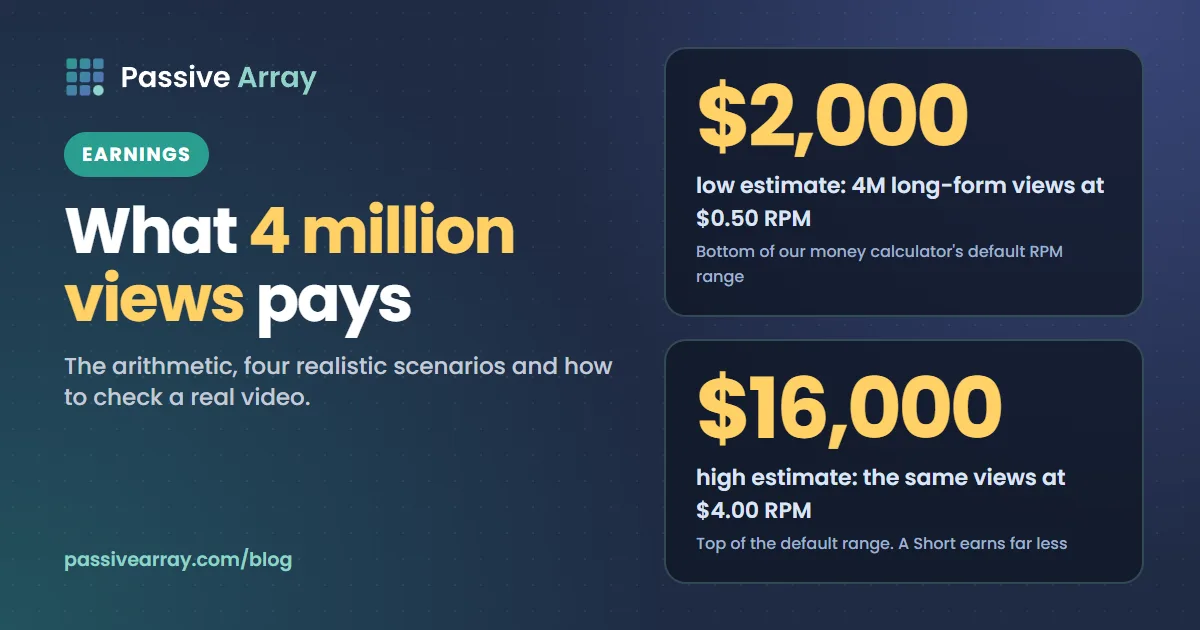
A long-form YouTube video with 4 million views usually earns somewhere between $2,000 and $16,000 from ads. That is 4,000 thousands of views multiplied by an RPM of $0.50 to $4.00, the default range in our YouTube money calculator. If the video is a Short, the figure is a small fraction of that. If the channel is not in the YouTube Partner Program, it is zero.
The arithmetic
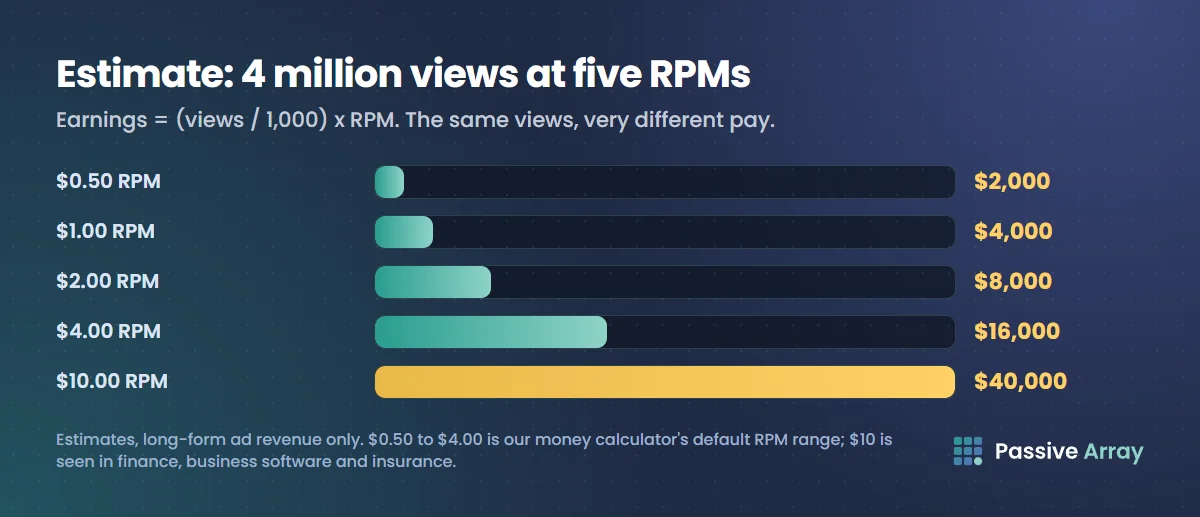
Earnings = (views / 1,000) x RPM
RPM is what the creator keeps per 1,000 views, after YouTube's share and after counting every view that showed no ad. For 4 million views:
| RPM | Earnings on 4,000,000 views |
|---|---|
| $0.50 | $2,000 |
| $1.00 | $4,000 |
| $2.00 | $8,000 |
| $4.00 | $16,000 |
| $10.00 | $40,000 |
The last row is not a typo. Finance, business software and insurance channels can run RPMs well above the usual high end, because advertisers pay far more to reach those viewers. Most channels never see it.
Four realistic scenarios
The same 4 million views can be worth very different amounts. These are the patterns that decide it.
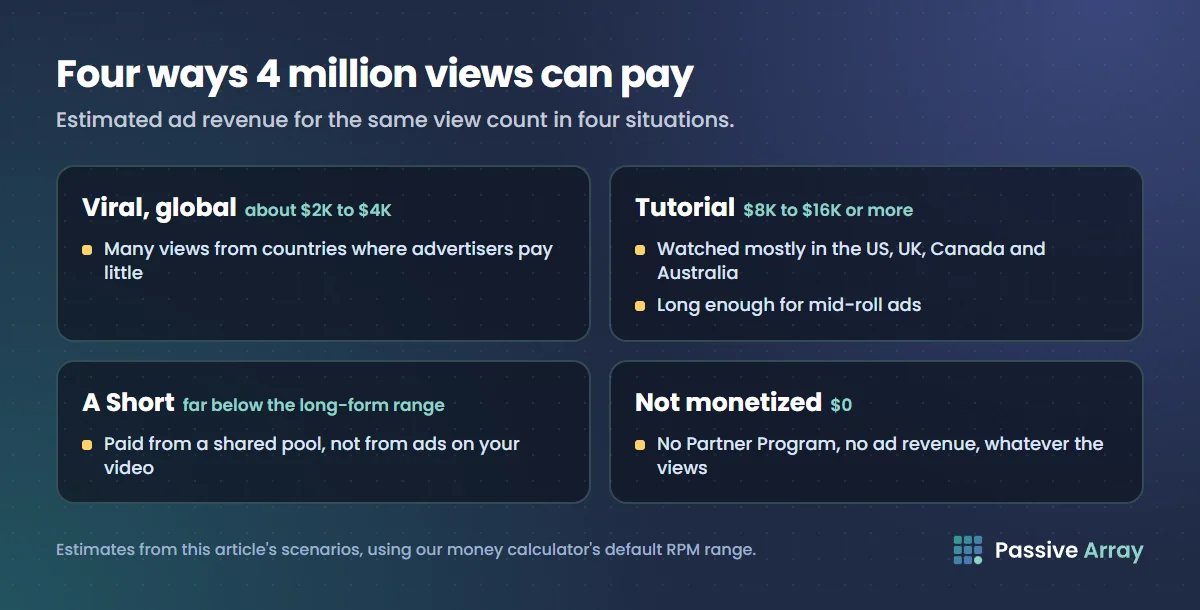
A viral entertainment video with a global audience. Views come from everywhere, many in countries where advertisers pay little. Expect the bottom of the range, around $2,000 to $4,000.
A long tutorial watched mostly in the US, UK, Canada and Australia. The audience is in the highest-paying ad markets and the video is long enough for mid-roll ads. Expect the upper half, $8,000 to $16,000 or more.
A Short with 4 million views. Shorts are paid from a shared pool, not from ads on your own video, and the per-view figure is far lower. A 4 million view Short usually earns an order of magnitude or more below the long-form figures above, and how far below depends on music use and where the viewers are. How YouTube pays for Shorts explains why.
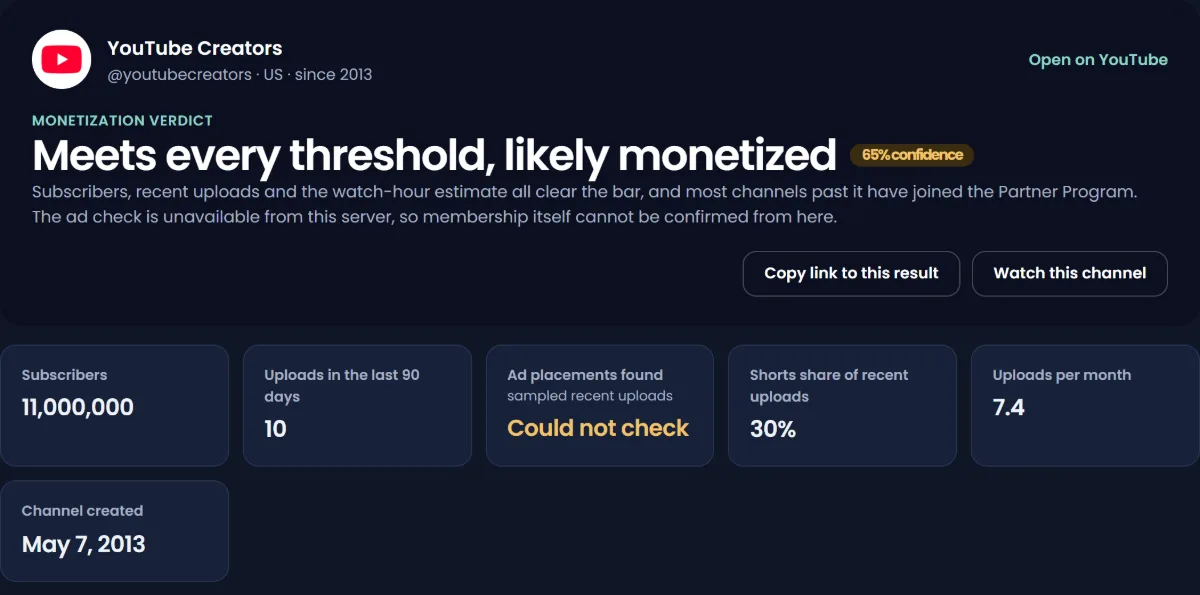
A video on a channel that is not monetized. No Partner Program, no ad revenue. Check this first with the monetization checker, because a big view count says nothing about it.
Why viral videos often earn less per view
A video that breaks out of its usual audience reaches people who would never search for it: international viewers, younger viewers, people scrolling past on the home feed. Those views are worth less to advertisers than a core audience that came for the subject. So a channel's breakout hit frequently has a lower RPM than its regular uploads, even while it earns the most in total.
When the money arrives
Views on a viral video do not all land in one month. Most come in the first weeks, then a long tail continues for months or years. YouTube pays monthly for the previous month's finalized earnings, so a video that hit 4 million views over six weeks is paid across two or three payments. How and when YouTube pays you has the schedule.
4 million views is often worth more off YouTube
At this scale the ad revenue is rarely the biggest number. A brand would price an integration on a video expected to reach millions at a placement rate far above ad RPM. The sponsorship price calculator shows what a channel with that reach could charge per video. Merchandise, memberships and affiliate links all scale with views too.
Check a real video or channel
- Confirm the channel is monetized with the monetization checker.
- Note whether the video is a Short or long-form, and whether it is over eight minutes.
- Run the channel through the YouTube money calculator, which takes the last 30 days of views from the official API and applies an RPM range you can edit.
- Treat the result as a bracket. Only the creator's YouTube Studio shows the real figure.
For the same arithmetic at other sizes, see what YouTube pays for 1 million views and for 1,000 views.