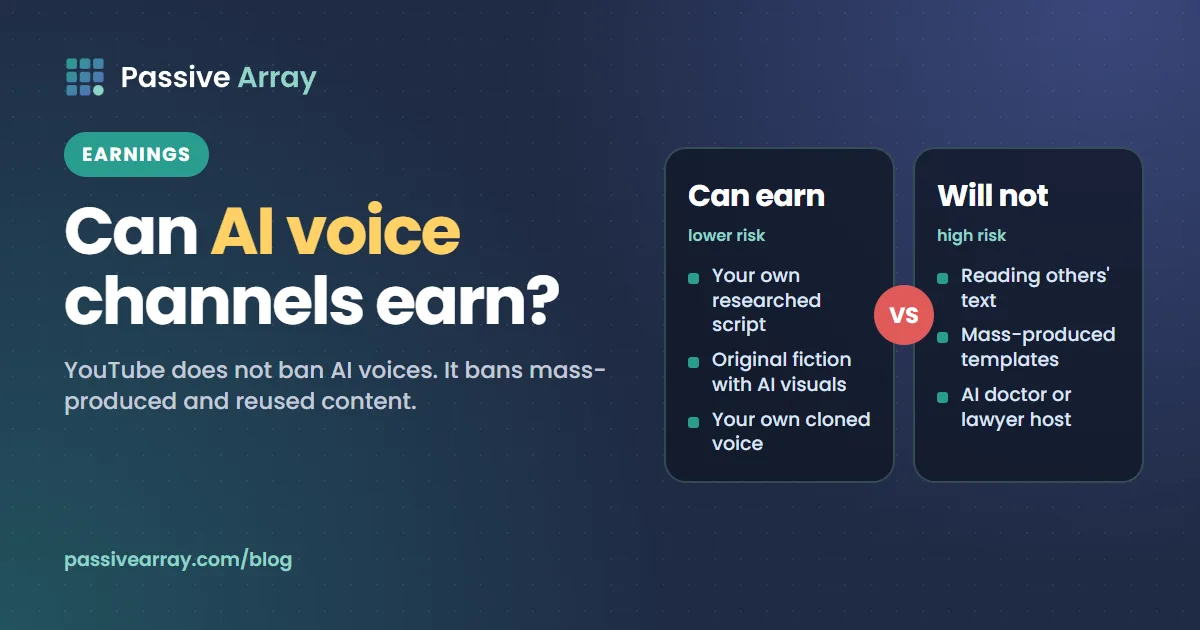
Yes, an AI voice channel can be monetized on YouTube. YouTube's monetization policies do not mention text-to-speech or synthetic voices at all, and its AI disclosure page says that disclosing AI content "alone won't limit a video's audience or impact its eligibility to earn money." What gets AI voice channels rejected is not the voice. It is content that YouTube calls inauthentic (mass-produced or repetitive) or reused (other people's material without meaningful changes). An AI narrator reading an original, researched script is fine. An AI narrator reading Reddit posts over stock footage, fifty times a week, is not.
This guide quotes what the policies actually say, sorts common AI voice formats by risk, and gives you a checklist to run before you apply. If you want to see whether a particular AI voice channel has made it into the Partner Program, the YouTube monetization checker reads its public signals and gives a confidence score.
What YouTube's policies actually say about AI
There is no single "AI policy" for monetization. AI content is judged by the same channel monetization policies as everything else, and four parts of them matter most.
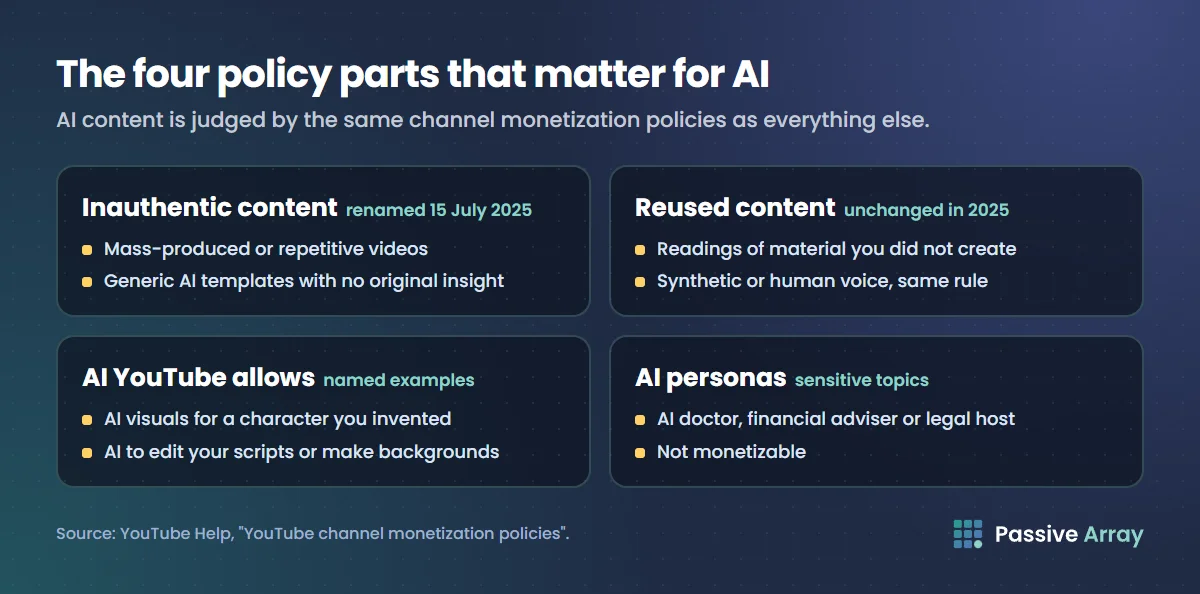
1. Inauthentic content (formerly "repetitious content")
On 15 July 2025 YouTube made what it called "a minor update" to its "repetitious content" policy "to better clarify this includes content that is repetitive or mass-produced", and renamed it inauthentic content. The list of what cannot be monetized includes:
- "Similar or repetitive content with low educational value, commentary, narratives, or minimal variation across videos"
- "Image slideshows, templated storylines, or scrolling text with minimal or no narrative, commentary, or educational value"
- "AI-generated content made with generic or unoriginal templates giving the impression of mass production", "without adding the creator's original, authentic insights or perspective"
What is allowed: the same intro and outro on every video, "but the bulk of your content is different", and a series where "each video has a distinct storyline, focus, or concept."
2. Reused content
This section was not changed in 2025, and it matters most for AI voice channels that narrate other people's material. YouTube lists as not monetizable:
- "Content that exclusively features readings of other materials you did not originally create", "like text from websites or news feeds"
- "Content downloaded or copied from another online source without any substantive modifications"
- "Short videos you compiled from other social media websites"
That first bullet is the one that catches the most AI voice formats. An AI voice reading a story you did not write, a news article or a forum post is "readings of other materials you did not originally create", whether the voice is synthetic or human.
3. AI that YouTube explicitly allows
YouTube's policies give examples of AI use that can be monetized:
- "Content that expresses your unique creative voice, like using AI to visualize a unique character and narrative you invented"
- "Content that utilizes creative tools to assist in delivering a unique, well-researched, or creative narrative, like using AI to edit your video scripts or generate a unique background visual for your content"
Both examples sit in the policy's section on unsatisfying or off-putting content, which also excludes one AI use by name: "videos that stitch together unrelated or inconsistent AI clips to surprise or shock viewers."
4. AI personas on sensitive topics
This section affects many faceless channels. YouTube lists these as not monetizable:
- "An AI "doctor" providing medical diagnoses, health advice, or wellness remedies"
- "AI-generated podcast hosts offering financial guidance, investment tips, or wealth management advice"
- "AI personas giving legal advice or interpreting laws"
If your plan is an AI-voiced finance, health or legal channel presented as an expert host, read that list twice. These are some of the best-paying topics on YouTube, and an AI persona giving advice in them is specifically excluded.
Does YouTube detect AI voices?
The more useful question is whether it matters, and by the policies it mostly does not. Nothing in the monetization policies says a video is ineligible because the narration is synthetic. YouTube's disclosure page even lists "Cloning one's own voice to create voice overs or dubs" as something that does not need an AI label.
What reviewers do look at is the channel as a whole. YouTube's monetization policies say reviewers may focus on its main theme, most viewed videos, newest videos, the videos with the biggest proportion of watch time, video metadata (titles, thumbnails and descriptions) and the About section. A reviewer who opens five of your videos and finds the same template, the same stock clips and a different scraped story in each will see "minimal variation across videos", regardless of how natural the voice sounds.
When you must label AI voice content
Disclosure is a separate rule from monetization. YouTube asks creators to disclose AI-generated or altered content that seems realistic, including content that:
- "Makes a real person appear to say or do something they didn't do"
- Alters footage of a real event or place
- Generates a realistic scene that did not occur
- Creates music that is the main focus of the video
So a synthetic voice imitating a real, identifiable person saying things they never said needs the label. A generic AI narrator explaining a topic does not fall into those examples, and cloning your own voice is listed as exempt. You set the label in YouTube Studio when uploading.
The label itself does not cost you money: YouTube says disclosing "alone won't limit a video's audience or impact its eligibility to earn money." Failing to disclose does. YouTube says creators who consistently do not disclose may face penalties "including removal of content or suspension from the YouTube Partner Program."
Which AI voice formats get monetized, and which do not
The table below is our reading of the policies quoted above, not a YouTube ruling. YouTube decides case by case, and a reviewer sees your whole channel, not one format.
| Format | Risk | Why |
|---|---|---|
| AI voice reading Reddit posts, forum threads or other people's stories | High | "Readings of other materials you did not originally create" |
| AI voice reading news articles or press releases | High | Same bullet: "like text from websites or news feeds" |
| Slideshow of images with AI narration of generic facts | High | "Image slideshows... with minimal or no narrative, commentary, or educational value" |
| Dozens of near-identical videos from one template a day | High | Mass-produced, "minimal variation across videos"; also the spam policy |
| Random AI clips stitched together for shock value | High | Named directly under unsatisfying content |
| AI "doctor", "financial advisor" or "lawyer" host | High | Named directly under AI personas on sensitive topics |
| Top-10 or explainer videos with a script you researched and wrote, AI narration, original edit | Lower | Original narrative and educational value; keep each video distinct |
| Screen-recorded tutorials with an AI voiceover of your own script | Lower | Original demonstration; the voice is a production choice |
| Original fiction or animated series with AI visuals and voices | Lower | "Using AI to visualize a unique character and narrative you invented" |
| Your own cloned voice narrating your own content | Lower | No disclosure needed for your own voice; judged like any other video |
"Lower" does not mean safe. A tutorial channel can still be rejected for thin content, and an original fiction channel can still drift into templated, repetitive episodes. The deciding question in every row is the one the policy asks: has the creator added "original, authentic insights or perspective"?
AI and the spam policy
Separately from monetization, YouTube's spam policy prohibits "Using automated tools or AI to churn out high volumes of similar content with minimal changes", including "coordinated mass-production and technical manipulation to bypass filters or trick viewers." It adds: "we don't allow use of these tools to flood our platform with repetitive content."
That is a Community Guidelines issue, not just a monetization one, so it can lead to removals and strikes, not only to a rejected application. The common "upload 10 AI videos a day across five channels" plan runs straight into it.
What happens if an AI channel breaks the rules
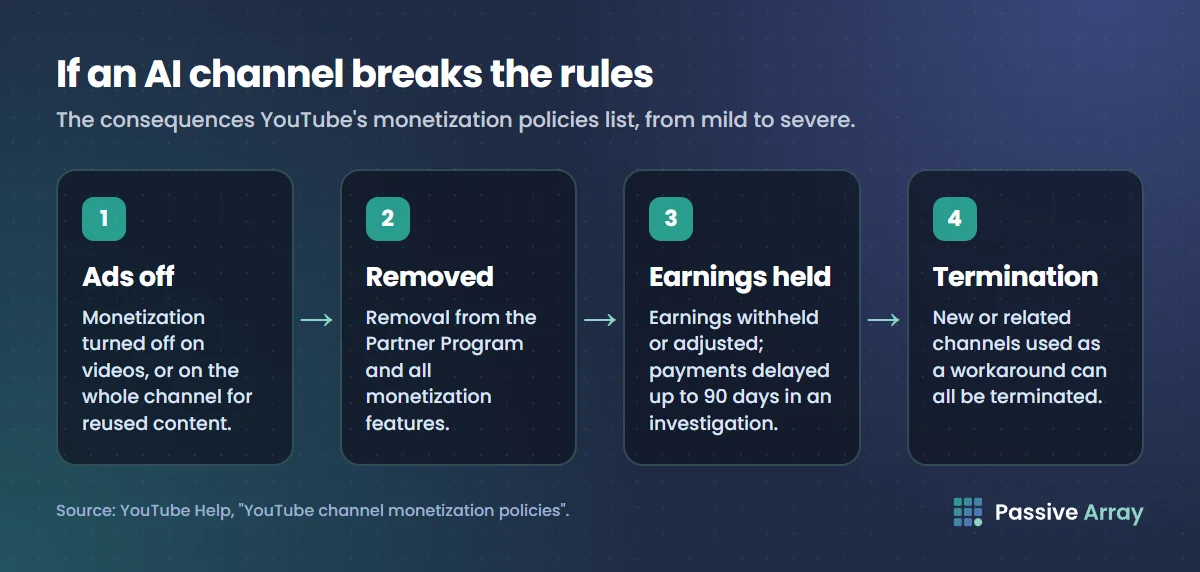
YouTube's monetization policies list the consequences:
- Monetization turned off on individual videos, or on the whole channel. For reused content, YouTube says it can remove monetization from the entire channel, not only the videos that broke the rule.
- Removal from the Partner Program, losing access to all monetization features.
- Earnings held: YouTube may withhold or adjust earnings, and delay payments by up to 90 days during an investigation.
- Termination for workarounds: creating new channels or reapplying through related channels during a suspension can lead to termination of all of them.
The last point matters for AI channel operators who run several channels. A problem on one can spread to the others. YouTube demonetization explains how to read the notices and appeal.
Can AI Shorts be monetized?
Yes, under the same rules. Shorts monetization depends on the channel being in the Partner Program and accepting the Shorts Monetization Module, and the inauthentic and reused content policies apply to Shorts exactly as to long-form. AI-voiced Shorts that read scraped text, or stitch unrelated AI clips together, face the same problems as long videos in those formats. Can YouTube Shorts be monetized covers the Shorts pool and the 2027 changes.
A checklist before you apply with an AI voice channel
Run through this with your ten most recent videos and your ten most viewed, because that is close to what a reviewer samples.
- Write your own scripts. Use AI to edit or tighten them if you like, which YouTube explicitly allows, but the research, structure and point of view should be yours. The script outline generator gives you a structure to fill, and our guide to writing a YouTube script covers the rest.
- Never build a video around reading someone else's text. If you cover a story, news item or post, the video needs your analysis, context or commentary, not a reading.
- Make each video distinct. Different topic, different structure where it suits, visuals chosen for that video. A shared intro and outro is fine.
- Use visuals that serve the script. Stock footage and AI images are allowed, but a slideshow of loosely related images with narration is listed as not monetizable.
- Avoid AI expert personas in health, finance and law. If you cover those topics, present information, cite sources and do not have an AI character give personal advice.
- Disclose realistic synthetic content. Especially any voice or likeness of a real person.
- Upload at a pace you can keep original. The policies set no upload limit. What they target is the templated, near-identical output that high volume tends to produce.
- Check your About section and metadata. Reviewers read them. Describe what the channel teaches or tells, and why it is yours.
- Meet the numbers. 1,000 subscribers plus 4,000 public watch hours in 12 months or 10 million public Shorts views in 90 days, rising to 8,000 hours or 20 million Shorts views for new applicants from 1 February 2027. YouTube monetization requirements has the full list.
Pick a niche where an AI voice is not a weakness
Some niches suit faceless, narrated videos: software tutorials, history explainers, science, personal finance education presented as information rather than advice, and original storytelling. Others depend on a recognisable person on camera, and an AI voice makes them harder to grow, whatever the policy says. The niche finder has a faceless option that filters out niches where viewers expect a person on screen and ranks the rest by pay, competition and effort. Those ratings are editorial estimates, and the tool says so.
To see which faceless videos in a niche are beating their channel's usual numbers, browse the outlier feed. Our guide to growing a faceless YouTube channel covers the content side, and best YouTube niches compares 26 niches on pay, competition and effort.
Will an AI voice channel earn less?
There is no published evidence that YouTube pays a lower rate for AI-narrated videos, and RPM is driven by audience country, topic, format and how many views carry ads. A monetized AI voice channel earns by the same formula as any other: monthly views divided by 1,000, times RPM. What tends to hold AI channels back is retention and trust, because viewers who can tell a video was produced in bulk often leave early. How much YouTube pays after monetization walks through the arithmetic for a newly monetized channel.
Sources
- YouTube Help: YouTube channel monetization policies (inauthentic content, reused content, AI personas, reviewer focus, consequences)
- YouTube Help: Disclosing use of altered or synthetic content
- YouTube Help: Spam policy
- YouTube Help: YouTube Partner Program overview and eligibility
- YouTube Help: Changes to the YouTube Partner Program
- YouTube Help: YouTube Shorts monetization policies
Frequently asked questions
Can you monetize a YouTube channel that uses an AI voice?
Yes. YouTube's monetization policies do not ban AI or text-to-speech voices. They ban mass-produced, repetitive and reused content, so an AI-narrated channel with original, researched scripts and distinct videos can be monetized, while one that reads other people's text over templates usually cannot.
Does YouTube Shorts monetize AI content?
Yes, if the channel is in the Partner Program and the Shorts follow the same policies as long-form. AI Shorts that read scraped text, use the same template with minimal variation, or stitch together unrelated AI clips for shock value are not monetizable.
Do I have to disclose an AI voice on YouTube?
Only when the content seems realistic and could mislead, such as making a real person appear to say something they did not. A generic AI narrator does not fall into YouTube's examples, and cloning your own voice for voiceovers is listed as not needing disclosure. Disclosing does not by itself affect your eligibility to earn.
Why was my AI voice channel rejected for monetization?
Usually because of the inauthentic content or reused content policy, not the voice. The rejection email names the policy. Common causes are reading other people's stories or news, slideshow-style videos, and many near-identical videos built from one template.
Can AI voice Reddit story channels be monetized?
Usually not as a straight reading. YouTube lists "Content that exclusively features readings of other materials you did not originally create" as not monetizable. A video that adds substantial original commentary, analysis or storytelling of its own is judged differently, but the reading itself is not enough.
Is it allowed to use AI to write YouTube scripts?
Yes. YouTube gives "using AI to edit your video scripts" as an example of allowed use, as long as the result delivers "a unique, well-researched, or creative narrative." The more of the research and point of view that is yours, the safer the channel.
Can AI finance or health channels be monetized?
Information channels on those topics can be. But YouTube specifically excludes AI personas giving advice: an AI "doctor" offering diagnoses or remedies, AI podcast hosts giving investment tips, and AI personas giving legal advice. Present information and sources, not an AI expert's personal advice.