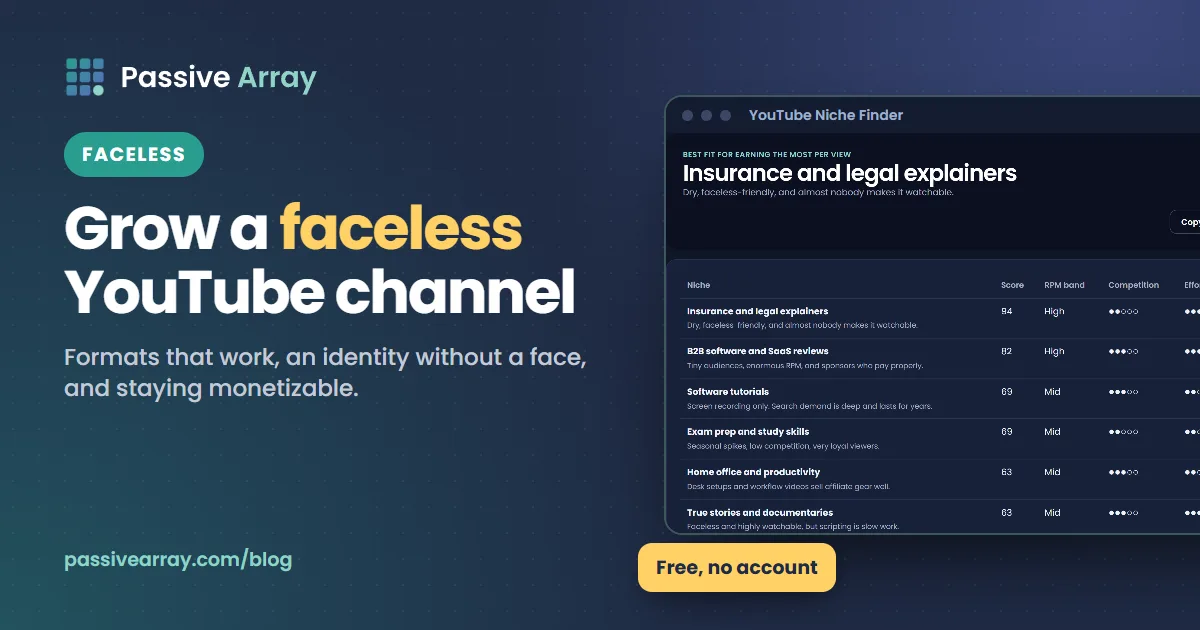
A faceless YouTube channel grows the same way any channel does: one clear audience, videos that hold attention, and series that bring viewers back. What changes is where your identity comes from. Without a face, viewers recognise you by your voice, your visual style and the way you explain things, so those need to be consistent from the first video. Start by choosing a subject you can make 50 videos about; the YouTube Niche Finder helps you compare topics before you commit.
The second thing that changes is risk. Many faceless channels are built on stock footage, AI voices, compilations or other people's clips, and those are exactly the formats YouTube's inauthentic content and reused content monetization policies target. A faceless channel can be monetized. A channel that looks mass-produced or copied usually cannot. This guide covers both: how to grow, and how to stay eligible.
Faceless formats that work
"Faceless" covers very different kinds of channels. The format decides how much work each video takes and how much of it is original.
| Format | What it looks like | Originality risk | Effort per video |
|---|---|---|---|
| Screen recording tutorials | Software, coding, spreadsheets, games, with your voiceover | Low: the recording is yours | Low to medium |
| Hands-only | Cooking, crafts, repairs, drawing, unboxing filmed from above | Low | Medium |
| Voiceover explainers | Your narration over diagrams, maps, footage you filmed or licensed | Low if the script is yours | Medium |
| Animation and motion graphics | Explainers, stories, history, science | Low if animation and script are yours | High |
| Gameplay with commentary | Your gameplay and your voice reacting and explaining | Low with real commentary, high without | Low to medium |
| Ambient and music | Rain sounds, study music, lo-fi with visuals | Medium: templated videos are a risk | Low, but hard to stand out |
| Clip commentary and reviews | Clips of films, matches or videos with your analysis | Medium: depends on how much you add | Medium |
| Compilations and reposts | Clips from other channels or social sites with little added | High: listed as not monetizable | Low |
| Text-to-speech readings | AI voice reading Reddit posts, news or website text | High: listed as not monetizable when it only reads others' material | Low |
The pattern: the less you add, the easier the video is to make, and the less likely it is to be monetized or recommended for long. The formats at the top of the table are slower to make and much safer.
What YouTube's monetization rules say about faceless content
YouTube's channel monetization policies apply to every channel in the Partner Program. Two sections matter most for faceless channels. On 15 July 2025, YouTube said it was "renaming this policy from 'repetitious content' to 'inauthentic content'", and clarified that it covers mass-produced and repetitive content.
Inauthentic (generic or repetitive) content
YouTube says these are not allowed to monetize:
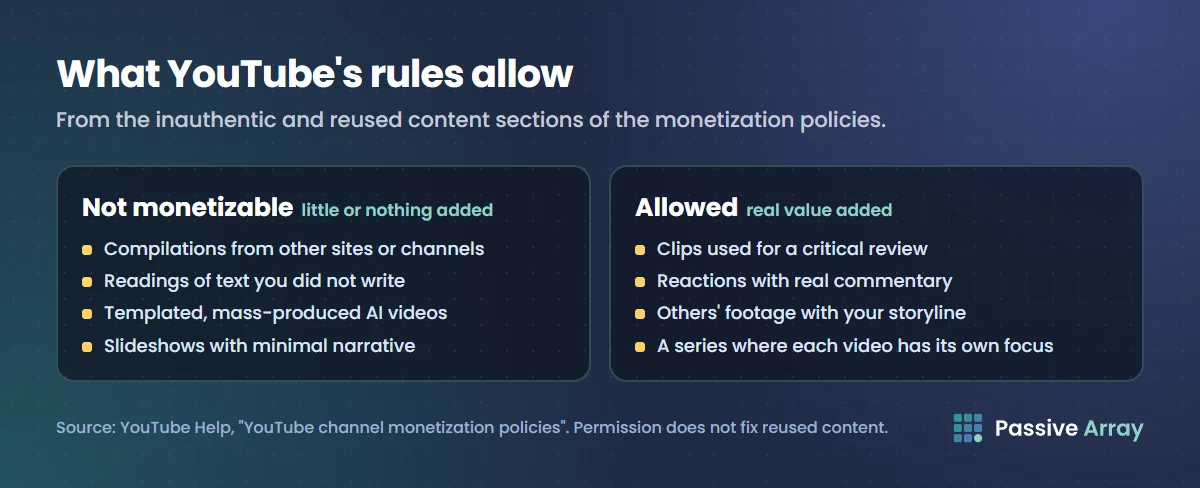
- "Similar or repetitive content with low educational value, commentary, narratives, or minimal variation across videos"
- "Image slideshows, templated storylines, or scrolling text with minimal or no narrative, commentary, or educational value"
- "AI-generated content made with generic or unoriginal templates giving the impression of mass production without adding the creator's original, authentic insights or perspective"
And these are allowed:
- The same intro and outro on every video, "but the bulk of your content is different"
- A series, such as recurring characters or a product review channel, "in which each video has a distinct storyline, focus, or concept"
Reused content
Reused content means using material that is already on YouTube or elsewhere online without adding significant original value. YouTube's list of what is not monetizable includes:
- "Clips of moments from your favorite show edited together with little or no narrative"
- "Short videos you compiled from other social media websites"
- "Content uploaded many times by other creators"
- "Content that exclusively features readings of other materials you did not originally create, like text from websites or news feeds"
- "Promotion of other people's content (even if you have permission)"
What is allowed includes "using clips for a critical review", "reaction videos where you comment on the original video", "edited footage from other creators where you add a storyline and commentary", and sports replays "where you explain the moves a competitor did to succeed."
Two details matter. First, permission does not fix reused content: several of the not-allowed examples say "even if you have permission". Permission is a copyright question; reused content is a monetization question. Second, YouTube reviews the channel, not just one video. For reused content it says "monetization may be removed from your entire channel."
Copyright is a separate system on top of this. Copyright claim vs copyright strike explains what happens when you use someone else's material, and YouTube demonetization explains how to recover if monetization is turned off.
AI voices and AI visuals
Using AI tools is not banned. What YouTube requires is disclosure of realistic altered or synthetic content. Its help page says: "We require creators to disclose AI-generated or altered content that seems realistic", such as content that "makes a real person appear to say or do something they didn't do." Clearly unrealistic content, and minor edits such as captions, beauty filters or idea generation, do not need disclosure. YouTube lists cloning your own voice for voiceovers or dubs as a minor edit.
The monetization risk with AI is not the voice itself. It is a channel of near-identical, templated AI videos with nothing original in them. Can AI voice YouTube channels be monetized goes deeper on that question.
Step 1: choose a niche where you can add something
The best faceless niches have two things: viewers who care about the information more than the person, and room for you to add knowledge, analysis or craft that a template cannot.
Ask four questions before you commit:
- Can I make 50 videos on this without copying anyone? If your ideas run out at 10, the niche is too narrow or you are not interested enough.
- What do I add? Expertise, research, original footage, a teaching style, humour, better design. If the answer is "nothing, I just re-edit", the channel will struggle on monetization.
- Do viewers search for this? Search is where a new channel competes on usefulness, not reputation.
- Does it pay enough for the effort? Advertisers pay very different rates across subjects. The best YouTube niches compares pay, competition and effort.
Some faceless-friendly niches where knowledge carries the video: software tutorials, personal finance basics, history and geography explainers, science explainers, cooking, home repair, game guides, productivity, book summaries with your own analysis, and language learning. Each is crowded at the top; you win by being specific ("Excel for small shop owners", not "Excel").
Step 2: build an identity without a face
Viewers subscribe to a person they recognise. On a faceless channel, that recognition has to come from somewhere else.
- Your voice. Your own voice, recorded with a decent microphone in a quiet room, is the strongest signal of a real creator. If you use a synthetic voice, use the same one every time and write scripts that sound like a person with opinions.
- A recurring visual style. The same colour palette, fonts, transitions and layout in every video and thumbnail. After five videos, a viewer should recognise your thumbnail before they read the channel name.
- A recurring character or mascot. An illustrated avatar, a pair of hands, a desk setup. Something that appears in every video.
- A point of view. Faceless channels that just list facts are interchangeable. Ones that say "this is overrated, here is why" are not.
- A name that tells people the subject. The YouTube Channel Name Generator suggests options, and the channel name ideas guide explains what makes one memorable.
Step 3: script every video
Without a face to carry energy, the script carries everything. Faceless videos lose viewers fastest when the narration rambles.
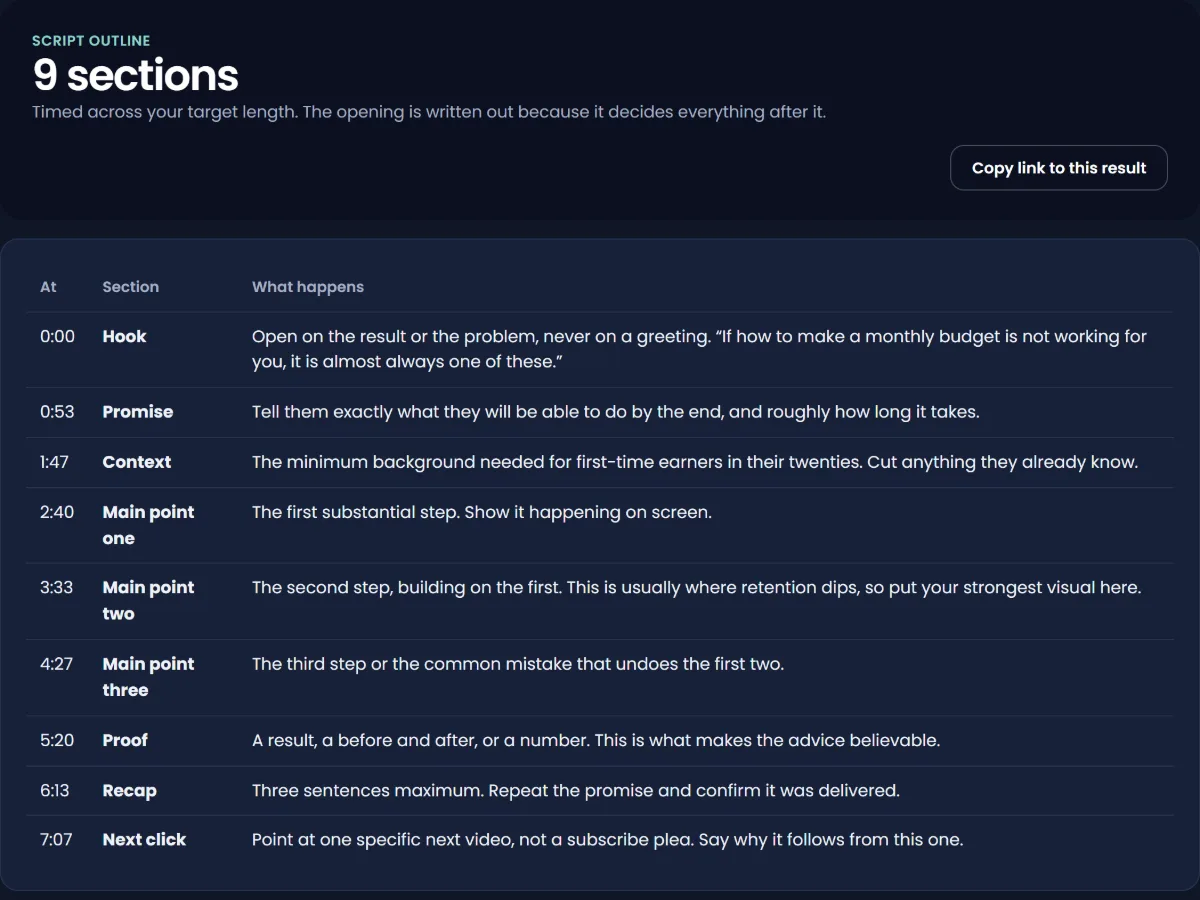
- Open with the payoff. State what the viewer will get in the first 15 seconds, and show it if you can.
- One idea per section. Each section answers one question, then moves on.
- Write for the ear. Short sentences, spoken words, no reading lists of numbers aloud.
- Plan visuals with the script. Every line should have something on screen that matches it. Mismatched stock footage is the most common sign of a low-effort faceless video.
- End with the next video. Point to the next episode or a related video, not a long outro.
The YouTube Script Outline Generator builds a hook, sections and a close for a topic, and how to write a YouTube script covers the full process.
Step 4: get the click without a face
Faces are common in thumbnails, but they are not required. Faceless thumbnails work when they show the subject clearly:
- The result, such as the finished dish, the fixed error message or the final map.
- A before and after split.
- A single striking object on a plain background.
- Your recurring character or style, so returning viewers recognise you.
Keep text to three words or fewer, and check the thumbnail at phone size in light and dark mode with the YouTube Thumbnail Tester. YouTube thumbnail examples shows patterns that work without a face.
Step 5: grow with series and searches
The growth playbook is the same as for any channel, covered in full in how to grow a YouTube channel:
- Answer specific searches first. "How to fix X in Y" is easier to win than a broad topic.
- Turn your best video into a series. A recurring format with a playlist and end screens.
- Make Shorts that point to long videos. Faceless formats such as tutorials and explainers cut well into one-tip Shorts.
- Reply to comments in your channel's voice. It shows a real person runs the channel.
For video ideas inside your niche, the YouTube Video Ideas Generator suggests topics from a keyword.
A realistic weekly workflow
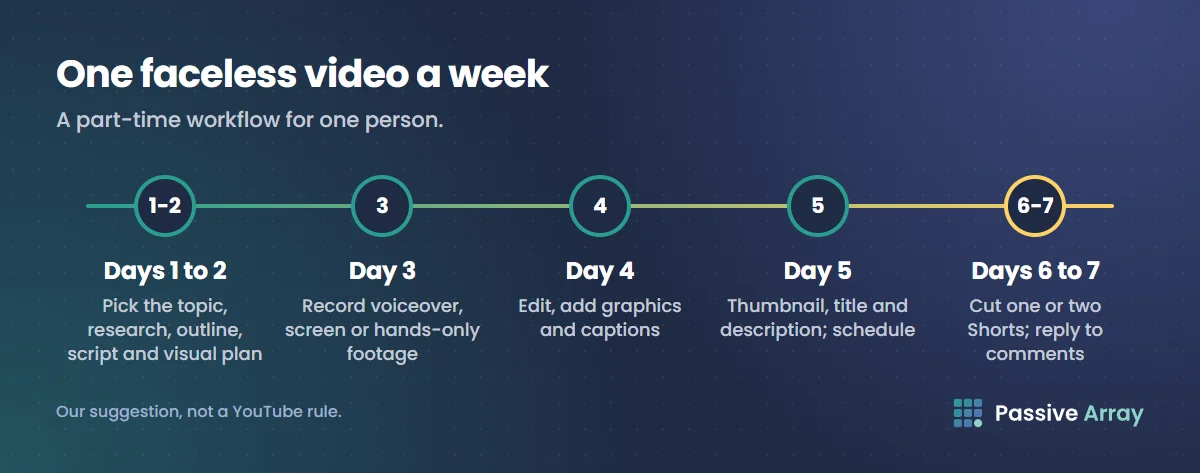
This is a suggestion for one person working part-time, not a YouTube rule.
| Day | Task |
|---|---|
| 1 | Pick the topic from searches or comments, research it, write the outline |
| 2 | Write the full script and the visual plan |
| 3 | Record the voiceover, screen recordings or hands-only footage |
| 4 | Edit, add graphics and captions |
| 5 | Thumbnail, title, description, related links; schedule the upload |
| 6 to 7 | Cut one or two Shorts from the video; reply to comments |
One finished, original video a week is a pace most people can keep. A channel that pushes out several templated videos a day is the pattern YouTube's inauthentic content policy describes.
Self-check: would a reviewer see a real creator?
When you apply to the Partner Program, YouTube reviews the channel against its monetization policies; meeting the subscriber and watch-time thresholds does not guarantee acceptance. Before you apply, open your channel page as a stranger would and answer these honestly. This checklist is our suggestion, built on the policy wording above.
- Could each video only have come from this channel? If you swapped the channel name, would anyone notice? A distinct voice, style or point of view says yes.
- Does each video have its own focus? Line up your last ten titles and thumbnails. If they look like the same video with a different noun, that is the "minimal variation across videos" pattern.
- Is the narration doing real work? Explanation, analysis, a story or teaching, not just describing what is on screen or reading someone else's text.
- Where did every clip come from? If most of the footage is someone else's, can you point to the commentary, storyline or editing you added on top?
- Would you be comfortable explaining your process? "I research, write, record and edit each video" is an easy answer. "A tool generates fifty a day" is not.
If two or more answers are uncomfortable, fix the format before you apply. It is easier to change a channel at 30 videos than to recover monetization after a rejection.
Mistakes that stall faceless channels
- Copying a viral faceless channel's format exactly. If viewers have seen the same video from ten channels, yours adds nothing, and YouTube's reused content rules cover "content uploaded many times by other creators".
- Stock footage that does not match the words. Viewers notice, and leave.
- Mass-producing AI videos. Fast to make, but this is exactly what the inauthentic content policy names.
- Reading other people's text. Reddit threads, news articles or website text read aloud with no analysis is listed as not monetizable.
- Changing voice, style and topic every few videos. Nobody can recognise the channel, so nobody returns.
- Buying "monetized faceless channels" or subscribers. Bought subscribers break the fake engagement policy, and a channel built on someone else's audience gives you viewers who never chose your content.
Sources
- YouTube Help: YouTube channel monetization policies (inauthentic and reused content)
- YouTube Help: Disclosing altered or synthetic content
- YouTube Help: YouTube Partner Program overview & eligibility
- YouTube Help: Fake engagement policy
- YouTube Help: Understand new, casual, & regular viewers
Frequently asked questions
Can a faceless YouTube channel be monetized?
Yes. Faceless channels can join the YouTube Partner Program on the same thresholds as any channel. What blocks them is not the missing face but content YouTube considers inauthentic (templated, mass-produced, repetitive) or reused (copied from elsewhere without significant original value).
What are good faceless YouTube niche ideas?
Niches where knowledge or craft carries the video work best: software tutorials, finance basics, history and science explainers, cooking, repairs, game guides and language learning. Pick one where you can add expertise or analysis, and make it specific, such as "Excel for small shop owners" rather than "Excel".
Can I make YouTube videos without showing my face or using my voice?
Yes, with text, music or a synthetic voice, but it is harder to build a recognisable channel. If you use an AI voice, use the same one consistently, write original scripts, and disclose realistic synthetic content when YouTube's rules require it. Videos that only read other people's text are not monetizable.
Are faceless YouTube Shorts monetized?
Faceless Shorts can earn from Shorts revenue sharing once the channel is in the Partner Program. The same reused content rules apply: YouTube lists short videos compiled from other social media sites as not monetizable, so Shorts should be your own material.
How do I grow a YouTube channel without showing my face?
Choose a specific niche, give the channel a consistent voice and visual style, script every video tightly, and use thumbnails that show the result rather than a face. Then grow like any channel: answer real searches, turn your best video into a series, and use Shorts to point to longer videos.
Do faceless channels grow slower than channels with a face?
YouTube has not published data comparing them. Faces can make thumbnails and introductions easier to connect with, but recommendations follow how satisfied viewers are, not whether a face appears. A faceless channel with useful, original videos can grow; a templated one usually stalls.
Is using AI for a faceless channel against YouTube rules?
No. AI tools are allowed, and YouTube requires disclosure only for realistic altered or synthetic content. The risk is monetization: AI-generated videos made with "generic or unoriginal templates giving the impression of mass production" are listed as not eligible.
By Nasir Uddin, founder of Passive Array. Rules and figures checked Nov 1, 2026.