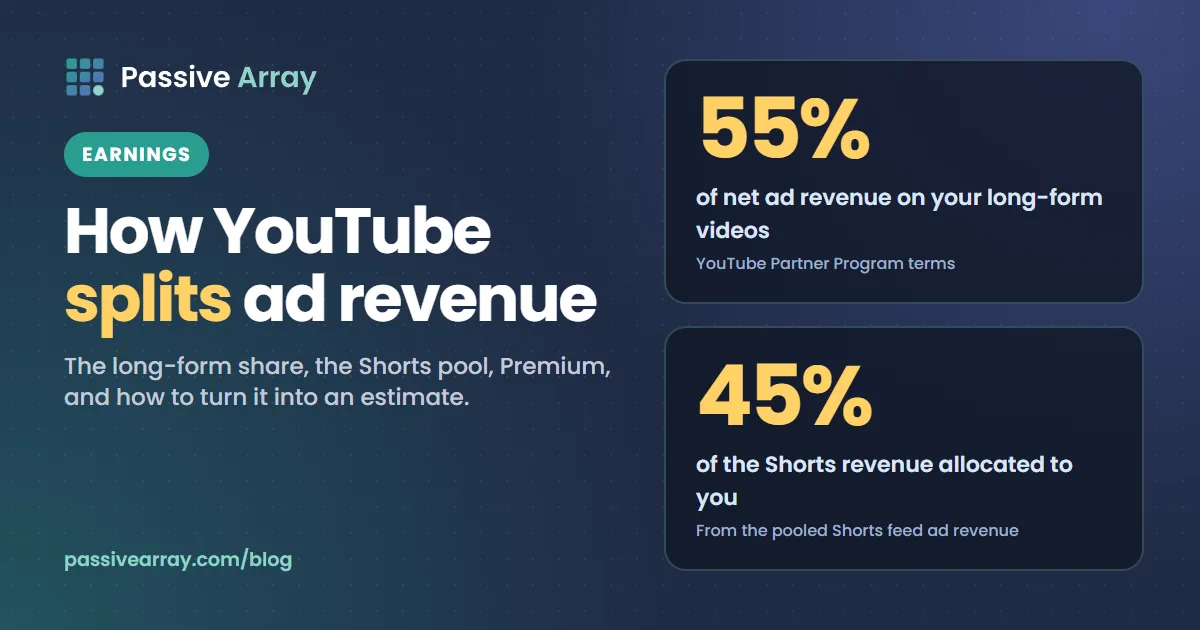
YouTube keeps part of the money advertisers pay and gives the rest to creators in the YouTube Partner Program. On long-form videos, creators get 55% of the net revenue from ads shown on their videos. On Shorts, ad revenue from the Shorts feed is pooled and creators get 45% of the share allocated to them. YouTube Premium revenue is shared separately, based on watch time.
Long-form videos: 55% to the creator
When an ad runs on or around your long-form video, the advertiser pays YouTube. YouTube's Partner Program terms give the creator 55% of the net revenue from ads displayed or streamed on their public videos, and YouTube keeps 45%.
That 55% is per ad, on your own video. So your revenue depends on how many ads ran, and what advertisers paid for them. That is what CPM measures: what advertisers paid per 1,000 ad impressions. Your share, spread across all your views including those with no ad, is RPM. How much YouTube pays per view explains the two numbers.
Shorts: a pooled 45%
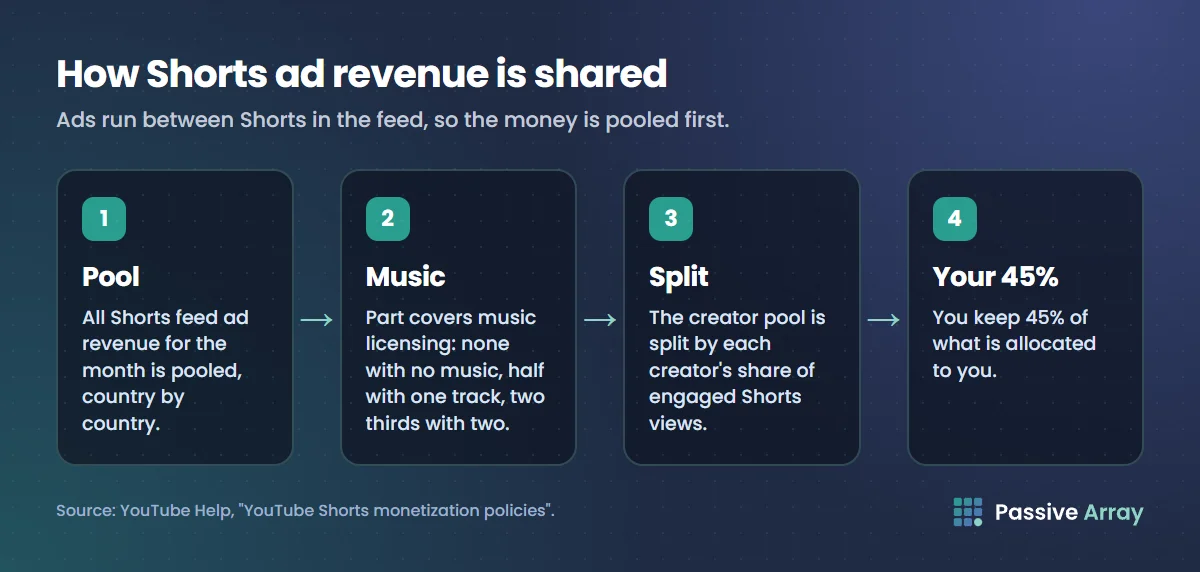
Shorts work differently, because ads run between Shorts in the feed rather than on one particular Short. YouTube explains the process like this:
- All Shorts feed ad revenue for the month is pooled, country by country.
- Part of the pool covers music licensing. A Short with no music sends all of its share to the creator pool. A Short using one track sends half. A Short using two tracks sends a third.
- The creator pool is split by each monetizing creator's share of engaged Shorts views in each country.
- The creator keeps 45% of what is allocated to them.
So a Short earns less per view than a long-form video, and using licensed music lowers it further. How YouTube pays for Shorts works through this in detail.
YouTube Premium revenue
Premium members watch without ads, so their views earn nothing from advertisers. Instead, YouTube shares Premium subscription revenue with creators according to how much Premium members watch their content. YouTube says the majority goes to partners but publishes no exact percentage. It is paid automatically to monetized channels and shows separately in the Revenue tab in Studio.
Which ads run on your videos
In the past creators chose ad types one by one. YouTube has removed those individual choices for pre-roll, post-roll, skippable and non-skippable ads. New long-form videos get them automatically when appropriate. The formats viewers see are:
- Skippable in-stream ads. Viewers can skip after 5 seconds.
- Non-skippable in-stream ads. 15 or 20 seconds (up to 30 seconds on TVs).
- Bumper ads. Non-skippable, up to 6 seconds.
- Mid-roll ads. Ads during the video, available on monetized videos of 8 minutes or longer. Creators still control these: YouTube can place them automatically, or you can set the breaks yourself.
Overlay ads, the banners across the bottom of a video, stopped running on 6 April 2023.
What advertisers pay, and why it varies
The 55% is fixed. What it is 55% of is not. Advertisers bid for each ad slot, and the price depends on:
- Viewer country. Advertisers pay most in the US, UK, Canada and Australia.
- Topic. Finance, software and insurance attract the highest bids. See YouTube CPM by niche.
- Time of year. Bids peak in the last quarter and fall in January.
- Advertiser-friendliness. Videos with limited ads get fewer, cheaper bids. See YouTube demonetization.
Revenue that is not from ads
YouTube also shares money from channel memberships, Super Chat, Super Stickers and Super Thanks. These have their own shares and are not part of the ad split. Together with ads and Premium, they make up the revenue in Studio, and RPM includes all of them.
Turn the split into an estimate
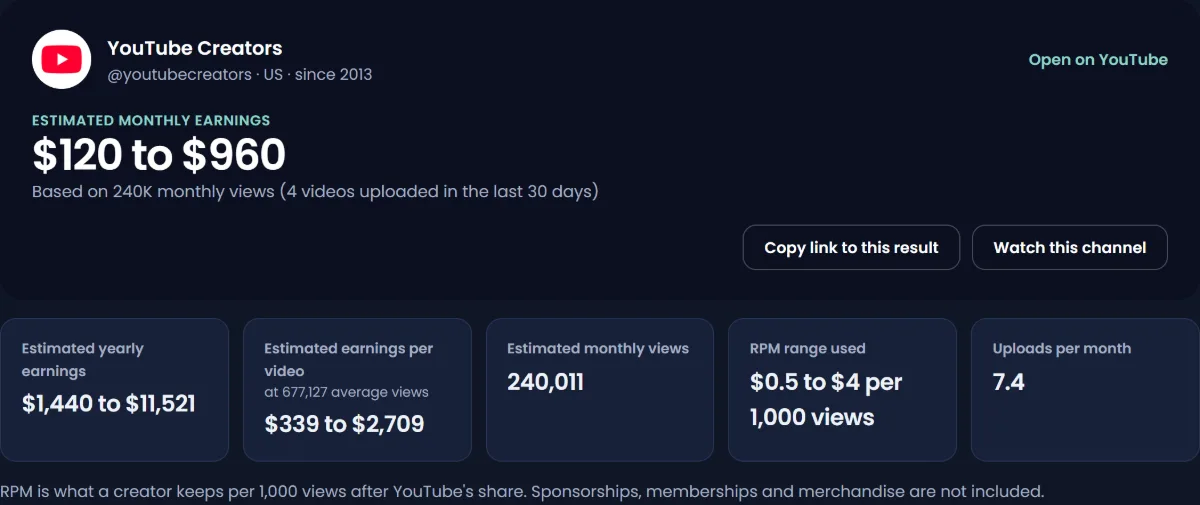
You do not need to calculate the split yourself, because RPM already includes it. Multiply monthly views by RPM per 1,000:
Monthly ad earnings = (monthly views / 1,000) x RPM
The YouTube money calculator does this for any channel using its last 30 days of views. First check the channel is in the Partner Program with the monetization checker, because without it the split does not apply. To see how the money then reaches you, read how and when YouTube pays you.