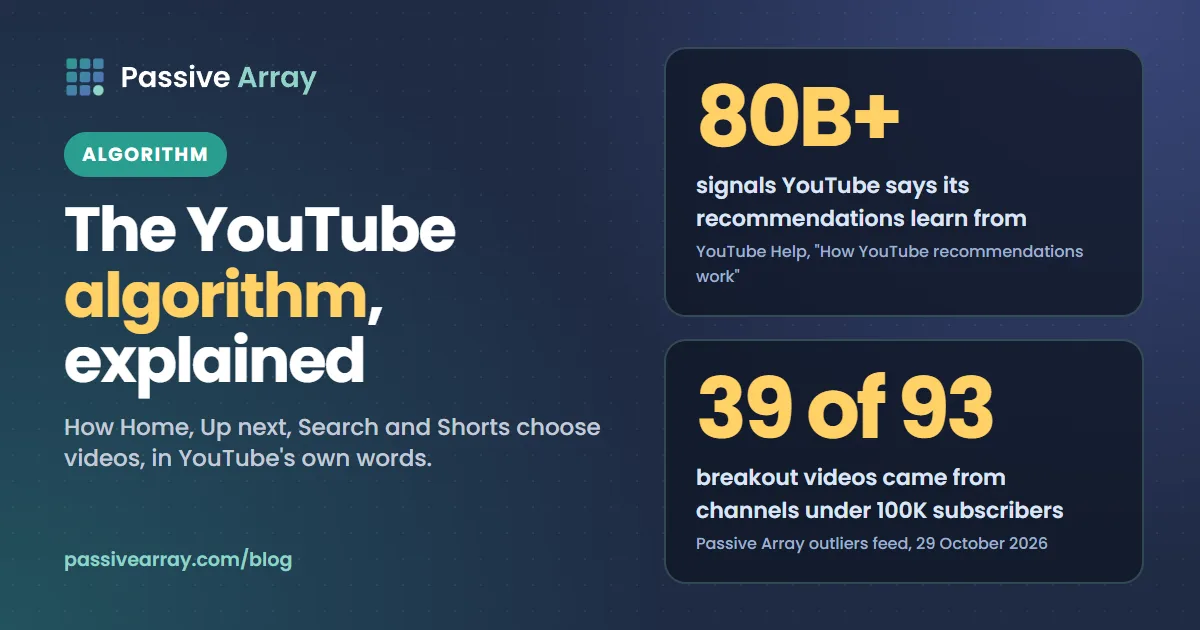
The YouTube algorithm is not one formula. It is a set of recommendation systems that choose videos for each viewer on Home, in Up next, in Search and in the Shorts feed. YouTube says it learns from over 80 billion signals, such as what people watch, skip, search for, like and dislike, and what they say in satisfaction surveys. It uses those signals to predict which videos a particular viewer will be glad they watched. It does not rank videos by a fixed score, and it does not reward a channel for uploading at a certain time, using tags or posting every day.
This guide is built only on what YouTube itself has published: its Help Center, its How YouTube Works site, and a 2021 post by its VP of Engineering. Where we add our own advice or data, we say so. The sources are linked at the end.
The short version
- Recommendations follow the audience. YouTube predicts what a specific viewer will enjoy, based on how similar viewers responded to a video. YouTube tells creators to ask "Does my audience like this?" rather than whether the algorithm likes it.
- Each video is judged on its own. YouTube says the system uses "fresh performance data for each individual video, rather than relying on past results."
- Satisfaction beats raw watch time. Clicks and watch time matter, but YouTube also asks viewers in surveys whether a video was worth their time.
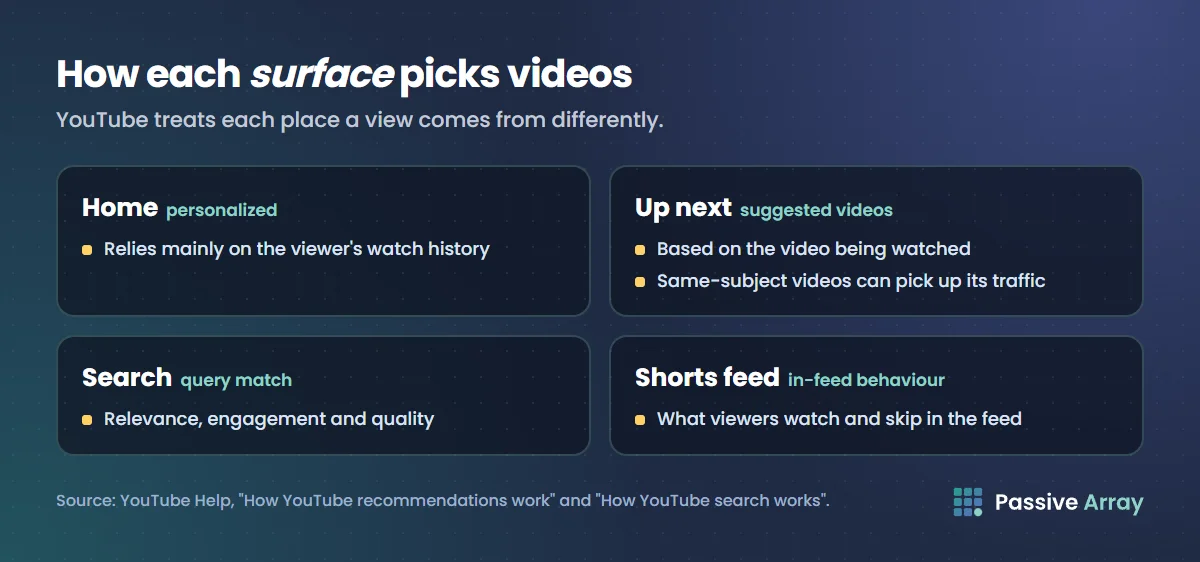
- Each surface works differently. Home leans on the viewer's history, Up next on the current video, Search on how well a video matches the query, and Shorts on what the viewer did in the feed.
- Many popular beliefs are wrong. Publish time, tags, breaks, channel location and monetization status do little or nothing to recommendations, according to YouTube.
The algorithm follows viewers, not videos
The most useful thing YouTube has said about its recommendations is that it does not judge videos in the abstract. It predicts what one viewer, at one moment, is likely to watch and be satisfied with. YouTube's Help Center says videos are ranked on Home by their performance and by the viewer's watch and search history. It describes performance as "how well your video has interested and satisfied similar viewers."
So a video is not "good" or "bad" to the algorithm. It is good for some viewers. If the people it is shown to keep watching and seem satisfied, YouTube shows it to more people like them. If they ignore it, click and leave quickly, or tell YouTube they are not interested, it is shown less.
Two consequences follow:
- A small channel can get recommended. YouTube says the system judges each video on fresh data, not on the channel's history. In our own outliers feed, which tracks long-form videos getting many times their channel's usual views, 39 of the 93 breakout videos listed on 29 October 2026 came from channels with fewer than 100,000 subscribers.
- A big channel can stall. YouTube also says that "frequently sharing content that doesn't resonate, can, over time, affect your channel's overall performance." That is not a penalty. It means the channel's regular viewers stop watching, so there are fewer satisfied viewers for the system to learn from.
How each surface works
Most views come from five places. YouTube treats each one differently.
| Surface | Main signal, in YouTube's words | What it means for you |
|---|---|---|
| Home | "Primarily a personalized surface", relying mainly on watch history | Your video appears to people whose history resembles your current viewers |
| Up next and suggested videos | "Suggestions based on the video you're watching" | Videos on the same subject as a popular video can pick up its traffic |
| Search | Relevance, engagement and quality | The title, description and content must match the query, and the video must satisfy those searchers |
| Shorts feed | "Personalized to reflect what we think you want to see next" | Each Short is tested on what viewers watch and skip in the feed |
| Subscriptions and notifications | Your subscribers' choices | Only a share of subscribers see or open each upload |
Home
Home is where most large channels get most of their views. It mixes videos from subscriptions, videos similar to what the viewer has watched, and some new things the system thinks they may like. If a viewer turns off their watch history and has no meaningful history, YouTube says Home shows only the search bar and the side menu, which shows how much Home depends on history.
Up next and suggested videos
Suggested videos are ranked by how likely the viewer is to watch them next, and can be personalized by watch history. In YouTube Studio this traffic is labelled Suggested videos, and it includes views from links in other videos' descriptions. A video that works well next to another popular video in your niche can keep earning suggested traffic for as long as that video is watched.
Search
YouTube's Help Center names three elements in search ranking:
- Relevance: "how well the title, tags, description, and video content match your search query."
- Engagement: "Engagement signals are a valuable way to determine relevance," such as how long people watch videos for that query.
- Quality: signals that "help determine which channels demonstrate expertise" on the topic.
YouTube says how much each element counts "may vary by search type". It adds that search results "are not a list of the most-viewed videos for a given search", and that YouTube "doesn't accept payment for better placement within organic search results." Search can also be personalized from search and watch history, so two people can see different results for the same words.
Search is the surface where a new channel competes mostly on how well it answers the query, not on how many people already watch it. Our keyword generator shows the real phrases people type, and free YouTube keyword research explains how to choose between them.
Shorts
The Shorts feed is personalized from what viewers watch, skip and engage with inside the feed. Shorts traffic is reported separately in Studio as Shorts. Because viewers swipe rather than choose from thumbnails, the opening second does the job a thumbnail does on long-form video.
The signals YouTube has named
YouTube lists the signals it uses on its Help Center and in its engineering posts. It does not publish their weights.
| Signal | What it tells YouTube |
|---|---|
| Clicks | YouTube's VP of Engineering wrote that clicking a video "provides a strong indication that you will also find it satisfying" |
| Watch time | Which videos people watched and for how long |
| Satisfaction surveys | Whether the viewer felt the video was worth their time |
| Likes and dislikes | YouTube calls them "some of the hundreds of signals we consider for ranking" |
| Shares | People are more likely to be satisfied with videos they share or like |
| "Not interested" and "Don't recommend channel" | Direct feedback that removes videos from that viewer's recommendations |
| Watch and search history | What each viewer has shown interest in before |
| Subscriptions | Channels the viewer chose to follow |
How YouTube measures satisfaction
YouTube's recommendations have changed what they optimize for over time, and it has explained why.
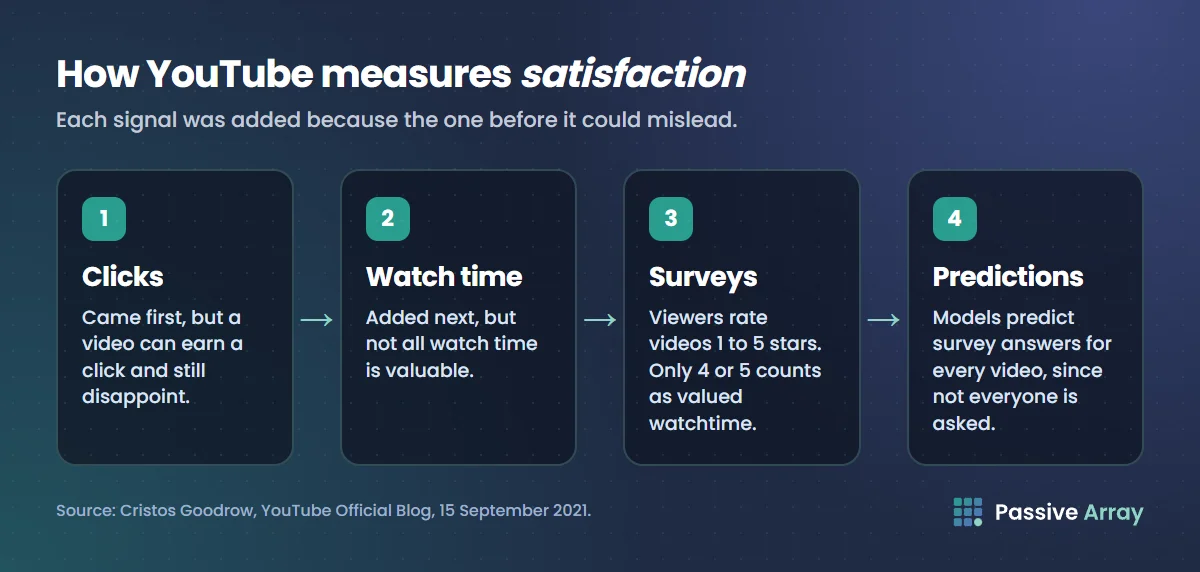
Clicks came first. In a 2021 post, YouTube's VP of Engineering, Cristos Goodrow, wrote that clicks alone could mislead, because a video can earn a click and still disappoint. So YouTube added watch time. But not all watch time is equal either: "We don't want viewers regretting the videos they spend time watching." So YouTube added surveys.
Viewers are sometimes asked to rate a video they just watched from one to five stars. In Goodrow's words, "Only videos that you rate highly with four or five stars are counted as valued watchtime." YouTube cannot survey everyone, so it trains models to predict how viewers would answer, and uses those predictions across all videos.
This is why clickbait has a short life. A misleading thumbnail can win the click, but the viewer leaves early, rates the video poorly if asked, and the system learns that the video does not satisfy people like them.
Average view duration or average percentage viewed?
Creators often ask which retention number matters more. YouTube says both are signals. Relative watch time, meaning average percentage viewed, matters more for short videos. Absolute watch time, meaning average view duration, matters more for long ones. A 90% average on a two-minute video and a 40% average on a 30-minute video can both be strong.
Borderline content and authoritative sources
For news and topics where accuracy matters, YouTube does not rely only on viewer behaviour. Goodrow's post says classifiers, trained with the help of human evaluators, score how authoritative a video is. "The higher the score, the more the video is promoted when it comes to news and information content." Videos classified as borderline, meaning close to breaking the rules without crossing the line, are treated differently: "Any video classified borderline is demoted in recommendations."
For most creators this rarely matters. If you cover health, finance, elections or breaking news, it matters a lot. Expertise and trustworthy sourcing affect reach on those subjects, not just engagement.
What does not affect recommendations
YouTube's performance FAQ answers most of the theories creators pass around. Here is what it says.
| Belief | What YouTube says |
|---|---|
| "Upload at the perfect time." | Publish time "is not known to impact a video's long-term performance". It matters more for Live and Premiere videos. Best time to post explains when timing helps |
| "You must upload daily or weekly." | View growth is not correlated with time between uploads. Quality matters more than frequency |
| "Taking a break kills your channel." | YouTube found no correlation between how long a break lasts and how views change. It may take time to re-engage viewers afterwards |
| "Tags drive recommendations." | YouTube calls tags "not important". They mainly help with common misspellings. See do YouTube tags still matter |
| "Demonetized videos get buried." | The system does not track monetization status. Some content is both demonetized and recommended less, because of what it contains |
| "Set your channel country to reach that country." | Channel location settings are not used in recommendations |
| "A flop hurts your next video." | Not directly. Channel views fall only when viewers stop watching most of a channel's videos |
| "Switching a video from unlisted to public hurts it." | No. What matters is how viewers respond after it is public |
Three more beliefs that YouTube has not addressed directly, with our view:
- "Deleting old videos resets the algorithm." Since each video is judged on its own viewers, removing an old video does not boost new ones. It does remove whatever views that video was still earning.
- "Long videos are always favoured." YouTube says satisfaction matters, not length. A tight eight minutes that viewers finish beats a padded twenty.
- "Shorts hurt long-form." YouTube's Help Center does not say this. Shorts and long-form are recommended on different surfaces to viewers in different modes, so judge each format by its own numbers.
Why your views dropped
YouTube lists the common reasons traffic from Home or Suggested falls:
- Your viewers are watching other content, or spending less time on YouTube overall, which is often seasonal.
- An earlier video went viral, and normal results look low next to that spike.
- You uploaded less often, so there were fewer new videos to recommend.
- Interest in your topic is declining.
Most of these are about viewers, not a penalty. To find which one applies, check traffic sources in Studio and compare the same period last year. YouTube Analytics explained shows where.
Why an old video suddenly takes off
YouTube gives the reverse reasons too: the topic is rising, new viewers are binge-watching older videos, the video is getting more clicks from recommendations, or a new upload sent viewers back to earlier episodes. An old video taking off is often a sign of what your audience wants more of.
Changing a title or thumbnail after upload
YouTube says changing a title or thumbnail may change how a video performs, because viewers respond differently to the new version. It also advises: "don't change what's working." If a video is still growing, leave it alone. If it stalled because few people clicked, a better title or thumbnail can give it a second chance. Studio's Test & compare feature runs up to three titles or thumbnails against each other on desktop, and chooses the one with the most watch time.
What this means for your videos
This part is our advice, built on what YouTube has said above.
- Earn the click honestly. The title and thumbnail should make a promise the video keeps. The title analyzer and thumbnail tester help with the first half. The video has to do the second.
- Keep the promise early. Viewers who leave in the first 30 seconds tell YouTube the video did not match the click. Show the payoff, or a clear path to it, at the start.
- Make videos for one audience. Recommendations spread through similar viewers. A channel that jumps between unrelated subjects gives the system no consistent group to learn from.
- Answer real searches. Search is the surface where a new channel competes on relevance rather than reputation. The keyword generator shows what people type.
- Build series. End screens, playlists and follow-up videos send satisfied viewers to your next video, and YouTube lists new uploads sending viewers back to old ones as a reason old videos grow.
- Ignore the hacks. Upload times, tag stuffing and daily uploads are not what YouTube rewards. A better video for the same audience is.
- Judge by your audience. If your regular viewers come back and watch to the end, the systems will find more people like them.
For the numbers that show whether this is working, read YouTube Analytics explained. For fixes grouped by the problem they solve, read how to get more views on YouTube.
Sources
- YouTube Help: How YouTube recommendations work
- YouTube Help: YouTube's recommendation system
- YouTube Help: How YouTube search works
- YouTube Help: YouTube performance FAQ and troubleshooting
- YouTube Official Blog: On YouTube's recommendation system, Cristos Goodrow, 15 September 2021
- YouTube Help: Test and compare thumbnails and titles
Frequently asked questions
What is the YouTube algorithm?
It is the set of recommendation and search systems that decide which videos each viewer sees on Home, in Up next, in Search and in the Shorts feed. YouTube says it learns from over 80 billion signals and aims to show each viewer videos they will be satisfied with.
How does the YouTube algorithm work in 2026?
It predicts what a specific viewer will watch and enjoy, using that viewer's history and how similar viewers responded to each video. Home relies mainly on watch history, Up next on the current video, Search on relevance, engagement and quality, and Shorts on behaviour in the feed. Each video is judged on its own fresh performance data.
Are CTR and watch time the main ranking factors?
They are two of the main signals, but not the only ones. YouTube has said clicks alone can mislead and that not all watch time is valuable, so it also uses satisfaction surveys, likes, dislikes, shares and "Not interested" feedback. It does not publish how much each one counts.
Does the time I publish affect the algorithm?
Not over the long term. YouTube says publish time is not known to affect a video's long-term performance. Publishing when your viewers are online can bring faster early views, and timing matters more for Live and Premiere videos.
Does taking a break hurt my channel?
YouTube says it found no correlation between the length of a break and changes in views, and encourages creators to take breaks when they need them. Fewer uploads mean fewer new videos to recommend, so views may dip, and it can take time to re-engage your audience.
How often should I upload?
There is no required schedule. YouTube says view growth is not correlated with the time between uploads, and that quality matters more than quantity. Upload as often as you can while keeping each video worth watching.
Do tags help the algorithm?
Barely. YouTube describes tags as not important, mainly useful for common misspellings of your topic. Title, thumbnail, description and the video itself matter far more.
Can a new channel get recommended?
Yes. YouTube says the system uses fresh performance data for each video rather than the channel's past results. A new channel's video that satisfies the viewers it is first shown to can be recommended more widely.
Does demonetization reduce recommendations?
YouTube says its recommendation system does not track monetization status. Some content, such as violent or graphic material, may be both demonetized and recommended less, but because of what it contains, not because ads are off.
By Nasir Uddin, founder of Passive Array. Rules and figures checked Oct 29, 2026.