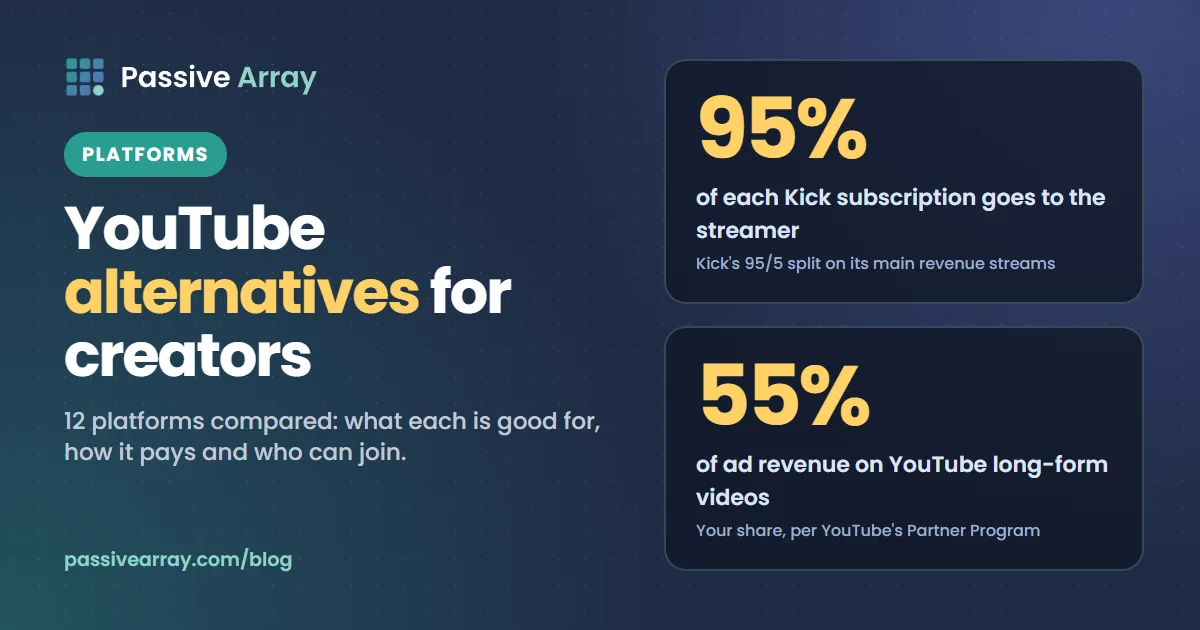
No platform replaces YouTube for long-form video that keeps getting found through search for years. But several are better at specific things:
- Twitch and Kick for live streaming.
- TikTok, Instagram and Snapchat for short vertical video and fast discovery.
- Facebook for reaching an older, broad audience.
- Rumble and Dailymotion for long-form video outside YouTube.
- Patreon for direct fan support.
- Vimeo for hosting video you sell or embed.
Most successful creators use YouTube plus one or two of these, rather than leaving it.
This guide is for creators who want to know where else to publish and how each platform pays. Every payment rule below comes from the platform's own help pages or announcements, checked in October 2026. Platforms change these often, and several changed them in 2026, so confirm on the official page before you rely on one. Sources are linked at the end. If you are a viewer looking for sites like YouTube, skip to the section near the end.
At a glance
| Platform | Best for | How creators earn | Who can earn |
|---|---|---|---|
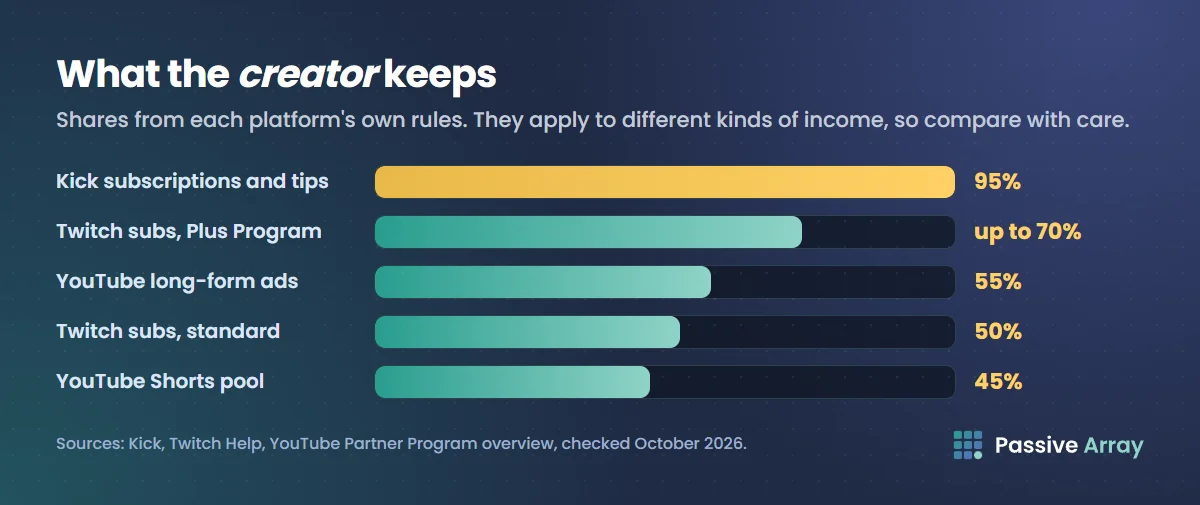
| YouTube (for comparison) | Long-form, search, Shorts | 55% of ad revenue on long-form, a pooled 45% on Shorts, Premium, fan funding | 1,000 subscribers plus 4,000 watch hours or 10M Shorts views |
| Twitch | Live streaming, gaming | Subscriptions, Bits, ads | Affiliates and Partners |
| Kick | Live streaming | Subscriptions and tips, 95% to the streamer | Streamers with subscriptions enabled |
| TikTok | Short video, discovery | Creator Rewards Program for videos over a minute | 18+, 10,000 followers, 100,000 views in 30 days |
| Short video, community | Subscriptions, gifts, bonuses | Varies by feature; gifts need 500 followers | |
| Older, broad audience | Content Monetization program | By invitation | |
| Snapchat | Short video, Stories | Unified Monetization Program, ads in Stories and Spotlight | By invitation; 50,000 followers among the criteria |
| X | Text and video posts | Original Content Rewards | Premium subscribers who meet its criteria |
| Rumble | Long-form video and streaming | Creator Program paid on watch time and sign-ups | Selected countries; criteria below |
| Dailymotion | Long-form video | Partner Program ad revenue share | Check Dailymotion's current terms |
| Vimeo | Hosting, selling video | Selling through Vimeo's streaming storefronts | Paid plans; no ad revenue |
| Patreon | Paying fans | Memberships; 10% platform fee | Anyone |
For the YouTube side in full, read YouTube monetization requirements and YouTube ad revenue explained.
Four ways platforms pay creators
It helps to know the model before comparing numbers, because the platforms pay in very different ways.
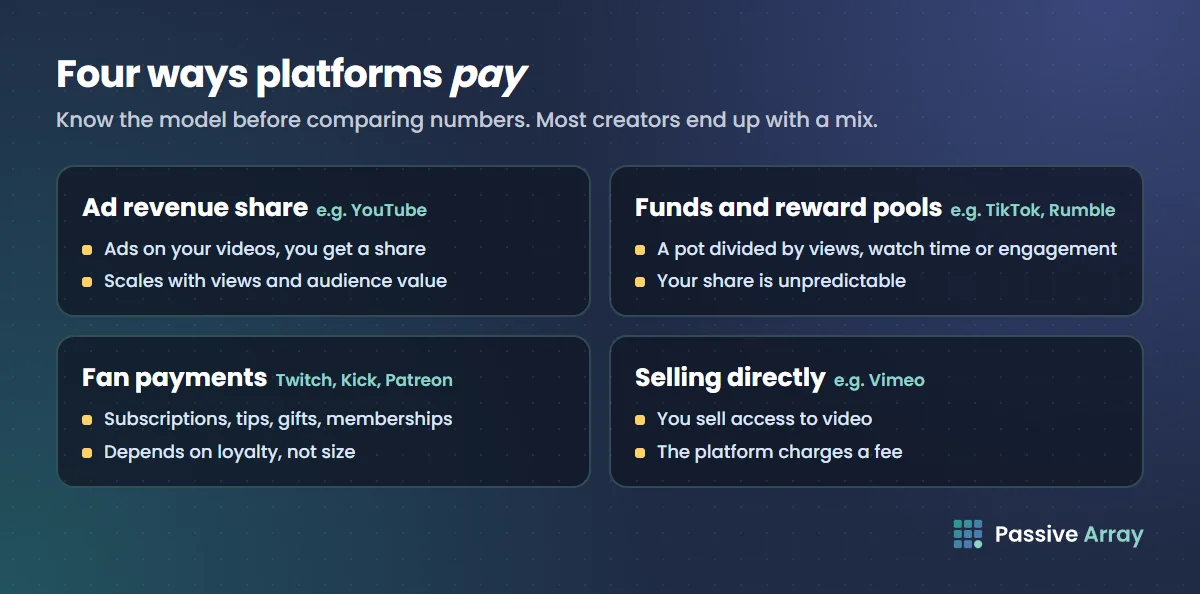
- Ad revenue share. The platform shows ads on your videos and pays you a share. YouTube is the main example. Earnings scale with views and with how valuable your audience is to advertisers.
- Creator funds and reward pools. The platform sets aside money and divides it between eligible creators by views, watch time or engagement. TikTok's Creator Rewards, Snapchat's program, X's rewards and Rumble's Creator Program all work broadly this way. You cannot predict your share in advance.
- Fan payments. Subscriptions, tips, gifts and memberships, with the platform taking a cut. Twitch, Kick, Patreon and Instagram subscriptions work this way. Earnings depend on how loyal your audience is, not how large.
- Selling directly. You sell access to video, and the platform takes a fee or charges for the service. Vimeo works this way.
Most creators end up with a mix. Ad and fund income is the least predictable. Fan payments and direct sales are the most stable, because they depend on people who already like you.
Twitch
The biggest live-streaming platform after YouTube. Most creators start as Affiliates. In 2026 Twitch lowered the Affiliate requirements to 4 hours streamed on 4 different days, an average of at least 3 concurrent viewers, and 25 followers, all within 30 days. You do not apply. Twitch invites you once you meet them.
The standard subscription split is 50/50. Twitch's Plus Program raises it to 60/40 or 70/30 for streamers who hold enough paid subscriptions for three months in a row. Twitch also pays for Bits, which viewers buy to tip, and a share of ads.
Good for: gamers, live hosts, and anyone whose content is better live than edited. Watch out for: discovery is weak for new streamers. Most grow by bringing an audience from elsewhere, often YouTube clips.
Check any Twitch channel's numbers with our Twitch follower count checker, or follow one over time with the Twitch follower tracker.
Kick
A newer live-streaming platform built on a generous split. Kick says it uses a 95/5 split on its main revenue streams: of each subscription, the streamer keeps 95%, and tips are split the same way. Its Partner Program has higher bars, including streaming hours, unique chatters, subscribers, followers and average concurrent viewers over 30 days.
Good for: streamers whose audience will follow them, and who want the highest share of what fans pay. Watch out for: a smaller audience than Twitch or YouTube, and fewer ways for new viewers to find you.
TikTok
The strongest platform for being discovered by strangers fast. TikTok's Creator Rewards Program pays for original videos at least one minute long. To join you need to be 18 or older, have at least 10,000 followers and at least 100,000 video views in the last 30 days, and use a personal account rather than a business one. The program is only available in some countries, so check in the app under your creator tools.
Good for: testing ideas quickly, and reaching people who have never heard of you. Watch out for: reach can be very uneven from one video to the next, and short videos rarely build the long-term search traffic that YouTube does.
Estimate what a TikTok account could earn with our TikTok money calculator, or what it could charge brands with the TikTok pricing calculator.
Instagram pays through subscriptions, gifts that viewers send on Reels, and bonuses offered to some creators. Gifts need a professional account, an age of 18 or over, and at least 500 followers. Most Instagram income still comes from brand deals, because brands value Instagram's audience and its shopping features.
Good for: lifestyle, fashion, food, fitness and any creator whose audience follows a person. Watch out for: platform payouts are small compared with brand deals, so treat Instagram as a sponsorship channel first.
The Instagram money calculator estimates what an account could charge, and how much to charge for a sponsored Instagram post explains pricing.
Facebook merged in-stream ads, ads on Reels and performance bonuses into one Content Monetization program in 2024. It started as an invitation-only beta. Creators can register interest from the Monetization section of the Professional Dashboard. Facebook has not published fixed eligibility numbers.
Good for: reaching an older audience than most video platforms, which suits niches like home, cooking, finance and local news. Watch out for: eligibility is not in your control while the program is invitation-based.
Snapchat
Snapchat replaced its older Spotlight rewards with a unified Monetization Program from February 2025. It pays a share of ads shown in creators' Stories and, for the first time, in Spotlight videos longer than one minute. Snap says creators may be invited if they meet its criteria, which include at least 50,000 followers, posting at least 25 times a month to Saved Stories or Spotlight, posting on at least 10 of the last 28 days, and reaching one of three thresholds in the last 28 days: 10 million Snap views, 1 million Spotlight views or 12,000 hours of view time.
Good for: creators with a young audience and a daily posting habit. Watch out for: the bar is high, and it rewards very frequent posting.
X
In 2026 X closed its Creator Revenue Sharing program. It stopped accepting new members on 7 August 2026 and retired the program on 7 September 2026. X now points creators to a new Original Content Rewards program, which pays on qualified impressions of original posts from Premium subscribers. Copied posts and reposts of other people's content do not qualify. You need a Premium subscription and must meet the program's criteria, which you can check under Creator Studio.
Good for: commentary, news, tech and finance creators who already post there. Watch out for: the rules have changed several times, and payouts depend on an audience of paying subscribers.
Rumble
A long-form video and live-streaming platform positioned as an alternative to YouTube. Rumble's Creator Program pays creators a share of a fund based on the watch time they generate, the new users they bring to Rumble, and the Rumble Premium sign-ups their content drives. Rumble's help center lists these requirements: at least 100 followers, at least one hour streamed through Rumble Studio in the last 30 days, and an active Rumble Premium account. The program is open only to creators in Australia, Canada, El Salvador, North Macedonia, South Korea, the United Kingdom and the United States.
Good for: creators in those countries whose audience already follows them there. Watch out for: a much smaller audience than YouTube, and no simple fixed revenue split.
Dailymotion
One of the oldest YouTube alternatives, based in France. Dailymotion runs a Partner Program that shares ad revenue with creators, and it has offered rentals and subscriptions in the past. We could not confirm its current eligibility thresholds or payout minimum on an official Dailymotion page, so check its help center before relying on any figure you see quoted. Its audience is far smaller than YouTube's, so the same video usually earns much less.
Vimeo
Vimeo is a hosting and business video platform, not an ad-funded audience platform. It shows no ads and shares no ad revenue. Creators earn by selling video through Vimeo's streaming storefronts, where they set the price for subscriptions, rentals or purchases and pay Vimeo for the service. Note that Vimeo's older Vimeo On Demand store shuts down fully on 20 November 2026. If you sell there, move your catalogue before then.
Good for: filmmakers, course creators and businesses that want clean, ad-free video to embed or sell. Watch out for: you bring all your own audience. Vimeo will not find viewers for you.
Patreon
Not a video platform, but where many YouTubers earn their most dependable income. Fans pay a monthly membership for extra videos, early access, behind-the-scenes posts or community. Creators who launched on Patreon after 4 August 2025 pay a standard 10% platform fee, plus payment processing, currency conversion and payout fees.
Good for: any creator with a loyal audience, in any niche. Watch out for: you need an audience first. Patreon does not bring you new fans.
YouTube's own channel memberships do a similar job inside YouTube, and unlock at 500 subscribers in the Partner Program's lower tier.
Nebula
A streaming service owned by its creators, mainly for educational and documentary channels. It is not open to anyone: creators join by invitation. Members pay a subscription and see videos without ads, often before they appear on YouTube. If you make educational content and are invited, it can be a useful second income. Otherwise it is not an option you can apply to.
How to use these alongside YouTube
The strongest setup for most creators is one home platform plus one or two others that feed it.
| You make | Home platform | Add | How they connect |
|---|---|---|---|
| Live gaming or chat | Twitch or Kick | YouTube | Upload highlights and edited videos to YouTube, which brings new viewers to the stream |
| Long tutorials or explainers | YouTube | TikTok or Instagram | Post one tip from each video as a short, pointing to the full video |
| Commentary or news | YouTube | X | Post takes as they happen, link to the full video |
| Films or courses | Vimeo or your own site | YouTube | Free trailers and lessons on YouTube, paid content on Vimeo |
| Anything with a loyal audience | YouTube | Patreon or memberships | Extra or early videos for paying fans |
Three rules make this work:
- Repurpose, do not duplicate. Cut a vertical version for short-video apps rather than reposting the same file everywhere.
- Point everything to one place. Each platform's content should give people a reason to visit your home platform, where you earn the most and own the audience.
- Track each platform separately. Compare channels and accounts with our YouTube channel comparison, TikTok account comparison and Twitch channel comparison.
Should you leave YouTube?
Rarely. Leaving YouTube entirely usually costs more than it saves, because its search traffic keeps old videos earning for years, and no other platform matches its long-form audience. The usual reasons creators look elsewhere are demonetization, copyright problems or slow growth. Each has a fix on YouTube itself:
- Demonetized? Read YouTube demonetization for how to appeal.
- Copyright trouble? Copyright claim vs strike explains how to resolve both.
- Not growing? How to get more views on YouTube shows how to find the problem.
To see what your YouTube views are worth before comparing, run your channel through the YouTube money calculator.
Sites like YouTube, for viewers
If you are a viewer looking for alternatives to YouTube rather than a creator, these are the main options:
- Dailymotion for general video, news and sport clips.
- Vimeo for short films and high-quality independent work.
- Twitch and Kick for live streams.
- TikTok for short videos.
- Rumble for long-form video and streams, with an audience that leans towards political commentary.
- Nebula for ad-free educational videos, by subscription.
- PeerTube, an open-source, decentralized video platform run by independent servers rather than one company.
None has YouTube's range. Most viewers use one of these alongside YouTube rather than instead of it.
Sources
- Twitch Help: Joining the Affiliate Program
- Snap Newsroom: Snapchat introduces new, unified monetization program for creators
- X Help Center: Creator Revenue Sharing
- Rumble Help Center: Rumble Creator Program
- Patreon: Pricing
- YouTube Help: YouTube Partner Program overview and eligibility
Frequently asked questions
What is the best alternative to YouTube for creators?
It depends on what you make. Twitch or Kick for live streaming, TikTok or Instagram for short video, Patreon for fan support and Vimeo for selling video. For long-form video that keeps getting found through search, no platform matches YouTube, so most creators add one of these rather than leaving.
Which platform pays creators the most?
There is no single answer, because platforms pay in different ways. Kick gives streamers the largest share of subscriptions and tips at 95%. YouTube's ad share of 55% on long-form is high for an ad platform. For many creators the biggest income comes from Patreon memberships and brand deals rather than any platform payout.
Are there websites like YouTube?
Yes. Dailymotion, Vimeo, Rumble, Twitch, Kick, TikTok, Nebula and PeerTube all host video. Dailymotion and Rumble are closest to YouTube for long-form video, but both have far smaller audiences.
Can I post the same video on YouTube and other platforms?
Yes, if you own the content. YouTube does not require exclusivity. It is better to adapt each upload to the platform, such as a vertical cut for TikTok and Instagram, than to post the same file everywhere.
Is Rumble better than YouTube for creators?
For most creators, no. Rumble's audience is much smaller, and its Creator Program is limited to a few countries. It suits creators in those countries whose audience already follows them there.
Does X still pay creators?
Yes, through a different program. X retired Creator Revenue Sharing on 7 September 2026 and replaced it with Original Content Rewards, which pays Premium subscribers for qualified impressions on original posts.
Is Twitch or YouTube better for streaming?
Twitch has the stronger live-streaming culture and chat features. YouTube is better at being found after the stream, because recordings and clips keep getting search and suggested views. Many streamers go live on Twitch and upload edited videos to YouTube.
What happened to Vimeo On Demand?
Vimeo is shutting down its Vimeo On Demand store, which closes fully on 20 November 2026. Vimeo itself continues as a hosting and business video platform. Sellers need to move their videos and customers to another storefront before then.