To grow a YouTube channel, you need more than views: you need viewers who come back. YouTube itself splits your audience into new, casual and regular viewers, and a channel grows when a steady share of new viewers turns into regulars who watch again and again. That comes from a clear promise (who the channel is for), videos that connect into series, and a reason to return each week. Track the result with the YouTube Channel Growth Tracker, which records a channel's public subscribers and views day by day, so you can see whether the curve is bending, not just whether one video did well.
This guide is about building that audience. If your problem is that individual videos get few views, start with how to get more views on YouTube, which covers impressions, click-through rate and retention. Views are the top of the funnel. Everything below is about what happens after the first view.
One rule before anything else: do not buy subscribers or join sub-for-sub groups. YouTube's fake engagement policy lists "offering to subscribe to another creator's channel only if they subscribe to your channel" as fake engagement, and says traffic found to be artificial "will not be counted" and "can lead to strikes on your account". People who subscribe for a favour never watch, and an audience that never watches is worse than a small one.
Views, subscribers and regular viewers are different numbers
Creators often treat subscribers as the goal. YouTube does not. Its performance FAQ says your subscriber count "reflects how many viewers have subscribed", and that the count "doesn't represent the number of viewers who watch your videos". It adds that "it's also common for viewers to be subscribed to channels they no longer watch."
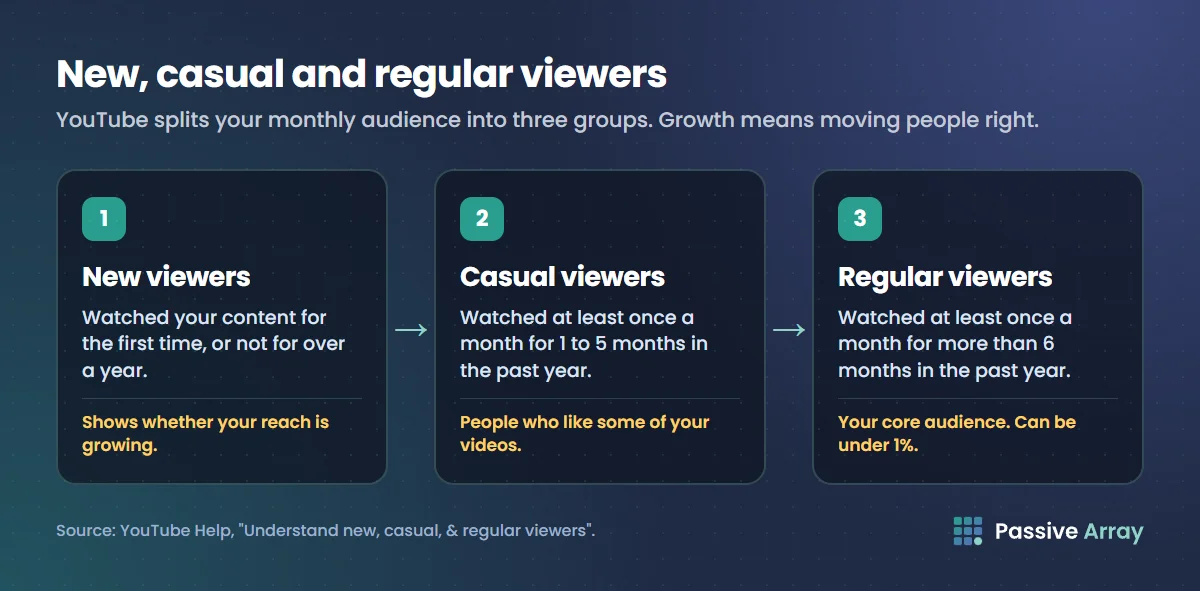
The number that shows a healthy channel is how many people come back. YouTube Studio groups your monthly audience (unique viewers in the last 28 days) into three segments:
| Segment | YouTube's definition | What it tells you |
|---|---|---|
| New viewers | Watched your content for the first time (also counts viewers who have not watched you for over a year, or who use private browsing or cleared history) | Whether your reach is growing |
| Casual viewers | Watched "at least once per month for one to 5 months in the past year" | People who like some of your videos |
| Regular viewers | Watched "at least once per month for more than 6 months in the past year" | Your core audience: the people who make the channel stable |
YouTube calls regular viewers "your most loyal audience members", and warns that the share can be small: "as low as <1%", especially for new channels, channels with a trending video, or channels that mostly post Shorts. These segments do not change your reach or monetization. They are a diagnostic, and the most honest one YouTube gives you.
A useful public proxy is views per subscriber: how many views a typical new video gets compared with the subscriber count. If it keeps falling, your subscribers have stopped watching. Views per subscriber explains how to calculate and read it for any channel.
Step 1: decide who the channel is for
Recommendations spread through similar viewers. YouTube says each video is recommended based on how well it has "interested and satisfied similar viewers", and tells creators to ask "Does my audience like this?" A channel can only build a group of regulars if its videos keep appealing to the same group.
Write your channel promise in one sentence, using this template:
"Videos that help [specific viewer] [get specific result or feel specific thing]."
| Too broad | Specific |
|---|---|
| Tech videos | Honest reviews of budget Android phones for students |
| Cooking | 20-minute dinners for people who hate washing up |
| Gaming | Strategy guides for players stuck in the ranked mid-tier of one game |
| Finance tips | Money basics for first-time earners in their twenties |
The specific version is not smaller in the long run. It is easier for YouTube to match with viewers, and easier for a viewer to decide "this channel is for me" and subscribe. You can widen later, once you have regulars who trust you.
If you are not sure which subject has room, the YouTube Niche Finder helps you compare topics, and the best YouTube niches compares pay, competition and effort across common categories. Pick something you can make 50 videos about without running out of ideas or interest.
When to start a second channel instead
If you want to cover two subjects whose audiences barely overlap, such as chess and home workouts, one channel will confuse both groups. YouTube says that "frequently sharing content that doesn't resonate, can, over time, affect your channel's overall performance": not as a penalty, but because the people who come for one topic stop watching the other. A second channel is often cleaner than a mixed one.
Step 2: make a channel a new visitor wants to subscribe to
Someone who liked one video usually visits your channel page before subscribing. What they see there decides whether they subscribe.
- Set a channel trailer for new visitors. In YouTube Studio, go to Customization > Home tab, then under Layout click Add section and choose Channel trailer. YouTube shows the trailer to people who have not subscribed. Keep it under a minute: who the channel is for, what they get, how often.
- Set a featured video for returning subscribers. Same path, but choose Spotlight. Use your newest or best video, so people who already subscribe have something to click.
- Organise the Home tab into sections. YouTube allows up to 12 custom sections. Use playlists named by viewer need ("Start here", "Beginner guides", "Full reviews"), not by date.
- Make the banner and description repeat the promise. One sentence, the same one you wrote above. YouTube's own tips for growing regular viewers include using "consistent branding across your channel".
- Choose a name people can remember and search. Short, easy to spell, and close to what the channel is about.
A channel page with 20 random videos sorted by date gives a visitor no reason to stay. A channel page that says "if you are a beginner, start here" gives them a path.
Step 3: build series, not one-off videos
YouTube's first tip for growing regular viewers is to "upload consistent content about similar topics, or in a familiar format". The simplest way to do that is a series: a repeating format with a clear name, so a viewer who liked episode 3 knows episodes 1, 2 and 4 exist.
Good series have three things:
- A repeatable format. "Budget phone, 30 days later", "Fixing a subscriber's channel", "Beginner recipe of the week".
- A reason to watch the next one. A problem that continues, a ranking that updates, a challenge with stages.
- Links between episodes. End screens pointing to the next episode, a series playlist, and a pinned comment with the playlist link.
YouTube's performance FAQ lists a new video in a series sending people back to older episodes as a common reason old videos suddenly grow. A series is how one good video lifts the ones around it.
Use playlists as your main navigation
Put every video in at least one playlist, ordered the way a viewer should watch them. A playlist that plays automatically from one video to the next keeps a new viewer with you for several videos in a row, which is exactly how casual viewers become regulars. Link the playlist, not just the single video, in your end screens and descriptions.
Get ideas that fit the series
When a series runs out of ideas, it dies. The YouTube Video Ideas Generator gives topic ideas for a niche, and YouTube video ideas for beginners lists formats that work for small channels. Your own comments are the best source: every question a viewer asks is a possible episode.
Step 4: give people a reason to subscribe, then ask
A subscribe request works when the viewer has just got something useful. Asking in the first ten seconds, before they know whether they like you, rarely works.
A better pattern:
- Deliver the main promise of the video.
- Point to what is coming next: "Next week I am testing the cheapest phone on this list for 30 days."
- Then ask: "If you want to see how that goes, subscribe."
The ask is now tied to a future video they want. That is a reason, not a favour.
Find out where subscribers come from
YouTube Studio shows which surfaces turn viewers into subscribers. Go to Analytics, click See more on any card, then choose Subscription source at the top. The rows include the watch page, your channel page, search, end screens and watermarks, posts and external sites. If the channel page converts well, invest in it. If almost all subscribers come from one or two videos, make more videos like those. The same report also shows subscriber losses from the subscriptions list, which tells you whether a change of direction is pushing people away.
Step 5: turn viewers into a community
YouTube names "community-building features like posts, comments, and live premieres/chats" as a way to grow regular viewers. These matter because they give people a reason to come back between uploads.
| Feature | Where it shows | How to use it |
|---|---|---|
| Posts (text, images, polls, quizzes, video) | Your channel, and sometimes viewers' Home and Subscriptions feeds; image posts may also appear in the Shorts feed | Ask the audience to vote on the next episode, share behind-the-scenes images, answer questions |
| Comments | Under every video | Reply in the first day, pin the best question, turn good questions into videos |
| Premieres | A public watch page with countdown and live chat | Launch your best videos as an event, so regulars watch together |
| Live streams | Live and as a replay | Q&A, behind-the-scenes, real-time help; see how to get more viewers on YouTube live |
Posts are not available for channels set as made for kids, and YouTube says posts are not currently available in Germany.
Do not expect every subscriber to see every upload. YouTube's notification help says new subscribers get personalized notifications by default, and "not every new upload will result in a notification." The bell is not a guarantee, which is one more reason your videos must earn their place on Home and in Suggested.
Step 6: use Shorts as a door, not as the house
Shorts reach people who have never heard of you. They can grow a channel, but YouTube itself notes that channels that mostly post Shorts often show a very low regular-viewer share. A Shorts viewer swiped to you; they did not choose you yet.
Use Shorts as a door into your long-form or your series. Link each Short to a related video from your channel (YouTube Studio > Content > the Short > Related video), and make Shorts that ask a question your long videos answer. How to grow a YouTube channel with Shorts covers this in detail.
Your first 100 and first 1,000 subscribers
There is no official timeline, and anyone who promises one is guessing. YouTube judges each video on its own: its recommendation help says the system "uses fresh performance data for each individual video, rather than relying on past results." So a small channel can get a strong video at any point, and a channel can also stay flat for months. What follows is our suggested plan, not a YouTube rule.
The first 100 subscribers
Your first 100 subscribers usually come from people who searched for something specific and found a video that answered it well. At this stage:
- Make 10 to 15 videos that answer specific searches in your niche. Search does not depend on YouTube already knowing who likes you.
- Keep them all for the same viewer. Do not test five different topics in your first ten videos; you will not know which one worked.
- Share each video where the question is asked: forums, communities, Discord servers. Read the rules, answer the question, then link.
- Reply to every comment. At this size, each reply is a relationship.
From 100 to 1,000 subscribers
Here the work changes from "get found" to "get them back".
- Find your best two videos by subscribers gained (each video's analytics in Studio shows how many subscribers it brought). Make the next five videos as close cousins of those two.
- Turn them into a series with a playlist and end screens.
- Set the trailer and Home tab described above.
- Start one community habit: a weekly post, a monthly live Q&A or a Premiere for your best video.
- Check returning viewers each month. If casual and regular viewers grow, you are on the right track even when subscribers grow slowly.
The 1,000 mark matters because it is part of the YouTube Partner Program threshold (with 4,000 public watch hours in 12 months or 10 million Shorts views in 90 days). Meeting it does not guarantee acceptance: YouTube still reviews the channel against its monetization policies.
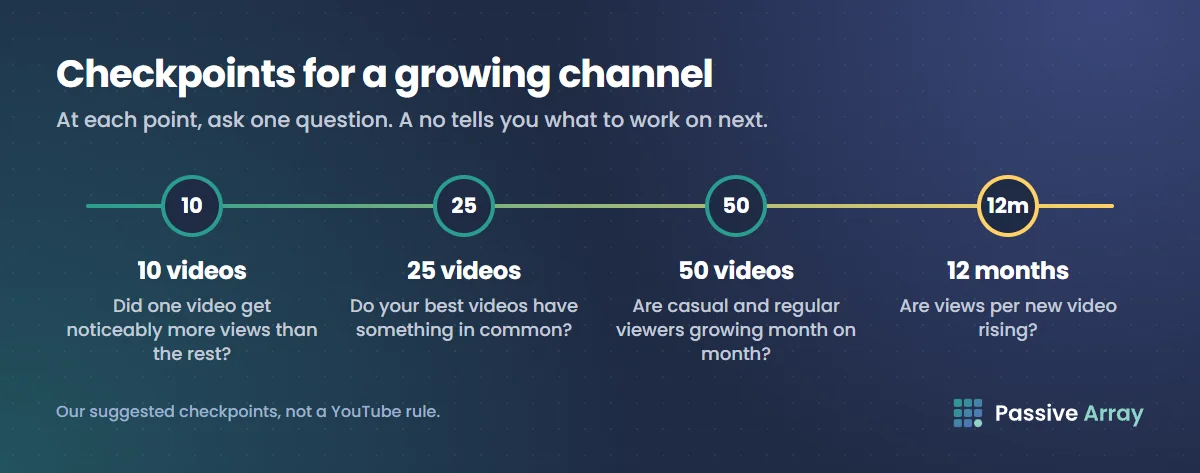
A realistic checkpoint table
| After | Ask yourself | If the answer is no |
|---|---|---|
| 10 videos | Did at least one video get noticeably more views than the rest? | Your topics may be too broad or your titles too vague |
| 25 videos | Do your best videos have something in common? | Plan the next 10 around that common thread |
| 50 videos | Are casual and regular viewers growing month on month? | Viewers come once and leave: work on series, playlists and community |
| 12 months | Is views per new video rising? | Revisit the channel promise, or consider a new angle |
How to track channel growth properly
Do not judge growth by one video or one day. Compare monthly.
- In YouTube Studio: Analytics > Audience shows returning and new viewers, subscribers gained and lost, and the monthly audience split into new, casual and regular viewers.
- Publicly: Add your channel, and two or three channels a little ahead of you, to the growth tracker. It records public subscribers and views daily, so you can see trend lines instead of guessing. Remember that public subscriber counts are rounded by YouTube.
- Find what is breaking out in your niche: The outliers feed lists long-form videos getting many times their channel's usual views. Small channels show up there often, and their titles and formats show what viewers want right now.
What does not grow a channel
- Buying subscribers or views. Against YouTube's fake engagement policy. Fake subscribers never watch, so your views per subscriber collapse.
- Sub-for-sub and comment groups. Named by YouTube as fake engagement, and the people involved are not your audience.
- Uploading every day for its own sake. YouTube says growth in views "is not correlated with time between uploads". Upload as often as you can keep the quality.
- Chasing every trend. A trend video can bring views from people who will never return, and YouTube warns that content that does not resonate with your audience can, over time, weaken a channel.
- Deleting old videos to "reset" the channel. Each video is judged on its own viewers. Deleting removes whatever views it still earned.
- Worrying about tags and upload time. YouTube says tags play a minimal role and publish time "is not known to impact a video's long-term performance". The YouTube algorithm, explained covers the other myths.
Sources
- YouTube Help: Understand new, casual, & regular viewers
- YouTube Help: YouTube performance FAQ and troubleshooting
- YouTube Help: YouTube's recommendation system
- YouTube Help: Customize your YouTube channel layout
- YouTube Help: Learn where viewers clicked Subscribe
- YouTube Help: Create posts
- YouTube Help: Manage YouTube notifications
- YouTube Help: Add a related video to your YouTube Shorts
- YouTube Help: YouTube Partner Program overview & eligibility
- YouTube Help: Fake engagement policy
Frequently asked questions
How do I grow my YouTube channel from 0 subscribers?
Pick one specific viewer to serve, then make 10 to 15 videos that answer searches that viewer actually makes. Search works for new channels because it does not depend on YouTube already knowing your audience. Reply to every comment, and share videos where people are asking the question.
How long does it take to grow a YouTube channel?
There is no fixed timeline. YouTube judges each video on its own performance, so one well-made video can grow a small channel quickly, and many channels need months of regular uploads before anything clicks. Judge progress monthly by returning viewers and views per new video, not by days.
What is the best way to grow a YouTube channel fast?
The fastest legitimate method is to find the one or two videos that already gained you the most subscribers and make close follow-ups, linked as a series. Buying subscribers or sub-for-sub looks fast but breaks YouTube's fake engagement policy and fills your channel with people who never watch.
How do I get more subscribers on YouTube organically?
Give viewers a reason to come back: a clear channel promise, a channel trailer for new visitors, series with playlists, and a subscribe request tied to an upcoming video they want. Check the Subscription source report in Studio to see which pages and videos convert best, and do more of that.
Can I grow a YouTube channel with Shorts only?
You can grow subscribers with Shorts, but YouTube notes that channels posting mostly Shorts often have a very low share of regular viewers. Shorts work best as a door into longer videos or a series. Link each Short to a related video so interested viewers have somewhere to go.
Can I grow a YouTube channel without showing my face?
Yes. Many channels use voiceover, screen recordings, animation or hands-only footage. The growth principles are the same, but watch YouTube's inauthentic and reused content rules if you plan to monetize. How to grow a faceless YouTube channel covers formats and policy.
Does uploading every day grow a channel faster?
Not by itself. YouTube says growth in views is not correlated with time between uploads, and that quality matters more than quantity. A steady schedule you can keep, with series viewers can follow, does more than a burst of rushed videos.
Do Google Ads help grow a YouTube channel?
Promoting a video through Google Ads is allowed, and it is not the same as buying views. Studio's Subscription source report even lists YouTube advertising as its own row. It can bring a video its first viewers, but paid viewers often do not return, so treat it as a small test rather than a growth plan.
By Nasir Uddin, founder of Passive Array. Rules and figures checked Nov 1, 2026.