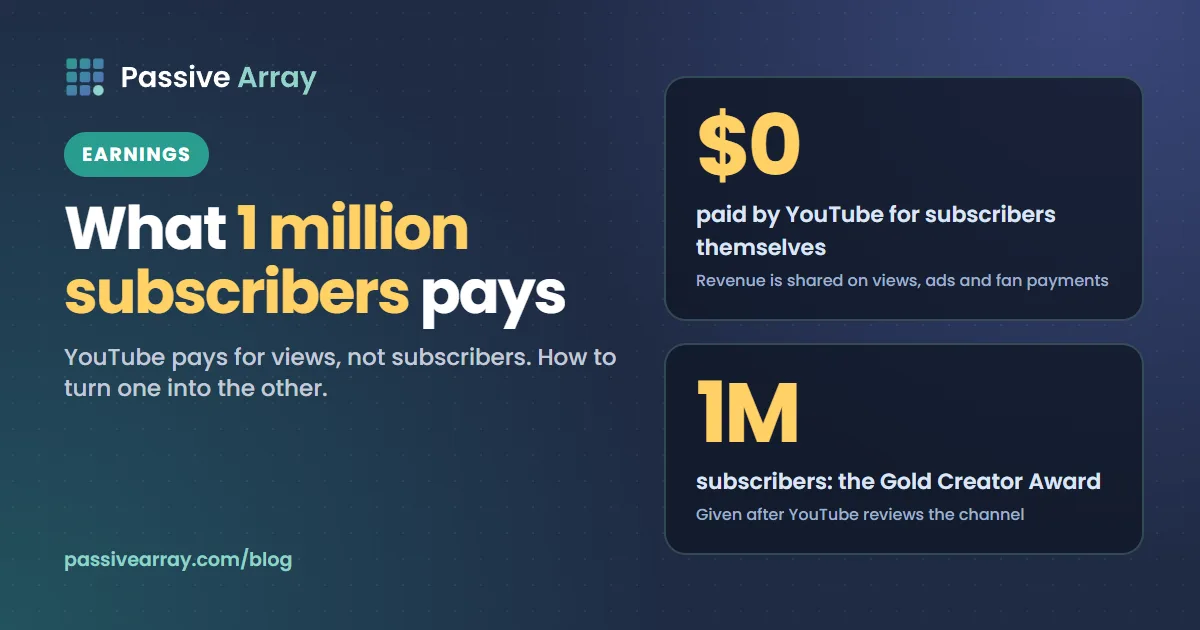
YouTube pays nothing for subscribers, at 1 million or any other number. It shares revenue from views: ads shown on your videos, Premium watch time, and money fans pay you directly. So a channel with 1 million subscribers earns whatever its monthly views earn. As an estimate, a channel that gets 1 million long-form views a month earns roughly $500 to $4,000 a month from ads at the RPM range our calculator uses, and two channels with the same 1 million subscribers can sit far above or far below that. What reaching 1 million does bring is the Gold Creator Award.
This guide shows how to turn a subscriber count into a views estimate, then into an income estimate, and lists what else a channel of this size earns from. To skip the arithmetic for a real channel, paste it into the YouTube money calculator, which works from the channel's recent views and ignores the subscriber count.
Subscribers do not pay. Views do
Nothing in the YouTube Partner Program pays per subscriber. YouTube's partner earnings page lists what it shares, and every line is tied to something a viewer watched or bought:
| Revenue | What YouTube says it pays the creator |
|---|---|
| Ads on long-form videos | "55% of net revenues from ads displayed or streamed on their public videos" |
| Ads in the Shorts feed | "45% of the revenue allocated to them based on their share of views" |
| Channel memberships, Super Chat, Super Stickers, Super Thanks | "70% of net revenues" |
Subscribers appear in the program in one place only: the entry requirement. YouTube's eligibility page asks for "1,000 subscribers with 4,000 qualified watch hours in the last 12 months" or "1,000 subscribers with 10 million qualified Shorts views in the last 90 days". Once a channel is in, there is no higher pay level at 100,000 or 1 million subscribers. The revenue shares above are the same for every partner.
How much a YouTuber makes gives the ranges by monthly views for channels of every size.
What 1 million subscribers does get you: the Gold Creator Award
The one thing YouTube gives at this milestone is a plaque. YouTube's Creator Awards page lists four levels: Silver at 100,000 subscribers, Gold at 1,000,000, Diamond at 10,000,000 and Red Diamond at 100,000,000.
Passing the number is not enough. YouTube says awards are given at its discretion and that each channel is reviewed. The criteria on its Help page include:
- "Your channel is active (has uploads within the last 6 months)."
- "You don't have an active Community Guidelines violation, and haven't received any in the last 365 days."
- "You don't have active copyright strikes or violations."
- "You haven't been rejected or suspended from the YouTube Partner Program."
- "You don't have content that is deceptive, spammy, or a scam."
- "Your main content is original."
On the last point, YouTube says channels built on compilations, mixes, curation or heavy use of other people's copyrighted material may not be eligible.
Two more details. The award does not depend on earning: "You don't have to be a member of the YouTube Partner Program (YPP) to be eligible for an award." And it is not something you can sell. YouTube says awards are for personal use and may not be sold or given to anyone outside your channel team.
If the channel passes review, YouTube sends a redemption code, and you enter it on the Creator Awards redemption site with your shipping details. YouTube's Help page says delivery takes approximately 2-3 weeks after you redeem. YouTube play button levels covers the ladder and the claiming steps.
Step 1: turn 1 million subscribers into views per upload
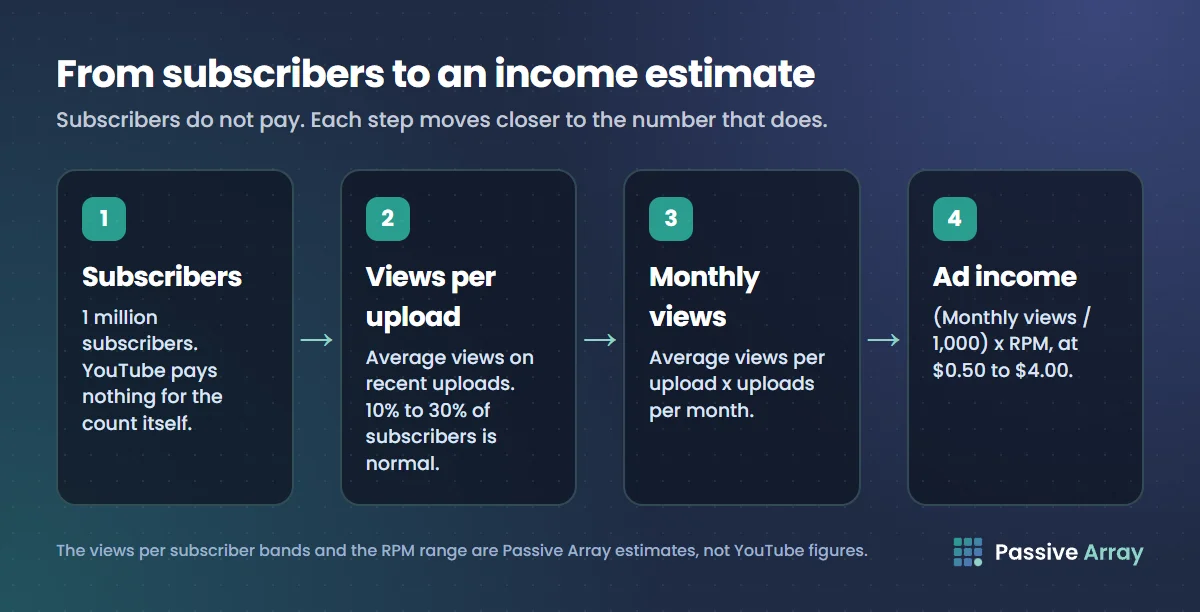
Since income follows views, the first job is to estimate how many views a channel with 1 million subscribers gets. The link between the two is views per subscriber:
Views per subscriber = average views on recent uploads / subscribers x 100
Our guide to views per subscriber uses three bands. Applied to a channel with exactly 1 million subscribers, they look like this:
| Views per subscriber | How we read it | Average views per upload at 1 million subscribers |
|---|---|---|
| 30% and above | Strong. Subscribers turn up for uploads | 300,000 or more |
| 10% to 30% | Normal for most active channels | 100,000 to 300,000 |
| Under 10% | Many subscribers are inactive, or views come from elsewhere | Under 100,000 |
These bands are the ones our channel tools use. They are our own reading of public channel data, not a YouTube figure, and YouTube publishes no benchmark for this ratio.
That guide makes one point that matters at this size: the ratio falls as channels grow, because a large channel carries many subscribers who have stopped watching. It gives the example of a two-million-subscriber channel sitting at 8% and being perfectly healthy. So for a 1 million subscriber channel, a figure under 10% is common and is not a sign the channel is failing.
You do not have to guess the ratio for a real channel. The subscriber count checker shows the current subscriber count next to averages taken from the channel's 10 most recent uploads.
Step 2: turn views per upload into monthly views
Ad income is counted by month, so the next step is:
Monthly views = average views per upload x uploads per month
This is a floor, not the whole picture. Older videos keep collecting views, and only the creator sees that total, in YouTube Studio. From outside, recent uploads are the best public signal, which is why our calculator uses views on videos uploaded in the last 30 days.
Step 3: turn monthly views into ad income
The formula used across this site is:
Monthly ad earnings = (monthly views / 1,000) x RPM
RPM is the creator's revenue per 1,000 views. YouTube defines it as "your total revenue (after YouTube's revenue share) per 1000 views". Our money calculator's default RPM range is $0.50 to $4.00, which is an estimate you can edit, not a number YouTube publishes. What is CPM on YouTube explains how RPM differs from the CPM figures you may see quoted.
Five hypothetical channels with 1 million subscribers
The table below puts the three steps together. Every row is a made-up channel with 1 million subscribers that uploads 10 long-form videos a month. Only the views per subscriber changes. The income column repeats the estimates already published in our guides to 1 million views and YouTuber income, at the $0.50 to $4.00 RPM range.
| Views per subscriber | Average views per upload | Monthly views (10 uploads) | Estimated ad income per month |
|---|---|---|---|
| 1% | 10,000 | 100,000 | $50 to $400 |
| 5% | 50,000 | 500,000 | $250 to $2,000 |
| 10% | 100,000 | 1,000,000 | $500 to $4,000 |
| 20% | 200,000 | 2,000,000 | $1,000 to $8,000 |
| 50% | 500,000 | 5,000,000 | $2,500 to $20,000 |
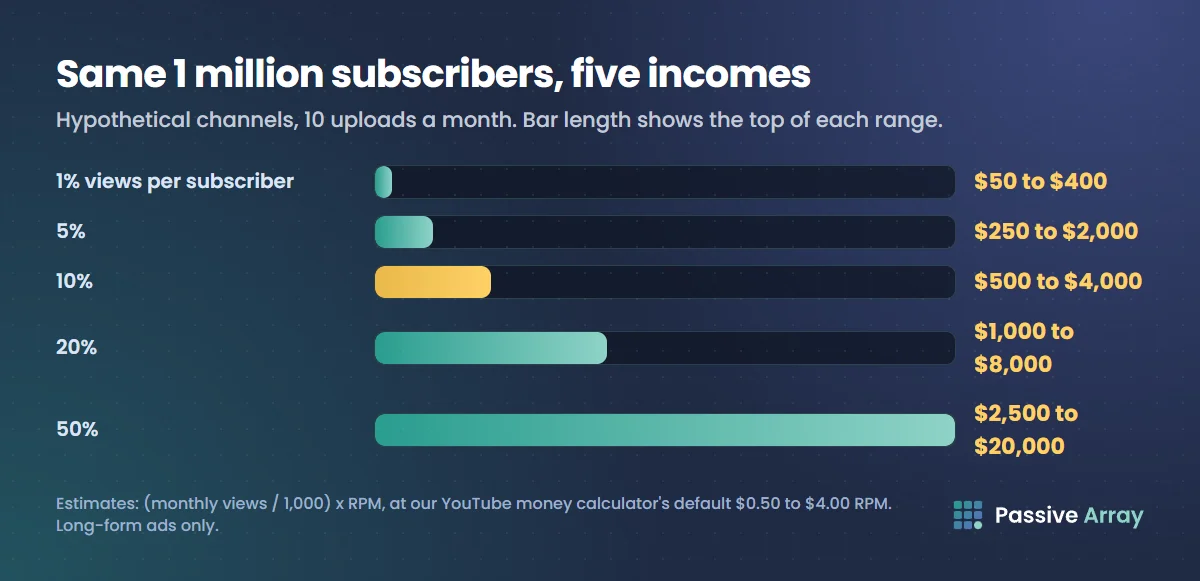
All five channels have the same subscriber count, and the bottom row earns fifty times as much as the top one. The subscriber count told you none of that.
These are estimates for long-form ad revenue on a monetized channel, and only the creator's own YouTube Studio shows a real figure. For the middle row, 1 million monthly views, our YouTuber income guide puts the yearly estimate at $6,000 to $48,000 from ads alone.
Why two channels with 1 million subscribers earn different amounts
Views explain most of the gap. The rate per view explains the rest. YouTube's own Help page on ad revenue names three things that move what advertisers pay:
- Time of year. "Advertisers tend to bid higher or lower depending on the time of year."
- Viewer geography. Advertisers choose which locations to reach, so rates differ by where the audience is.
- Ad formats. "Different ad types tend to have different CPMs."
The same page explains why some views earn nothing from ads at all. A view may have no ad because the video is not advertiser-friendly, because ads are turned off for it, or because there is no ad available to show that viewer.
Then there is format. A channel can reach 1 million subscribers mainly through Shorts, and Shorts are paid differently: ad revenue from the Shorts feed is pooled, and the creator keeps 45% of the amount allocated to them by their share of views. YouTube has also announced that from 1 February 2027 a channel needs 10 million qualified Shorts views over the last 90 days to earn monthly from the Shorts pool. How YouTube pays for Shorts covers the pool, and our views per subscriber guide notes that Shorts-heavy channels usually show a low ratio on long videos.
Finally, a channel has to be in the Partner Program to earn from any of this, and that is not automatic at any size. YouTube notes that channels outside the program may still have ads on their videos without receiving a share. For a channel you do not own, how to tell if a YouTube channel is monetized shows what the public signals can and cannot tell you.
Income beyond ads at 1 million subscribers
Ads are one line. YouTube's "How to earn money on YouTube" page lists the others it pays through the Partner Program:
| Source | How YouTube describes it |
|---|---|
| Advertising revenue | Earnings from ads on the Watch page and in the Shorts feed |
| YouTube Premium revenue | Part of a Premium subscriber's fee when they watch your content |
| Channel memberships | Members make recurring monthly payments in exchange for perks |
| Super Chat and Super Stickers | Fans pay to highlight messages or animated images in live chat |
| Super Thanks | Fans pay for an animation and a highlighted comment on a video or Short |
| Shopping | Fans buy from your store, or from other brands' products you tag |
The fan-paid lines depend on how many people care enough to pay, not on how many ads ran. The creator's share is 70% of net revenues from memberships and Supers. Our guide to YouTube channel memberships covers levels, perks and what the 70% is taken from.
Then there is income YouTube does not pay at all:
- Sponsorships. A brand pays the creator directly. YouTube leaves "revenue made through brand deals and sponsorships" out of RPM, so it never appears in the rate figures above. Brands price on the views a video is expected to get, not on the subscriber count, which is why the views per subscriber step matters here too. How much to charge for a sponsored YouTube video explains the method.
- Affiliate links. A commission when viewers buy through the creator's link. See YouTube affiliate marketing.
- Own products and services. Merchandise, courses and anything else sold to the audience. Ways to make money on YouTube has the full list.
How to estimate a real channel with 1 million subscribers
- Check the views, not the subscribers. Paste the channel into the subscriber count checker and read the average views on its last 10 uploads.
- Work out views per subscriber. Divide those average views by the subscriber count. Compare the result with the three bands above.
- Check it earns from ads. The monetization checker reads the public signals and gives a verdict with a confidence score. YouTube publishes nothing about a channel's Partner Program status, so this is a judgement, not a fact.
- Run the money calculator. It takes views on videos uploaded in the last 30 days and applies the RPM range. Change the low and high RPM if you know the channel's niche or audience.
- Look at the format. If most recent uploads are Shorts, expect the bottom of the range or below it.
- Treat the answer as a bracket. It leaves out sponsorships, memberships and Shorts revenue, and it cannot see the back catalogue.
What a 1 million subscriber channel is worth
There is no official valuation of a channel, and subscriber count is a poor basis for one. The channel value calculator takes a different route: it estimates yearly ad earnings from recent views and an RPM range, then multiplies by a number of years of earnings that you set. Every input is on the page, and the tool describes itself as a planning estimate, not an appraisal.
Gross is not take-home
Whatever the estimate, it is the amount YouTube pays out, not what the creator keeps. YouTube's partner earnings page says "Google withholds U.S. taxes on earnings that you generate from viewers in the U.S.", and that creators "may be liable to pay taxes" in their own country or region. Editing, design and any manager or network share come out of it too. How and when YouTube pays you covers payment dates and tax withholding.
Sources
- YouTube Help: YouTube partner earnings overview (the 55%, 45% and 70% revenue shares, US tax withholding)
- YouTube Help: YouTube Partner Program overview and eligibility (the 1,000 subscriber entry requirements, ads on channels outside the program)
- YouTube Help: Changes to the YouTube Partner Program (the Shorts pool requirement from 1 February 2027)
- YouTube Help: YouTube Creator Awards (award levels, eligibility criteria, redemption and delivery)
- YouTube Creators: Creator Awards for subscriber milestones (award levels and review)
- YouTube Help: How to earn money on YouTube (the list of revenue sources)
- YouTube Help: Understand ad revenue analytics (the RPM definition, what RPM excludes, why rates change, why some views have no ads)
Frequently asked questions
How much does YouTube pay for 1 million subscribers?
Nothing. YouTube does not pay for subscribers at any level. It shares revenue from ads on your views, Premium watch time and fan payments such as memberships. A channel with 1 million subscribers earns according to its monthly views, not its subscriber count.
How much does a YouTuber with 1 million subscribers make per month?
It depends on monthly views. As an estimate at a $0.50 to $4.00 RPM, a channel getting 1 million long-form views a month earns roughly $500 to $4,000 from ads, and a channel getting 5 million earns roughly $2,500 to $20,000. Sponsorships, memberships and products come on top of that.
Do you get paid when you hit 1 million subscribers on YouTube?
No. There is no payment or bonus at 1 million subscribers. What YouTube offers at that milestone is the Gold Creator Award, a plaque, and only after it reviews the channel against its eligibility criteria.
What do you get from YouTube at 1 million subscribers?
The Gold Creator Award, if the channel passes review. YouTube's criteria include uploads within the last 6 months, no Community Guidelines violation in the last 365 days, no active copyright strikes and original main content. You do not need to be in the Partner Program to receive it.
How many views does a channel with 1 million subscribers get?
There is no fixed number. Using the bands on this site, a views per subscriber figure of 10% to 30% is normal for active channels, which would be 100,000 to 300,000 views per upload at 1 million subscribers. Large and older channels are often below 10%, and that can still be healthy.
Can a channel with 1 million subscribers earn less than a small channel?
Yes. A channel with 1 million subscribers and 100,000 monthly views earns less from ads than a much smaller channel getting 1 million monthly views. Income follows views, so an inactive subscriber base adds nothing.
How much is a YouTube channel with 1 million subscribers worth?
There is no official valuation and subscriber count alone does not set one. A common starting point is the channel's yearly earnings multiplied by a number of years. Our channel value calculator does that from recent views, with every input editable, and it is a planning estimate, not an appraisal.